💥UPSC 2026, 2027, 2028 UAP Mentorship (March Batch) + Access XFactor Notes & Microthemes PDF

Type: Prelims Only

  • ISRO Missions and Discoveries

    India set to launch its first X-Ray Polarimeter Satellite (XPoSat)

    Note4Students

    From UPSC perspective, the following things are important:

    Prelims level: X-Ray Polarimeter Satellite (XPoSat)

    Mains level: Read the attached story

    Central Idea

    • The Indian Space Research Organisation, following a landmark 2023, will ring in the new year with the launch of the PSLV-C58 X-ray Polarimeter Satellite (XPoSat) mission on January 1, 2024.

    About XPoSat Mission

    • Orbital Details: XPoSat will operate in a Low Earth Orbit at an altitude of about 650 km, with a low inclination of around 6 degrees.
    • Dual Scientific Payloads: The satellite is equipped with two payloads, enabling comprehensive studies of X-ray sources, including their temporal, spectral, and polarization characteristics.
    • Mission Goals: XPoSat’s primary objectives include measuring X-ray polarization in the 8-30 keV energy band and conducting long-term studies in the 0.8-15 keV band.
    • Mission Lifespan: The satellite is expected to be operational for approximately 5 years.
    • Observation Strategy: Observations by XPoSat will primarily occur during the Earth’s eclipse period to maximize efficiency.

    Payloads aboard XPoSat

    • POLIX – Primary Payload: The Polarimeter Instrument in X-rays (POLIX), developed by Bengaluru’s Raman Research Institute (RRI) with ISRO’s collaboration, is tailored to assess the degree and angle of polarization in medium X-ray energy ranges.
    • XSPECT – Secondary Payload: The X-ray Spectroscopy and Timing (XSPECT) payload, created by ISRO’s U.R. Rao Satellite Centre (URSC), will gather spectroscopic data in the 0.8-15 keV range.

    Significance of XPoSat

    • Polarization refers to the orientation of light waves. X-rays, a form of electromagnetic radiation, can also be polarized.
    • Studying it from cosmic sources provides valuable information about the physical conditions and processes occurring in extreme environments, such as around black holes, neutron stars, and supernova remnants.

  • Indian Navy Updates

    [pib] Exercise MILAN

    Note4Students

    From UPSC perspective, the following things are important:

    Prelims level: Exercise MILAN

    Mains level: NA

    Exercise MILAN

    Central Idea

    • Scheduled for February 2024, Exercise MILAN is set to be India’s largest multilateral naval exercise, with over 50 countries expected to participate.

    Exercise MILAN

    • Origin: Biennial exercise initiated by the Indian Navy in 1995 at the Andaman and Nicobar Command.
    • Initial Participation: Began with four countries – Indonesia, Singapore, Sri Lanka, and Thailand in 1995.
    • Growth over Years: The exercise has significantly grown in the number of participants and the complexity of exercises.
    • Expansion with Policies: Expanded under India’s ‘Act East policy’ and the SAGAR initiative.
    • Broader Inclusion: Now includes island nations in the Western Indian Ocean Region (IOR) and IOR littoral states.

    Significance of Exercise MILAN

    • Showcasing Naval Strength: This exercise reflects the Indian Navy’s growing engagement and capability to assist as a first responder and Preferred Security Partner in the Indian Ocean Region (IOR).
    • Enhanced Operational Reach: The Indian Navy’s increasing presence and operational reach through Mission Based Deployments and other engagements underscore India’s commitment to strong defense ties.
    • Importance of Naval Exercises: Conducting 17 multilateral and 20 bilateral exercises annually, these events are crucial for operational capability enhancement, interoperability, and strengthening diplomatic and maritime security ties.
  • Food Processing Industry: Issues and Developments

    Halal Certification Ban in Uttar Pradesh: A Comprehensive Overview

    Note4Students

    From UPSC perspective, the following things are important:

    Prelims level: Halal

    Mains level: Read the attached story

    Central Idea

    • On November 18, the Uttar Pradesh government imposed a state-wide ban on the “production, storing, distribution, and sale of halal certified edible items.”

    Understanding Halal and Halal Food

    • Definition of Halal: ‘Halal’ is an Arabic term meaning ‘permissible’ in English.
    • FAO Guidelines on Halal Food: The Food and Agriculture Organization defines halal food as compliant with Islamic Law, including specific slaughter methods.
    • Vegetarian Food and Halal: Generally, vegetarian food is deemed halal unless it contains prohibited substances like alcohol.
    • Labeling of Halal Products: Products claimed as halal must visibly display this on their labels.

    Halal-Certified Products

    • Purpose of Certification: Halal certification ensures food preparation adheres to Islamic law and is free from contamination.
    • Certification Bodies in India: Various private companies in India, like Halal India Pvt Ltd and Jamiat Ulama-i-Hind Halal Trust, offer halal certification. Some are government-recognized, while others are not.

    Controversy Surrounding Halal-Certified Products

    • Legality: The debate centers on the legality of certificate-issuing authorities and allegations of targeting specific religious communities.
    • Parallel Authority issue: The Indian government does not require halal certification; FSSAI certification is the standard for edible products.
    • International Trade and Halal Certification: As per the USDA 2022 report, halal certification is not essential for export or import trade permissions.
    • Religious violations: A case was filed against entities in Lucknow for purportedly exploiting religious sentiments to enhance sales through halal certification.

    Legal Aspects of Halal Certification

    • Complaints against Certification: Complaints have emerged against companies for allegedly issuing forged halal certificates for financial benefits.
    • Accusations of Illegal Certification: These companies are accused of lacking official recognition to issue halal certificates.

    Halal Certification System in India

    • Certifying Agencies: Various agencies provide halal certification to Indian companies, products, or food establishments.
    • Government Accreditation: The National Accreditation Board for Certification Bodies under the Quality Council of India accredits these Halal Certification Bodies.
    • Advantages of Certification: Certification from recognized bodies benefits companies in both domestic and international markets.
    • DGFT Guidelines: The Directorate General of Foreign Trade mandates that only facilities with valid certification from accredited bodies can export ‘halal certified’ meat and meat products.
    • Government’s i-CAS Scheme: The ‘India Conformity Assessment Scheme’ was developed to regulate the halal certification process.

    Implications of the Ban

    • Quality confusions: The ban aims to address confusion over food quality standards and align with the Food Safety and Standards Act.
    • Curbing forged certification: Companies issuing forged certificates are accused of fostering social unrest and betraying public trust.
    • Economic Impact: There are apprehensions about a potential conspiracy to undermine the sales of non-halal certified products.
    • Financial Misuse: There are allegations that profits from these activities could be funneled towards supporting terrorist organizations and anti-national activities.

    Conclusion

    • This ban reflects the complex interplay between food safety regulations, religious practices, and commercial dynamics.
    • It highlights the need for a balanced approach in addressing such multifaceted issues.
  • Finance Commission – Issues related to devolution of resources

    Cabinet clears terms of reference for 16th Finance Commission

    Note4Students

    From UPSC perspective, the following things are important:

    Prelims level: Finance Commission

    Mains level: Read the attached story

    Central Idea

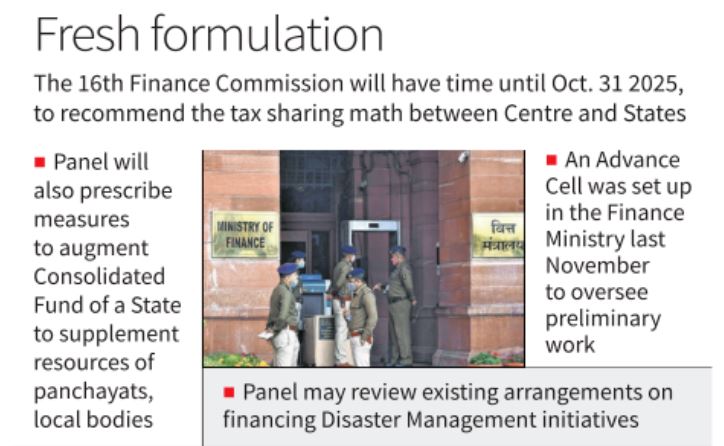
    • The Union Cabinet approved the terms of reference (ToR) for the Sixteenth Finance Commission.
    • The Commission will devise a formula for revenue sharing between the Centre and the States for the period starting April 1, 2026.

    About Finance Commission

    • Establishment: The Finance Commission (FC) of India was established by the President in 1951 under Article 280 of the Indian Constitution.
    • Purpose: Its primary role is to define and regulate the financial relations between the central government and the individual state governments.
    • Legislative Framework: The Finance Commission (Miscellaneous Provisions) Act, 1951, further outlines the qualifications, appointment, disqualification, term, eligibility, and powers of the Finance Commission.
    • Composition: Appointed every five years, the FC comprises a chairman and four other members.
    • Evolution: Since the First FC, changes in India’s macroeconomic landscape have significantly influenced the Commission’s recommendations.

    Constitutional Provisions

    • Article 268: Facilitates the levy of duties by the Centre, with collection and retention by the States.
    • Article 280: Outlines the FC’s composition, qualifications for members, and its terms of reference. It mandates the FC to recommend the distribution of net tax proceeds between the Union and States and the allocation among States. It also addresses the financial relations between the Union and States and the devolution of unplanned revenue resources.

    Key Functions of the Finance Commission

    • Tax Devolution: Recommends how net tax proceeds should be distributed between the Center and States.
    • Grants-in-Aid: Determines the principles governing these grants to States.
    • Augmenting State Funds: Advises on measures to enhance the States’ Consolidated Funds to support local bodies and panchayats, based on State Finance Commissions’ recommendations.
    • Other Financial Functions: Addresses any other financial matters referred by the President.

    Members of the Finance Commission

    • Structure and Standards: The Finance Commission (Miscellaneous Provisions) Act, 1951, provides a structured format and global standards for the FC.
    • Qualifications and Powers: Specifies rules for members’ qualifications, disqualification, appointment, term, eligibility, and powers.
    • Composition: The Chairman is chosen for their experience in public affairs. The other members are selected based on their judicial experience, knowledge of government finances, administrative and financial expertise, or special economic knowledge.

    Challenges for the 16th Finance Commission

    • Overlap with GST Council: The coexistence with the GST Council, a permanent constitutional body, presents a new challenge.
    • Conflict of Interest: Decisions by the GST Council on tax rates could impact the FC’s revenue-sharing calculations.
    • Feasibility of Recommendations: While the Centre often adopts the FC’s suggestions on tax devolution and fiscal targets, other recommendations may be overlooked.

    Major Outstanding Recommendations

    • Fiscal Council Creation: The 15th FC proposed a Fiscal Council for collective macro-fiscal management, but the government has shown reluctance.
    • Non-Lapsable Fund for Internal Security: Though the Centre agreed ‘in principle’ to establish this fund, its implementation details are pending.
  • Historical and Archaeological Findings in News

    Who were Nolamba Pallavas?

    Note4Students

    From UPSC perspective, the following things are important:

    Prelims level: Nolamba Pallava Dynasty

    Mains level: NA

    Central Idea

    • Ancient relics belonging to the Nolamba Pallavas dynasty were unearthed in Cholemarri village, situated 22 km from Penukonda in Sri Sathya Sai district.

    Significant Findings

    • Battlefield Site: Evidence suggests a fierce battle in the 9th century AD between the Nolamba Pallavas and the Bhana-Vaidambas.
    • Inscriptions and Artifacts:
      1. An inscription of Mahendra Nolambadhi Raja (875-897 AD), ruler of Henjeru (now Hemavati), was found in the fields.
      2. Hero stones with Telugu inscriptions (written in ancient Kannada script) from the Nolamba and Vijayanagara periods were discovered near Anjaneyaswamy temple.

    About the Nolamba Dynasty

    • Time Period: Ruled from the 8th to the 12th centuries C.E.
    • Geographical Extent: Nolambavadi region, covering parts of southeast Karnataka, Tamil Nadu, and Andhra Pradesh.
    • Political History: Initially feudatories to Pallavas, Chalukyas of Badami, Gangas, and Rashtrakutas, later to Chalukyas of Kalyani. Often referred to as Nolamba Pallava in inscriptions.
    • Capitals: Initially Chitradurga, later shifted to Hemavati.
    • Origin:
      • Founded by Mangala Nomabathi Raja (735–785 A.D.).
      • Emerged as governors under Pallavas and Chalukyas.
      • Experienced shifts in allegiance between Pallavas, Chalukyas, Banas, and Vaidumbas.
      • The term “Nolambas” came into existence post the Chalukyas’ resurgence under Vikramaditya I.
    • Decline: Overrun by Ganga king Marasimha, who claimed the title Nolambakulantaka.
    • Cultural Contributions: Known for constructing grand temple complexes like Kalleshwara Temple in Aralaguppe, Bhoganandishwara Temple in Nandi, and Ramalingeshwara Temple in Avani.
    • Religious Affiliation: Predominantly Shaivites, with temples dedicated to Lord Shiva.
  • Festivals, Dances, Theatre, Literature, Art in News

    Second phase of Kashi Tamil Sangamam

    Note4Students

    From UPSC perspective, the following things are important:

    Prelims level: Kashi Tamil Sangamam

    Mains level: NA

    Central Idea

    • The Centre announced the schedule for second phase of the Kashi Tamil Sangamam from December 17 to 30.

    Kashi Tamil Sangamam

    • Kashi Tamil Sangamam celebrates the historical and cultural ties between North and South India.
    • It is managed by IIT Madras and BHU (Banaras Hindu University).
    • Its main goal is to bring together the knowledge and cultural traditions of North and South India, helping people understand our shared history and strengthen connections between these regions.
    • The Ministry of Education organizes this event with help from other ministries like Culture, Textiles, Railways, Tourism, Food Processing, Information & Broadcasting, and the Uttar Pradesh Government.
    • This effort aligns with the National Education Policy (NEP), 2020, which focuses on combining traditional Indian knowledge with modern knowledge systems.

    Cultural Significance

    • In the 15th century, King Parakrama Pandya from the Madurai area wanted to build a Lord Shiva temple, so he went to Kashi (Uttar Pradesh) to get a lingam.
    • On his way back, he rested under a tree, but the cow carrying the lingam wouldn’t move when he tried to continue his journey.
    • Parakrama Pandya took this as a divine sign and set up the lingam there, in what is now known as Sivakasi, Tamil Nadu.
    • The Pandyas built the Kasi Viswanathar Temple in present-day Tenkasi, southwestern Tamil Nadu, near the Kerala border, for those who couldn’t travel to Kashi.
  • Artificial Intelligence (AI) Breakthrough

    What is Project Q*, the AI breakthrough from OpenAI?

    Note4Students

    From UPSC perspective, the following things are important:

    Prelims level: Project Q*

    Mains level: AI advancements

    Central Idea

    • OpenAI, a leading AI technology company, has been embroiled in a high-profile controversy following the dismissal of Sam Altman, its CEO.
    • At the heart of the controversy is the development of a new AI model named Q* (Q-star), which has raised significant concerns among OpenAI staff and the broader tech community.

    What is Project Q*?

    • Advanced AI Algorithm: Q* represents a significant advancement in AI, capable of solving complex mathematical problems, even those outside its training data.
    • Step towards AGI: This model is seen as a stride towards Artificial General Intelligence (AGI), capable of performing any intellectual task that a human can.
    • Development Team: The breakthrough is attributed to Ilya Sutskever, with further development by Szymon Sidor and Jakub Pachoki.

    Why is Q* Feared?

    • Potential for Accelerated Scientific Progress: Researchers have expressed concerns about Q*’s ability to rapidly advance scientific discovery, questioning the adequacy of existing safety measures.
    • Internal Warnings: Reports suggest that Q*’s capabilities could pose a threat to humanity, a concern believed to be a major factor in Altman’s dismissal.

    Concerns Surrounding Project Q*

    • Advanced Reasoning and Abstract Understanding: Q* reportedly exhibits unprecedented logical reasoning and understanding of abstract concepts, raising concerns about unpredictable behaviors.
    • Combination of AI Methods: According to researcher Sophia Kalanovska, Q* might merge deep learning with human-programmed rules, enhancing its power and versatility.
    • AGI Implications: As a step towards AGI, Q* could surpass human capabilities in various domains, leading to control, safety, and ethical issues.
    • Capability for Novel Idea Generation: Unlike existing AI models, Q* could potentially generate new ideas and pre-emptively solve problems, leading to decisions beyond human control or understanding.
    • Risks of Misuse and Unintended Consequences: The advanced capabilities of Q* heighten the risk of misuse or unforeseen harmful outcomes.
  • Historical and Archaeological Findings in News

    Parthenon Sculptures Dispute: A Diplomatic Row between Greece and the UK

    Note4Students

    From UPSC perspective, the following things are important:

    Prelims level: Parthenon Sculptures

    Mains level: Not Much

    Central Idea

    • UK PM Rishi Sunak cancelled his meeting with visiting Greek PM over the latter’s comments on ancient Parthenon Sculptures housed in the British Museum.

    Parthenon Sculptures

    • The Parthenon Sculptures are ancient Greek stone sculptures over 2,000 years old, originally part of the Parthenon temple in Athens.
    • These sculptures, including a 75-meter-long frieze, are significant artifacts of Athens’ Golden Age, depicting gods, heroes, and mythical beings.
    • In the early 19th century, Thomas Bruce, 7th Earl of Elgin and British ambassador to the Ottoman Empire, removed the sculptures from the Parthenon.
    • The marbles were subsequently purchased by British Museum in 1816.

    Debate over Legitimacy

    • Greece has accused Lord Elgin of stealing the sculptures, while he maintained he had permission from the Ottoman authorities.
    • The original document granting permission has been lost, leading to disputes over its authenticity and content.

    Greece’s Campaign for Return

    • Greece’s demand for the sculptures’ return dates back to its independence in the early 1830s.
    • The campaign gained momentum in the 1980s, spearheaded by Greek actress and then-culture minister Melina Mercouri.
    • The British Museum argues that the sculptures were legally acquired and rejects Greece’s demands for their return.
    • The museum contends that public benefit lies in having the sculptures in two locations, citing the impossibility of reassembling them completely and concerns over safe return.

    Current Developments

    • Prime Minister Sunak has described the marbles as a significant asset to the UK and opposes changing laws to facilitate their return.
    • Despite the cancelled meeting, Greek officials intend to continue negotiations with the British Museum.
  • Festivals, Dances, Theatre, Literature, Art in News

    In news: Guru Nanak Jayanti

    Note4Students

    From UPSC perspective, the following things are important:

    Prelims level: Guru Nanak and his teachings

    Mains level: NA

    guru nanak

    Central Idea

    • Guru Nanak Jayanti commemorates the birth of Guru Nanak, the founder of Sikhism and the first of its ten Gurus.
    • It is celebrated worldwide as Guru Nanak Gurpurab on Kartik Poornima, the full-moon day in the month of Katak (October–November).

    Five Key Aspects of Guru Nanak’s Life

    [1] Early Life and Philosophical Inclination:

    • Born on April 15, 1469, in a Hindu family in Nankana Sahib (now in Pakistan).
    • Displayed an early interest in philosophical and spiritual questions.
    • Worked as an accountant before embarking on a spiritual journey with a Muslim minstrel, Mardana.

    [2] Mystical Experience at Age 30:

    • Had a transformative spiritual experience during an early morning ablution by a river.
    • Received a divine mission to spread a message of unity and devotion.
    • Emerged after three days with the profound declaration, “There is no Hindu, there is no Mussalman.”

    [3] Extensive Travels and Interfaith Dialogue:

    • Traveled widely, including to Sri Lanka, Baghdad, and Mecca, on journeys called ‘udaasis’.
    • Engaged with various religious figures, including Hindu pandits and Sufi saints.
    • Advocated for the oneness of God and universal brotherhood.

    [4] Preaching the Oneness of God:

    • Emphasized the unity of humanity and the presence of one God in all.
    • Challenged religious orthodoxy and rituals, promoting a direct connection with the divine.
    • His teachings laid the foundation for Sikhism, attracting followers from diverse backgrounds.
    • His teachings and hymns are compiled in the Guru Granth Sahib, the holy scripture of Sikhism.
    • He wrote in Punjabi, using a script known as Gurmukhi.

    [5] Succession and Legacy:

    • Spent his final years in Kartarpur, establishing a community with daily prayers and hymns.
    • Introduced the practice of ‘langar’, a communal kitchen serving free meals.
    • Chose Lehna (later Guru Angad) as his successor, bypassing his own sons.
    • Passed away on September 22, 1539, leaving behind a legacy of spiritual and social reform.
  • Promoting Science and Technology – Missions,Policies & Schemes

    Evolution and Future of Fiber Optic Technology

    Note4Students

    From UPSC perspective, the following things are important:

    Prelims level: Fibre Optic Technology

    Mains level: NA

    Fiber Optic

    Central Idea

    • COVID-19 pandemic highlighted the crucial role of the internet in maintaining global connectivity, facilitated largely by high-speed internet connections.
    • These connections, enabling video chats, online payments, and virtual meetings, largely depend on the technology of optical fibers.

    Understanding Optical Fibers

    • Composition and Size: Optical fibers are thin strands of glass, almost as thin as a human hair, used for transmitting information.
    • Information Transmission: They carry various forms of data, including text, images, and videos, at speeds close to that of light.
    • Everyday Relevance: Optical fibers play a vital role in everyday communications like text messaging and phone calls.
    • Fragility vs. Strength: Despite their thinness, these fibers are strong and durable when encased in protective materials.
    • Versatility: They are flexible enough to be laid underground, underwater, or wound around spools.

    Historical Perspective

    • Charles Kao’s Contribution: About 60 years ago, physicist Charles Kao proposed using glass fibers for telecommunications, a suggestion that earned him a Nobel Prize in 2009.
    • Replacing Copper Wires: Kao’s idea was initially met with skepticism but eventually replaced copper wires in telecommunication.

    How Optical Fibers Work?

    • Light as an Electromagnetic Wave: Light, part of the electromagnetic spectrum, can be controlled and guided through optical fibers.
    • Total Internal Reflection: This phenomenon allows light to travel long distances within the fiber with minimal loss of power.
    • Fiber Optic Communication System: This system includes a transmitter, the optical fiber, and a receiver to encode, carry, and reproduce information.

    Data Transmission and Resistance

    • High Data-Transmission Rate: Optical fibers can transmit data at rates of several terabits per second.
    • Insensitivity to External Disturbances: Unlike copper cables, they are not affected by external factors like lightning or bad weather.

    Development of Fiber Optic Cables

    • Early Experiments: The concept of guiding light in transparent media dates back to the 19th century, with demonstrations by Jean-Daniel Colladon and others.
    • Medical and Defense Applications: Early glass objects were used in medicine and defense before their adaptation for data transmission.
    • Advancements in the 20th Century: Significant progress occurred in the 1950s and 1960s, including the development of glass-clad fibers and the invention of lasers.

    Modern Manufacturing

    • Fiber-Optic Cable Production: Today, glass fibers are produced using the fiber-drawing technique, ensuring high purity and engineered refractive index profiles.
    • Loss Reduction: Modern optical fibers have significantly reduced signal loss, less than 0.2 dB/km.

    Future of Fiber Optics

    • Expanding Applications: Fiber optics technology is now integral to various fields, including telecommunication, medical science, and laser technology.
    • India’s National Mission: The Indian government’s 2020 Union Budget announced a significant investment in quantum technologies and applications, highlighting the future potential of fiber optics.
    • Quantum Optics and Communication: The technology stands at the forefront of a new era, with expanding possibilities in quantum optics and home connectivity.

    Conclusion

    • Impact of Fiber Optics: The evolution of fiber optics has revolutionized communication and connectivity, offering high-speed, reliable data transmission.
    • Continued Growth and Innovation: As the technology continues to advance, its applications are likely to expand further, driving innovations in various sectors and enhancing global connectivity.