💥UPSC 2026, 2027, 2028 UAP Mentorship (March Batch) + Access XFactor Notes & Microthemes PDF

Type: World Mapping

  • Contention over South China Sea

    In news: Flashpoint Reef

    Note4Students

    From UPSC perspective, the following things are important:

    Prelims level: Flashpoint Reef

    China reasserted its claim over Flashpoint Reef (the Scarborough Shoal) in the South China Sea following Philippines’ establishment of defined sea boundaries.

    Why in the News?

    China reasserted its claim over Flashpoint Reef (the Scarborough Shoal) in the South China Sea following Philippines’ establishment of defined sea boundaries.

    Do you know?

    • Fiery Cross Reef is a rock located in the Spratly Islands. China first took possession of the feature in 1988.
    • Mischief Reef is a Low-Tide Elevation (LTE) within the Philippines’ EEZ. It is part of the submerged continental shelf of the adjacent coastal state, which is the Philippines.

    About the Flashpoint Reef 

    • It generally refers to Scarborough Shoal, a contested reef in the South China Sea.
    • Known as Huangyan Dao in China, this reef has become a focal point of territorial disputes between China and the Philippines.
    • It lies close to the Philippines’ Exclusive Economic Zone (EEZ) but is also claimed by China, which asserts control over nearly the entire South China Sea under its nine-dash line claim.
    • China took control of the shoal in 2012 after a standoff with the Philippines, despite an international tribunal ruling in 2016 that invalidated China’s claims.

    Its significance in the South China Sea

    • It is strategically located near key shipping lanes that are essential for global trade, with about one-third of global shipping passing through the South China Sea.
    • Its proximity to the Philippines, Vietnam, and China makes it an ideal location for military outposts, providing control over surrounding waters and a base for monitoring activities in the region.
    • Control over Scarborough Shoal could allow China to extend its air and naval reach, reinforcing its influence and deterrence capabilities over other Southeast Asian nations.
    • The South China Sea, including Scarborough Shoal, is believed to hold vast reserves of oil and natural gas—up to 11 billion barrels of oil and 190 trillion cubic feet of natural gas.
    • This reef is strategically important due to its proximity to rich fishing grounds and potential undersea mineral resources.

    PYQ:

    [2011] Southeast Asia has captivated the attention of global community over space and time as a geostrategically significant region. Which among the following is the most convincing explanation for this global perspective?

    (a) It was the hot theatre during the Second World War

    (b) Its location between the Asian powers of China and India

    (c) It was the arena of superpower confrontation during the Cold War period

    (d) Its location between the Pacific and Indian oceans and its preeminent maritime character

  • Contention over South China Sea

    Places in News: Loaita Island

    Note4Students

    From UPSC perspective, the following things are important:

    Prelims level: Loaita Island

    Why in the News?

    Philippine forces conducted combat exercises in the South China Sea to practice retaking the Loaita Island in the disputed waters.

    Loaita Island

    About Loaita Island:

    • Loaita Island, also known as Kota Island, has an area of 6.45 hectares and is the 10th largest of the naturally-occurring Spratly Islands.
    • The island is administered by the Philippines as part of Kalayaan, Palawan, and is also claimed by China, Taiwan, and Vietnam.
    • Loaita Island fringes the Loaita Bank, which includes shoals and reefs, and its western side features calcarenite outcrops visible at low tide.
    • The island is covered with mangrove bushes, coconut palms, and other small trees.
    • On May 22, 1963, a sovereignty stele was rebuilt on Loaita Island by South Vietnam, marking its claim.
    • The Philippines has stationed soldiers on the island since 1968, and the island contains minimal structures serving as shelters for the soldiers.
    China also reasserted its claim over Flashpoint Reef (the Scarborough Shoal) in the South China Sea following Philippines’ establishment of defined sea boundaries.

    About the Flashpoint Reef 

    • Flashpoint Reef generally refers to Scarborough Shoal (part of the
      Spratly Islands), a contested reef in the South China Sea.
    • Known as Huangyan Dao in China, this reef has become a focal point of territorial disputes between China and the Philippines.
    • Flashpoint Reef lies close to the Philippines’ Exclusive Economic Zone (EEZ); which asserts control over the entire South China Sea under its nine-dash line claim.
    • China took control of the shoal in 2012 after a standoff with the Philippines, despite an international tribunal ruling in 2016 that invalidated China’s claims.

    Do you know?

    • Fiery Cross Reef is a rock located in the Spratly Islands. China first took possession of the feature in 1988.
    • Mischief Reef is a Low-Tide Elevation (LTE) within the Philippines’ EEZ. It is part of the submerged continental shelf of the adjacent coastal state, which is the Philippines.


    PYQ:

    [2018] Consider the following pairs:

    Regions sometimes Country mentioned in news

    1. Catalonia — Spain
    2. Crimea — Hungary
    3. Mindanao — Philippines
    4. Oromia — Nigeria

    Which of the pairs given above are correctly matched?

    (a) 1, 2 and 3

    (b) 3 and 4 only

    (c) 1 and 3 only

    (d) 2 and 4 only

  • The Crisis In The Middle East

    Places in news: Jordan Valley

    Note4Students

    From UPSC perspective, the following things are important:

    Prelims level: Jordan River and its Valley

    Jordan Valley

    Why in the News?

    Extremist groups held drone strikes on Israeli territory in the Jordan Valley (which forms Jordan’s border with Israel and the West Bank).

    About Jordan Valley:

    Details
    Geography • Part of the Great Rift Valley, extending from the Sea of Galilee to the Dead Sea.
    • Forms a natural border between Jordan, Israel, and the West Bank.
    • Low-lying, with parts below sea level, especially near the Dead Sea.
    Climate Semi-arid to arid, with hot summers and mild winters.
    • Limited rainfall, necessitating irrigation for agriculture.
    Significance • An essential agricultural region, growing citrus, dates, and vegetables.
    • The Jordan River is a vital water source for agriculture and drinking water.
    Ecological corridor for migratory birds.
    History • Rich in biblical and historical significance, including Jesus’ baptism in the Jordan River.
    • Archaeological sites from ancient civilizations like the Canaanites and Romans.
    Geopolitical Aspects • Critical in the Israeli-Palestinian conflict, with strategic importance for security and border control.
    • Vital for Palestinian economic development and a future state.
    • Shared water resources create tensions between Israel, Jordan, and Syria.
    Economic Activities Agriculture is the mainstay of the economy.
    Tourism is also significant due to religious and historical sites.
    Environmental Concerns Water scarcity and the shrinking Dead Sea due to river diversion are major issues.
    Pollution and overuse of the Jordan River affect water quality and ecosystem health.


    PYQ:

    [2015] Which one of the following countries of South-West Asia does not open out to the Mediterranean Sea?

    (a) Syria

    (b) Jordan

    (c) Lebanon

    (d) Israel

  • Global Geological And Climatic Events

    Baku and South Caucasus Region

    Note4Students

    From UPSC perspective, the following things are important:

    Prelims level: South Caucasus Region (Transcaucasia); Important places mentioned

    South Caucasus Region (Transcaucasia)

    Why in the News?

    • The 29th COP to the United Nations Framework Convention on Climate Change (UNFCCC) will begin on November 11, 2024, in Baku, the capital of Azerbaijan.
      • As global leaders gather near the Caspian Sea, the surrounding region of the South Caucasus faces significant climate challenges.

    Key Areas at Risk:

    (1) Regional/transboundary areas:

    • Northern Armenia and southern Georgia
    • North-west Azerbaijan and north-east Georgia (Alazani/Ganykh river basin)

    (2) Within countries:

    • Yerevan and Ararat Valley (Armenia)
    • Lake Sevan (Armenia)
    • Kura-Ara(k)s lowlands (Azerbaijan)
    • Baku and Absheron peninsula (Azerbaijan)
    • Adjara and the Black Sea coast (Georgia)
    • Tbilisi, Mtskheta-Mtianeti, and Kakheti regions (Georgia)


    About South Caucasus Region (Transcaucasia):

    Details
    Location South of the Greater Caucasus Mountains, bordered by Russia (north), Turkey and Iran (south), between the Black Sea (west) and Caspian Sea (east).
    Countries Armenia, Azerbaijan, and Georgia; includes disputed territories like Nagorno-Karabakh (Artsakh), Abkhazia, and South Ossetia.
    Mountains Lesser Caucasus Mountains (up to 3,000m); includes the Zangezur Range, Meskheti Range, and Armenian Highlands.
    Seas Between the Black Sea and Caspian Sea; Absheron Peninsula (Azerbaijan) extends into Caspian Sea, rich in oil.
    Rivers and Lakes Major rivers: Kura River (Georgia & Azerbaijan) and Aras River (Armenia & Azerbaijan). Key lake: Lake Sevan (Armenia).
    Climate
    • Continental climate: hot summers and cold winters;
    • Subtropical climate along Georgia’s Black Sea coast;
    • Semi-arid to desert climate near Caspian Sea, especially Azerbaijan.
    Natural Resources Rich in oil and natural gas, particularly in Azerbaijan; critical hub for energy pipelines like the Baku-Tbilisi-Ceyhan pipeline.
    Geopolitical Importance Strategic transit route for energy resources to Europe; region of geopolitical tensions due to conflicts (Nagorno-Karabakh, South Ossetia, Abkhazia).


    PYQ:

    [2014] Turkey is located between:

    (a) Black Sea and Caspian Sea

    (b) Black Sea and Mediterranean Sea

    (c) Gulf of Suez and Mediterranean Sea

    (d) Gulf of Aqaba and Dead Sea

  • Indian Ocean Power Competition

    Why Chagos Islands matter?

    Note4Students

    From UPSC perspective, the following things are important:

    Prelims level: Chagos Islands (Archipelago)

    Why in the News?

    • British Foreign Minister announced that the deal with Mauritius has settled the long-standing dispute over the sovereignty of the Chagos Islands, the UK’s last overseas territory in Africa.
      • The agreement also ensures the long-term future of the Diego Garcia military base, which is jointly operated by the UK and US.

    About Chagos Islands (Archipelago)

    • The Chagos Archipelago is a group of 58 islands located in the Indian Ocean, approximately 500 km south of the Maldives.
    • It is a strategically significant area, with one of its islands, Diego Garcia, serving as a key military base jointly operated by the UK and US.
    • The archipelago has been at the centre of a decades-long sovereignty dispute between the UK and Mauritius.

    Key Deals and Agreements Related to the Chagos Archipelago

    1. British Indian Ocean Territory (BIOT) Formation (1965)

    • The UK established the BIOT, incorporating the Chagos Archipelago.
    • The islands were detached from Mauritius before its independence.
    • Mauritius received a grant of 3 million pounds from the UK as compensation for the detachment.

    2. UK-US Agreement on Diego Garcia (1966)

    • Britain and the US signed a defense agreement, making the BIOT available for joint military purposes.
    • Diego Garcia became a key military outpost due to its strategic location in the Indian Ocean.
    • The land for the military base was acquired in 1967, and in 1971, the plantation on Diego Garcia was shut down.
    • The BIOT administration passed an Immigration Ordinance, which prohibited residents from remaining on the island without a permit. This led to the forced expulsion of around 2,000 Chagossians, many of whom were resettled in Mauritius and the UK.

    3. United Nations and International Court of Justice (ICJ) Involvement

    • 2017: The UN General Assembly requested the ICJ to issue an advisory opinion on the legal status of the Chagos Islands.
    • 2019: The ICJ ruled that the UK’s continued administration of the islands was illegal, and the detachment of the islands from Mauritius in 1965 was not done with the free consent of the Chagossians. The UNGA adopted a resolution calling on the UK to withdraw from the Chagos Archipelago within six months.

    4. UK-Mauritius Agreement (2023)

    • After years of dispute, Mauritius and the UK reached an agreement over the sovereignty of the Chagos Islands.
    • Under this agreement:
      • The UK has ceded its claims over the islands.
      • Mauritius is allowed to implement a resettlement program on the islands, excluding Diego Garcia.
      • The UK retains sovereignty over Diego Garcia, allowing the military base to remain operational for an initial period of 99 years.
      • A new trust fund is being created for the benefit of Chagossians.

    Why did the UK keep Diego Garcia Base?

    • US-UK Defense Agreement: The base is vital for joint military operations, allowing rapid deployment in critical areas.
    • Global Operations Hub: Key for US air and naval missions during conflicts like the Gulf War and War in Afghanistan.
    • Geopolitical Control: Ensures a strong US-UK presence in the Indian Ocean to counteract other powers, especially China.
    • Strategic Location: Diego Garcia monitors the Malacca Strait and other essential global trade routes, especially energy supplies.

    PYQ:

    [2013] Discuss the political developments in Maldives in the last two years. Should they be of any cause of concern to India?

  • Climate Change Impact on India and World – International Reports, Key Observations, etc.

    Little Prespa Lake on Albanian-Greek Border slowly dying

    Note4Students

    From UPSC perspective, the following things are important:

    Prelims level: Little Prespa Lake

    At the Albanian-Greek border, Little Prespa Lake is slowly drying.

    Why in the News?

    At the Albanian-Greek border, Little Prespa Lake is slowly drying.

    About Little Prespa Lake

    • Little Prespa Lake, also known as Small Lake Prespa, is located on the Albanian-Greek border.
    • The majority of the lake lies in Greek territory, with the southern tip extending into Albania.
    • The total area of the lake is approximately 450 hectares within Albanian territory, though much of this area has now transformed into swamps or dried up.
    • It is the smaller part of the nearby Great Prespa Lake, which lies to the south.
    • Historically, the lake was fed by snowmelt and precipitation, but these have reduced significantly due to climate change and human intervention.
    • In the 1970s, communist authorities in Albania diverted the Devoll River for agricultural irrigation around the city of Korca.
    • This diversion significantly reduced the water inflow to the lake, beginning its ecological decline.

    Impact of Little Prespa Lake’s Drying

    • The drying has led to the collapse of the fishing industry, depriving locals of their primary livelihood.
    • The once-thriving aquatic ecosystem has transformed into a marshland, resulting in biodiversity loss as fish populations vanish.
    • The diversion of the Devoll River for agricultural purposes has exacerbated the lake’s decline.
    • The lake could completely disappear if current trends continue, threatening the region’s environmental and economic stability.

    PYQ:

    [2018] Which of the following has/have shrunk immensely/dried up in the recent past due to human activities?

    1. Aral Sea

    2. Black Sea

    3. Lake Baikal

    Select the correct answer using the code given below:

    (a) 1 only

    (b) 2 and 3

    (c) 2 only

    (d) 1 and 3

  • The Crisis In The Middle East

    Philadelphi Corridor

    Note4Students

    From UPSC perspective, the following things are important:

    Prelims level: Philadelphi Corridor

    Why in the News?

    The Philadelphi Corridor is a key issue in ceasefire talks as Israel’s war on Gaza continues, with Palestinian deaths nearing 41,000.

    About Philadelphi Corridor

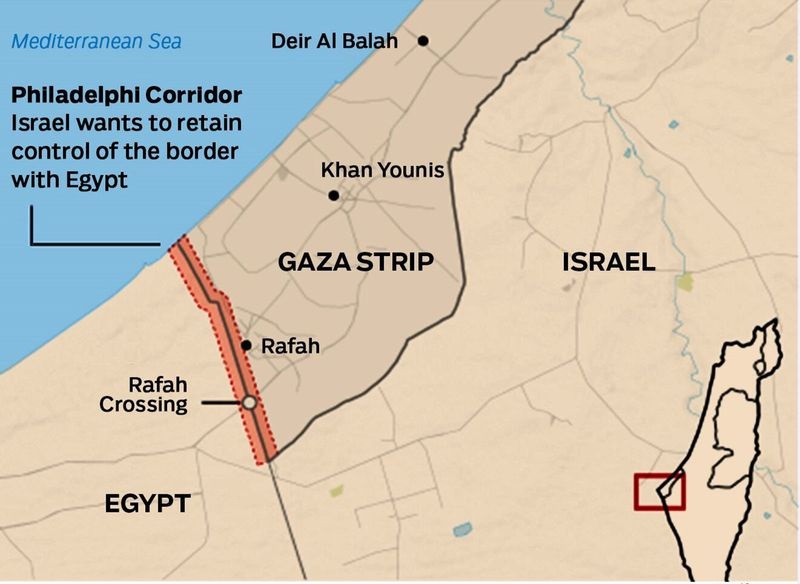
    • The Philadelphi Corridor is a strategically significant strip of land between the Gaza-Egypt border.
    • It spans about 14 kilometers in length and 100 meters in width.
    • This area plays a critical role in regional security and the geopolitics surrounding Gaza, Israel, and Egypt.
    • It runs from the Mediterranean Sea in the north to the Kerem Shalom crossing with Israel in the south.
    • It includes the Rafah crossing, the main border point between Gaza and Egypt.
    • It acts as a buffer zone between Egypt and Gaza, with control over it influencing security and smuggling activities in the region.

    Significance for Israel

    • The Corridor became significant after the 1979 Camp David peace treaty, allowing Israel to maintain a limited military presence.
    • In 2005, Israel withdrew from Gaza, including the corridor, leaving Egypt and the Palestinian Authority responsible for security.
    • In 2007, Hamas took control of Gaza, increasing smuggling activities through tunnels in the corridor.
    • Israel regained control of the corridor in May 2023 during a ground offensive in Gaza.
    • The corridor has since been central to Israel’s strategy for controlling arms smuggling and preventing Hamas from using it as a supply route.
  • Places in News: Neom Megacity Project

    Note4Students

    From UPSC perspective, the following things are important:

    Prelims level: Neom Megacity Project

    Why in the News?

    The Wall Street Journal has highlighted controversies surrounding the Neom Megacity Project, a key project of Saudi Arabia and world’s largest construction real-estate project.

    About Neom Megacity Project:

    Details
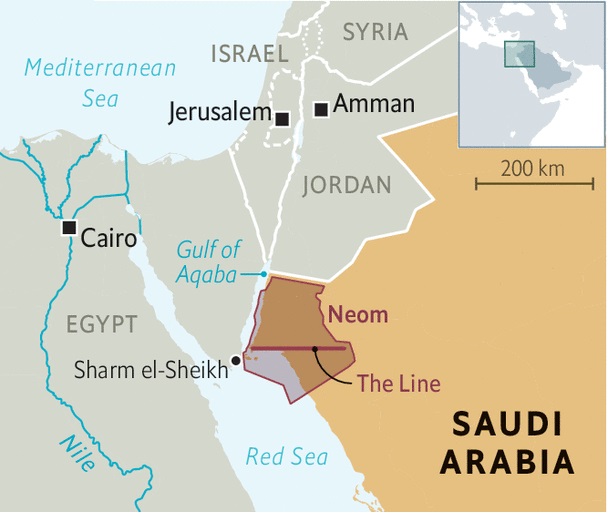
    Location Northwestern Tabuk Province, Saudi Arabia, along the Red Sea
    Launched
    • 2017 by Crown Prince Mohammed bin Salman
    • Part of Saudi Arabia’s Vision 2030.
    Objective To diversify Saudi Arabia’s economy and reduce its reliance on oil.
    Size
    • 26,500 sq km
    • Initially $500 billion, now estimated at $1.5 trillion
    Completion Year Expected by 2039
    Key Projects
    • The Line: 170-km long linear city for 9 million residents
    • Oxagon: Octagonal industrial city
    • Trojena: Mountain resort for 2029 Asian Winter Games
    • Magna: Luxury coastal city
    • Sindalah: Luxury island, opening in 2024
    Technological Focus
    • Renewable energy (solar, wind)
    • AI and robotics
    • Green hydrogen production
    Environmental Goals
    • Powered by 95% renewable energy
    • Focus on sustainable development

    Controversies surrounding the Project:

    • Displacement of Indigenous Tribes: The Huwaitat tribe has been forcibly displaced, leading to human rights concerns.
    • Slow Progress: Construction is behind schedule, with only 1.4 km of The Line expected to be completed by 2030.
    • Workplace Misconduct: Reports of toxic culture and unethical leadership, including neglect of worker safety.
    • Surveillance Concerns: Critics worry about the project’s use of real-time monitoring, raising privacy concerns.
    • Cost Overruns: The project’s budget has ballooned from $500 billion to $1.5 trillion, leading to scaled-down plans.
  • Global Geological And Climatic Events

    Shiveluch Volcano

    Note4Students

    From UPSC perspective, the following things are important:

    Prelims level: Shiveluch Volcano

    Why in the News?

    The Shiveluch Volcano in Russia erupted following a 7.0 magnitude earthquake off the country’s eastern coast.

    About Shiveluch Volcano

    Details
    Location
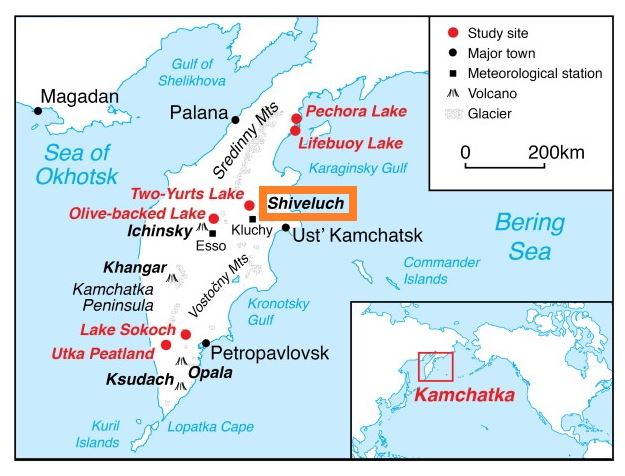
    • Kamchatka Peninsula, Russia
    • Approximately 56°39′N 161°21′E
    • Stratovolcano (Composite Volcano)
    • Approximately 3,283 meters (10,771 feet)
    Geological Features Large actively growing lava dome, andesitic to dacitic lava
    Eruption History Frequent eruptions; significant activity in 2005, 2010, and ongoing in 2023-2024
    Hazards Ash plumes, pyroclastic flows, lahars
    Kamchatka Peninsula
    • Lies in far eastern Russia, between the Sea of Okhotsk on the west and the Pacific Ocean and Bering Sea on the east.
    • One of the world’s most concentrated areas of geothermal activity, with about 30 active volcanoes.
    • Approximately 1,200 km long and 480 km across at its widest.
    • Climate: Severe, with prolonged, cold, and snowy winters and wet, cool summers.
    • Regional Capital: Petropavlovsk-Kamchatsky.
    • Kuril Island chain runs from the southern tip of the peninsula to near Japan’s northern Hokkaido Island.
  • Foreign Policy Watch: India-Bangladesh

    St Martin’s Island

    Note4Students

    From UPSC perspective, the following things are important:

    Prelims level: St Martin’s Island

    Why in the News?

    The ousted Bangladeshi PM Sheikh Hasina claimed she could have stayed in power if she had given up St. Martin’s Island and parts of the Bay of Bengal to the United States.

    About St Martin’s Island

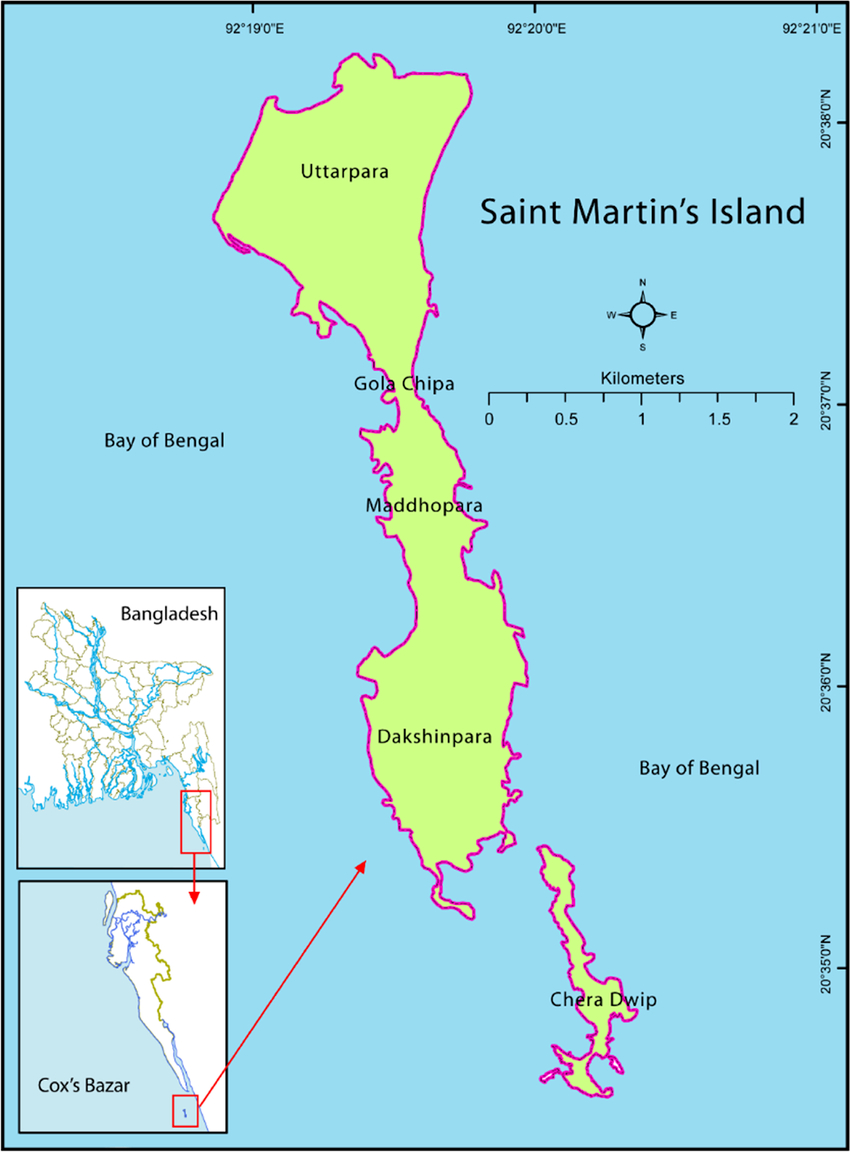
    • St. Martin’s Island is located in the northeastern region of the Bay of Bengal, near the maritime boundary between Bangladesh and Myanmar.
    • It lies about 9 kilometers south of the Cox’s Bazar-Teknaf peninsula in Bangladesh.
    • The island is approximately 7.3 km long and is mostly flat, with an elevation of about 3.6 meters above mean sea level.
    • It is Bangladesh’s only coral island and is surrounded by coral reefs that extend 10-15 km to the west-northwest of the island.
    • Historical Background:
      • The island was originally part of the Teknaf peninsula but gradually submerged into the sea around 5,000 years ago.
      • It resurfaced approximately 450 years ago.
      • Arab merchants were among the first settlers in the 18th century. They named it “Jazira” and later “Narikel Jinjira” (Coconut Island).
      • In 1900, British India annexed the island, and it became known as St. Martin’s Island, named after a Deputy Commissioner of Chittagong.

    Strategic importance:

    • Near the Strait of Malacca: Close to one of the world’s busiest maritime routes, making it strategically important for military oversight.It offers potential for monitoring maritime activities, including strategic interests of global powers.
    • Border with Myanmar: Proximity to Myanmar adds significance in regional security dynamics.

    Other significance for Bangladesh:

    • It is part of Bangladesh’s EEZ, rich in marine resources like fish, oil, and gas. Also a key tourist destination.
    • It is important for biodiversity, with coral reefs and diverse marine life.

    PYQ:

    [2023] Consider the following pairs:

    Area of conflict mentioned in news: Country where it is located

    1.Donbas: Syria

    2.Kachin: Ethiopia

    3.Tigray: North Yemen

    How many of the above pairs are correctly matched?

    (a) Only one

    (b) Only two

    (c) All three

    (d) None