💥UPSC 2026, 2027, 2028 UAP Mentorship (March Batch) + Access XFactor Notes & Microthemes PDF

Archives: News

  • Minority Issues – SC, ST, Dalits, OBC, Reservations, etc.

    Ninth Schedule of the Indian Constitution

    A parliamentarian has said in an interview that reservation should be put under the Ninth Schedule of the Constitution.  His comments came days after the Supreme Court ruled that reservation in the matter of promotions in public posts was not a fundamental right and that a state cannot be compelled to offer quota if it chooses not to.

    What is the Ninth Schedule?

    • The Ninth Schedule contains a list of central and state laws which cannot be challenged in courts.
    • Currently, 284 such laws are shielded from judicial review.
    • The Schedule became a part of the Constitution in 1951, when the document was amended for the first time.
    • It was created by the new Article 31B, which along with 31A was brought in by the government to protect laws related to agrarian reform and for abolishing the Zamindari system.
    • While most of the laws protected under the Schedule concern agriculture/land issues, the list includes other subjects, such as reservation.
    • A Tamil Nadu law that provides 69 per cent reservation in the state is part of the Schedule.

    Article 31A and 31 B

    • While Article 31A extends protection to ‘classes’ of laws, A. 31B shields specific laws or enactments.
    • Article 31B also has retrospective operation: meaning if laws are inserted in the Ninth Schedule after they are declared unconstitutional, they are considered to have been in the Schedule since their commencement, and thus valid.
    • Although Article 31B excludes judicial review, the apex court has said in the past that even laws under the Ninth Schedule would be open to scrutiny if they violated fundamental rights or the basic structure of the Constitution.
  • Foreign Policy Watch: India-United States

    USTR takes India off developing country list


    The Office of the United States Trade Representative (USTR) has published a notice, amending lists of developing and least-developed countries that are eligible for preferential treatment with respect to countervailing duties (CVD) investigations.

    New classification by US

    • To harmonise U.S. law with the World Trade Organization’s (WTO) Subsidies and Countervailing Measures (SCM) Agreement, the USTR had, in 1998, come up with lists of countries classified as per their level of development.
    • These lists were used to determine whether they were potentially subject to U.S. countervailing duties. The 1998 rule is now “obsolete” as per the USTR notice.
    • Countries not given special consideration have lower levels of protection against a CVD investigation.
    • A CVD investigation must be terminated if the offending subsidy is de minimis (too small to warrant concern) or if import volumes are negligible.
    • The de minimis thresholds and import volume allowance are more relaxed for developing and least-developed countries.

    Criteria set by US

    • The USTR used the following criteria to determine whether a country was eligible for the 2% de minimise standard:

    (1) Per capita Gross National Income or GNI

    (2) share of world trade

    (3) other factors such as Organisation for Economic Co-operation and Development (OECD) membership or application for membership, EU membership, and Group of Twenty (G20) membership.

    Delisting India

    • India was, until February 10, on the developing country list and therefore eligible for these more relaxed standards. It has now been taken off of that list.
    • India, along with Brazil, Indonesia, Malaysia, Thailand and Vietnam were taken off the list since they each have at least a 0.5% share of the global trade, despite having less than $12, 375 GNI (the World Bank threshold separating high-income countries from others).
    • India was taken off the list also because — like Argentina, Brazil, Indonesia and South Africa — it is part of the G20.
    • Given the global economic significance of the G20, and the collective economic weight of its membership (which accounts for large shares of global economic output and trade), G20 membership indicates that a country is developed a/c to USTR.
  • Modern Indian History-Events and Personalities

    Conservation plan for Konark Sun Temple

    A plan to restore and preserve the nearly 800-year-old Konark Sun Temple in Odisha would be drawn up soon. Among the potential choices before the government would be to fill in more sand or to remove all the sand andput in place alternate support.

    Konark Sun Temple

    • Konark Sun Temple is a 13th-century CE Sun temple at Konark about 36 kilometres northeast from Puri on the coastline of Odisha, India.
    • The temple is attributed to king Narasinga Deva I of the Eastern Ganga Dynasty about 1250 CE.
    • Dedicated to the Hindu Sun God Surya, what remains of the temple complex has the appearance of a 100-foot (30 m) high chariot with immense wheels and horses, all carved from stone.
    • Once over 200 feet (61 m) high, much of the temple is now in ruins, in particular the large shikara tower over the sanctuary; at one time this rose much higher than the mandapa that remains.
    • The structures and elements that have survived are famed for their intricate artwork, iconography, and themes, including erotic kama and mithuna scenes.
    • Also called the Surya Devalaya, it is a classic illustration of the Odisha style of Architecture or Kalinga Architecture.
    • Declared a UNESCO world heritage site in 1984 it remains a major pilgrimage site for Hindus, who gather here every year for the Chandrabhaga Mela around the month of February.

    Earlier restoration efforts

    • It had been filled with sand and sealed by the British authorities in 1903 in order to stabilize the structure, a/c to ASI.
    • A scientific study was carried out by the Roorkee-based Central Building Research Institute from 2013 till 2018 to ascertain the temple’s structural stability as well as the status of the filled-in sand.
    • The sand filled in over 100 years ago had settled, leading to a gap of about 17 feet.  However the structure was found to be stable.
  • Climate Change Impact on India and World – International Reports, Key Observations, etc.

    ‘Future of Earth, 2020’ Report


    The “The Future of Earth, 2020” Report was recently released.

    About the report

    • The report is released by the South Asia Future Earth Regional Office, Divecha Centre for Climate Change, Indian Institute of Science.
    • The report was prepared with the aim of reducing carbon footprint and halting global warming below 2 degree Celsius by 2050.

    Highlights of the report

    • Five global risks that have the potential to impact and amplify one another in ways that may cascade to create global systemic crisis have been listed by report.
    • It listed the following as five global risks:
    1. failure of climate change mitigation and adaptation
    2. extreme weather events
    3. major biodiversity loss and ecosystem collapse
    4. food crises; and
    5. water crises
    • Offering examples of how the interrelation of risk factors play a role, scientists say extreme heatwaves can accelerate global warming by releasing large amounts of stored carbon from affected ecosystems, and at the same time intensify water crises and/ or food scarcity.
    • The loss of biodiversity also weakens the capacity of natural and agricultural systems to cope with climate extremes, increasing our vulnerability to food crises, they point out.
  • Parliament – Sessions, Procedures, Motions, Committees etc

    In news: Two-child Norm

    A Rajya Sabha MP has introduced a Private Member’s Bill on two-child norms.

    Key propositions of the Bill

    • Essentially, the Bill aims to amend the Constitution in order to incentivise limiting families to two children by offering tax concessions, priority in social benefit schemes and school admissions, among other things.
    • It proposes incentives in taxation, education and employment for people who limit their family size to two children.

    Article 47A

    • The Bill has sought the incorporation of a new provision, Article 47A in Part IV of the Constitution, to withdraw all concessions from people who fail to adhere to the “small-family” norm.
    • Article 47A says the following:

     “47A. The State shall promote small family norms by offering incentives in taxes, employment, education etc. to its people who keep their family limited to two children and shall withdraw every concession from and deprive such incentives to those not adhering to small family norm, to keep the growing population under control.”

    Note: Article 47 of the Indian Constitution is one of the DPSP  which directs the State to raise the level of nutrition and the standard of living and to improve public health as among its primary duties and, in particular, the State shall endeavour to bring about prohibition of intoxicating drinks and drugs which are injurious to health.

    Why such Bill?

    • The Bill’s Statement of Object and Reasons states that the fact that India’s population has already crossed 125 crore is “really frightening”.
    • It goes on to say that India’s population has doubled in the last 40 years and that it is expected to unseat China as the world’s most populous nation in the next couple of decades.
    • Despite the fact that we have framed a National Population Control Policy, we are the second most populous country in the world.
    • Further, the population explosion will cause “many problems” for our future generations.
    • The Bill also makes a reference to “overburdened” natural resources that are overexploited because of overpopulation.

    Statewide policies relating to two-child norms

    Assam Cabinet has recently decided that those with more than two children will be ineligible for government jobs from 2021. Other states with similar norms:

    Rajasthan: For government jobs, candidates who have more than two children are not eligible for appointment.

    Madhya Pradesh: The state follows the two-child norm since 2001. Under Madhya Pradesh Civil Services (General Condition of Services) Rules, if the third child was born on or after January 26, 2001, one becomes ineligible for government service. The rule also applies to higher judicial services.

    Telangana: Under Section 19 (3) read with Sections 156 (2) and 184 (2) of Telangana Panchayat Raj Act, 1994, a person with more than two children shall be disqualified from contesting election. However, if a person had more than two children before May 30, 1994, he or she will not be disqualified.  The same sections in the Andhra Pradesh: AP Panchayat Raj Act, 1994, apply to Andhra Pradesh, where a person having more than two children shall be disqualified from contesting election.

    Gujarat: In 2005, the government amended the Gujarat Local Authorities Act. The amendment disqualifies anyone with more than two children from contesting elections for bodies of local self-governance — panchayats, municipalities and municipal corporations.

    Maharashtra: The Maharashtra Zilla Parishads And Panchayat Samitis Act disqualifies people who have more than two children from contesting local body elections (gram panchayats to municipal corporations). The Maharashtra Civil Services Rules, 2005 states that a person having more than two children is disqualified from holding a post in the state government. Women with more than two children are also not allowed to benefit from the Public Distribution System.

    Karnataka: The Karnataka (Gram Swaraj and Panchayat Raj) Act, 1993 does not bar individuals with more than two children from contesting elections to local bodies like the gram panchayat. The law, however, says that a person is ineligible to contest “if he does not have a sanitary latrine for the use of the members of his family”.

    Odisha: The Odisha Zilla Parishad Act bars those individuals with more than two children from contesting.

  • Air Pollution

    Global cost of air pollution from fossil fuels


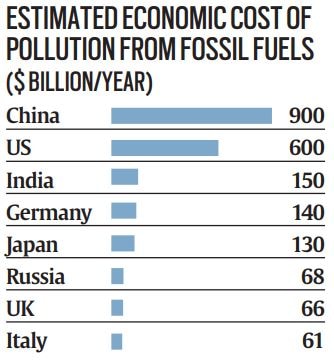
    A new Greenpeace report has estimated the global cost of air pollution from fossil fuels at around $2.9 trillion per year, or $8 billion per day — 3.3% of the world’s GDP.

    Cost of air pollution

    India is estimated to bear a cost of $150 billion, or 5.4% of the country’s GDP, which is the third-highest absolute cost from fossil fuel air pollution worldwide.

    China and the US are estimated to bear the highest absolute costs from fossil fuel air pollution, respectively at $900 billion and $600 billion.

    Loss of lives

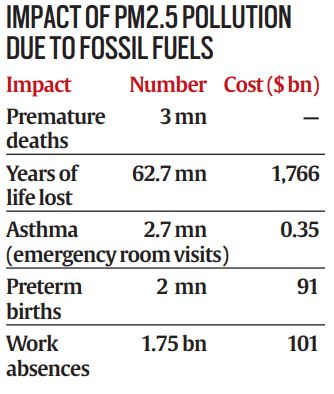
    • Globally, air pollution is estimated to cause 4.5 million premature deaths each year.
    • This includes 3 million deaths attributable globally to PM2.5, which is one of the principal pollutants in northern Indian cities including Delhi.
    • Globally, PM2.5 is also estimated to cause the loss of 62.7 million years of life, 2.7 million emergency room visits due to asthma, 2 million preterm births and 1.75 billion work absences.
    • The 2 million preterm births include 981,000 in India and over 350,000 in China.

    Economic cost

    In India, exposure to fossil fuels also leads to a loss of around 490 million workdays, the report said.

  • Animal Husbandry, Dairy & Fisheries Sector – Pashudhan Sanjivani, E- Pashudhan Haat, etc

    [pib] ‘Apiary on Wheels’ Initiative


    ‘Apiary on Wheels’ was recently flagged off today by the Union Minister of MSME.

    ‘Apiary on Wheels’

    • It is a unique concept designed by KVIC for the easy upkeep and migration of Bee Boxes having live Bee colonies.
    • It is a platform which can carry 20 Bee Boxes from one place to another without any difficulty.
    • It is like an attachment which can be easily connected with a Tractor or a Trolley and may be pulled to any suitable destination.
    • Specially, in summers, the beekeepers usually adopted crude methods to feed the bees and many bees used to die in the process.
    • This concept of migration, cooling with the help of solar panels and sugar drips with zero risk to the lives of bees, will prevent any damages to the bee boxes or bee colonies and help produce quality honey.

    How it works?

    • Two large wheels on either side of the Apiary and 4 separate compartments with independent doors, having 5 bee boxes each help the platform to remain intact without disturbing the live bee colonies.
    • It is also connected with a solar panel system which automatically triggers a fan inside the compartment as soon as the temperature reaches 35 degree centigrade or above.
  • Telecom and Postal Sector – Spectrum Allocation, Call Drops, Predatory Pricing, etc

    Missed call

    Context

    As the dust settles after the Union budget and the Supreme Court’s decision to not provide relief to telcos from their licence fee liabilities, it is an appropriate moment to step back and examine how we got here.

    The issue over the definition of AGR (Aggregate Gross Revenue)

    • What is AGR issue: Since the New Telecom Policy of 1999 (NTP 1999), operators were required to pay a percentage of their AGR to the government as licence fees instead of a one-time licence fee.
      • License fee based on earnings: This was done in exchange for moving operators from fixed licence fee-based on irrationally exuberant bids they had made in the mid-nineties-to a regime that determined licence fee based on revenue earned, thereby de-risking the obligation.
      • Why it matters? What constitutes AGR is important for the purpose of the computing licence fee and thousands of crore are dependent on this.
    • Consequences of ambiguity over the definition of AGR: Bundling – a pervasive phenomenon in most telecom markets have not taken off in India.
      • What is bundling? Product bundling is a marketing strategy that involves offering several products and/or services for sale as one combined product.
      • The fear is that handset sales will also come under the purview of AGR. Handsets, it could still be argued are part of the service offering.
      • Dividend on earning is considered as the part of AGR: Interest and dividend earnings on investments have also been included in AGR.

    Unfair practices and cancellation of licences by the court

    • Controversy over conversion charges: In 2003, “limited” mobility service was converted into a fully mobile service with a one-time payment of Rs 1,658 crore as “conversion” charges, generating controversy. It was labelled as a “back door entry” to full mobility.
    • Disguising international calls as domestic: Around the same time, the DoT used to levy a fee of Rs 4.75 per minute on international calls known as “access deficit charge” (ADC) to fund universal coverage. It is well known that an operator disguised international calls as domestic to bypass ADC.
    • Showing call revenue as internet services revenue: For some time, internet services attracted lower or no licence fee and it became expedient for operators to indulge in license fee “arbitrage” by showing more revenue from internet services.
    • Inflating subscriber numbers: Another manoeuvre was to inflate subscriber numbers to gain access to scarce spectrum in the days when fresh spectrum was administratively assigned based on subscriber numbers.
    • First come first serve policy: Finally, the shameful spectacle was the battle fought by operators to jump the queue to deposit earnest money for gaining rights over the spectrum that was oddly sought to be assigned by a method called “first come first served” and whose definition itself was quite elastic.
    • Cancellation of licence by the Court: Thereafter, in the litigation that inevitably followed, the Court cancelled 122 telecom licences and mandated allocation of spectrum by auction.

    Conclusion

    • Erosion of trust between the public and private sector in general and in the telecom sector, in particular, has been a negative externality of the reform process.
    • Restoration of trust between public and private sector is necessary: In this context, the appeal made by the finance minister during her budget speech for the restoration of “vishwaas” between the public and private sectors and between citizens and government is critical
  • Digital India Initiatives

    Riding on data for mobility

    Context

    Data-based governance can assist in reducing traffic congestion, as illustrated by a pilot study in Hyderabad.

    How the Digital revolution is transforming lives

    • Seamless and efficient interaction: The digital revolution has made interactions between humans and machines, and among citizens, governments and businesses, seamless and efficient.
    • Helping efficient delivery of services: Today, e-governance enables and empowers citizens to directly engage with the state, thereby eliminating barriers in the delivery of public services.
    • The next wave of transformation: The next wave of transformation in digital governance is at the intersection of data and the public good.
      • Data as a strategic asset: The key to this transformation lies in incorporating data as a strategic asset in all aspects of-
      • Policy.
      • Planning.
      • Service delivery and-
      • Operations of the government.

    Transportation system improvement by leveraging Digital revolution

    • Loss caused by the congestion
      • Congestion caused an estimated $24 billion to the four metro cities in India in 2018.
      • Given the limited land resources available, the key to solving congestion lies in improving the efficiency of existing transportation systems.
    • How can Digital revolution help tackle the problem?
      • An efficient transportation system would help ease congestion, reduce travel time and cost, and provide greater convenience.
      • How it will work? Data from multiple sources such as-
      • CCTV cameras.
      • Automatic traffic 
      • Map services and-
      • Transportation service providers could be used.
    • Results of the previous studies
      • London example: A study by Transport for London estimates that its open data initiative on sharing of real-time transit data has helped add £130 million a year to London’s economy by improving productivity and efficiency.
      • Results from China: In China, an artificial intelligence-based traffic management platform developed by Alibaba has helped improve average speeds by 15%.

    Hyderabad Open Transit Data portal

    • Hyderabad Open Transit Data, launched by Open Data Telangana, is the country’s first data portal.
      • What does it do? It publishes datasets on bus stops, bus routes, metro routes, metro stations, schedules, fares, and frequency of public transit services.
    • The objective of the portal: The objective is to empower start-ups and developers to create useful mobility applications.
      • The datasets were built after an intensive exercise carried out by the Open Data Team and Telangana State Road Transport Corporation to collect, verify and digitise the data.
    • Collaboration with the private sector: Hyderabad has also begun collaborating with the private sector to improve traffic infrastructure.
      • MoU with Ola Mobility Institute: One such partnership followed a Memorandum of Understanding signed between the Telangana government and Ola Mobility Institute.
      • Monitoring the quality of roads in the city: Under this collaboration, Ola has developed a tool, Ola City Sense, to provide data-based insights that can monitor the quality of Hyderabad’s roads and identify bad quality patches.
      • Other areas in which the data is used: The information thus given is useful not only for carrying out road repairs, it also helps officials take initiatives to improve road safetymonitor quality of construction, and study the role of bad roads in causing congestion.
    • A pilot project to prioritisation of repairs: A pilot was implemented in a municipal zone to gauge the efficacy of the data in supporting road monitoring and prioritisation of repairs.
      • The early results of this pilot project were encouraging. The dashboard helped city officials plan the pre-monsoon repair work and budget for repairs last year.

    Conclusion

    • The willingness of the government to apply data-based insights: The Hyderabad project and the pilot demonstrated the willingness of government departments to apply data-based insights for better decision making.
      • This could also serve as a model for other cities to emulate.
    • Making the departments data-centric: The Hyderabad example also shows that governments can make their departments data-centric by-
      • Institutionalising data collection.
      • Building technology platforms.
      • And helping the departments develop the capacity to handle the insights generated from the data.
      • Smart cities as a starting point: Command and control centres under the ‘smart cities’ initiative can be an ideal starting point.
      • Data security and privacy: Such interventions, however, also need to address genuine concerns around data security and privacy.


  • Hunger and Nutrition Issues – GHI, GNI, etc.

    Nutrition and the Budget’s fine print

    Context

    There are well-equipped schemes to address the malnutrition, plugging the policy gaps is the problem.

    Nutrition and hunger in India

    • Global Hunger Index rank 102: A few months ago, the Global Hunger Index, reported that India suffers from “serious” hunger, ranked 102 out of 117 countries.
    • Only one-tenth of children getting proper diet: Just a tenth of children between six to 23 months are fed a minimum acceptable diet.
    • Urgency reflected in the budget: The urgency around nutrition was reflected in the Union Finance Minister’s Budget speech, as she referred to the “unprecedented” scale of developments under the scheme for Holistic Nutrition, or POSHAN Abhiyaan, the National Nutrition Mission with efforts to track the status of 10 crore households.
    • The Economic Survey notes that “Food is not just an end in itself but also an essential ingredient in the growth of human capital and therefore important for national wealth creation”.
    • How malnutrition affects? Malnutrition affects cognitive ability, workforce days and health, impacting as much as 16% of GDP (World Food Programme and World Bank).

    Addressing Nutrition through Agriculture

    • Multiple dimension of malnutrition: There are multiple dimensions of malnutrition that include-
      • Calorific deficiency.
      • Protein hunger.
      • Micronutrient deficiency.
    • Addressing the issue through Agriculture: An important approach to address nutrition is through agriculture.
      • The Bharatiya Poshan Krishi Kosh which was launched in 2019 is a recent attempt to bridge this gap.
      • The krishi kosh was launched by Ministry of Women and Child Development along with Bill & Melinda Gates Foundation (BMGF).
      • Existing schemes can well address India’s malnutrition dilemma. Following is the analysis of budgetary allocation and expenditure in the previous year.

    First- Calorific deficiency

    • The Integrated Child Development Services (ICDS) scheme provides a package of services including-
      • Supplementary nutrition.
      • Nutrition and health education.
      • Health check-ups and
      • Referral services addressing children, pregnant and lactating mothers and adolescent girls, key groups to address community malnutrition, and which also tackle calorific deficiency and beyond.
      • Underutilisation of funds: For 2019-20, the allotment was ₹27,584.37 crore but revised estimates are ₹24,954.50 crore, which points to an underutilisation of resources.
      • Which area needs the emphasis: The allocation this year is marginally higher, but clearly, the emphasis needs to be on implementation.
    • Mid-Day Meal Scheme: Another pathway to address hunger is the Mid-Day Meal Scheme, to enhance the nutrition of schoolchildren.
      • Here too, the issue is not with allocation but with expenditure.
      • The 2019-20 Budget allocation was ₹11,000 crore and revised estimates are only ₹9,912 crores.

    Second-Protein Hunger

    • Contribution of pulses: Pulses are a major contributor to address protein hunger.
      • Underutilisation of funds: A scheme for State and Union Territories aims to reach pulses into welfare schemes (Mid-Day Meal, Public Distribution System, ICDS) has revised estimates standing at just ₹370 crores against ₹800 crore allocation in the 2019-20 Budget.

    Third-micronutrient deficiency

    • Horticulture Mission: The Horticulture Mission can be one of the ways to address micronutrient deficiency effectively, but here too implementation is low.
      • Revised estimates for 2019-20 stand at ₹1,583.50 crores against an allocation of ₹2,225 crores.
    • National Millet Mission: In 2018-19, the Government of India launched a national millet mission which included renaming millets as “nutri-cereals” also launching a Year of Millets in 2018-19 to promote nutritious cereals in a campaign mode across the country.
      • This could have been further emphasised in the Budget as well as in the National Food Security Mission (NFSM) which includes millets.
      • Under-utilisation of funds: The NFSM strains to implement the allocation of ₹2,000 crores during 2019-20, as revised expenditures stand at ₹1,776.90 crore.
      • Need to sustain the momentum: As millets have the potential to address micronutrient deficiencies, the momentum given to these cereals needs to be sustained.

    POSHAN Abhiyan and issues involved

    • 72% expenditure on technology: The National Nutrition Mission which is a major initiative to address malnutrition, had 72% of total expenditure going into “Information and Communication Technology.
      • Misplaced focus: The focus of the bulk of the funding has been on technology, whereas, actually, it is a convergence that is crucial to address nutrition.
      • Under-utilisation of funds: Only 34% of funds released by the Government of India were spent from FY 2017-18 to FY 2019-20 till November 30, 2019.
      • Limiting the possibility of an increase in the allocation: With underspending, allocations for subsequent years will also be affected, limiting the possibility of increasing budgets and the focus on nutrition schemes.

    Agriculture-nutrition link

    • The agriculture-nutrition link is another piece of the puzzle.
    • Link not explicitly mentioned: While agriculture dominated the initial Budget speech, the link between agriculture and nutrition was not explicit.
      • Why the link is important: The link is important because about three-fifths of rural households are agricultural in India (National Sample Survey Office, 70th round)
      • The malnutrition rates, particularly in rural areas are high (National Family Health Survey-4).
      • Need for greater emphasis: Agriculture-nutrition linkage schemes have the potential for greater impact and need greater emphasis.

    Way forward

    • Focus: Focus on nutrition-related interventions, beyond digitisation.
    • Bring all departments in one place: Intensify the convergence component of POSHAN Abhiyaan, using the platform to bring all departments in one place to address nutrition.
    • Nutrition based activities by farmer-producer: Direct the announcement to form 10,000 farmer producer organisations with an allocation of ₹500 crores to nutrition-based activities.
    • Youth schemes: Promotion of youth schemes to be directed to nutrition-agriculture link activities in rural areas.
    • Emphasis on fund allocation: Give explicit emphasis and fund allocation to agriculture-nutrition linked schemes.
    • Early disbursement and utilisation of funds: Ensure early disbursement of funds and optimum utilisation of schemes linked to nutrition.

    Conclusion

    Nutrition goes beyond just food, with economic, health, water sanitation, gender perspectives and social norms contributing to better nutrition. This is why the implementation of multiple schemes can contribute to better nutrition.


Join the Community

Join us across Social Media platforms.