💥UPSC 2027,2028 Mentorship (May Batch) + Access XFactor Notes & Microthemes PDF

Archives: News

  • Judicial Pendency

    Judiciary needs more HC judges: CJI

    Chief Justice of India N.V. Ramana said there was a need to both increase the number of judges in High Courts and urgently fill existing vacancies.

    Judicial vacancy in India

    • The Indian judiciary faces high vacancies across all levels (the Supreme Court, High Courts, and subordinate courts).
    • Vacancy of judges in courts is one of the reasons for delays and a rising number of pending cases, as there are not enough judges to hear and decide cases.
    • As of today, more than four crore cases are pending across all courts in India.

    Appointing judges to the HC

    • The appointment of the judges to the high courts is governed by Article 217 of the Constitution.
    • In addition to the constitutional provisions, the process of appointments outlined in the Memorandum of Procedure (MoP) is a lengthy one.
    • It is initiated by the Chief Justice of the concerned high court who recommends the nominees to the state government.
    • Ideally, this process should begin six months prior to the occurrence of the vacancy.
    • The state government then sends the recommendation to the Union Law Ministry, which then sends it to the Supreme Court Collegium.

    HC Vacancies

    • The total sanctioned judicial strength in the 25 High Courts is 1,080.
    • However, the present working strength is 661 with 419 vacancies as on March 1.
    • The Supreme Court has been repeatedly conveying to the government its growing alarm at the judicial vacancies in High Courts.
    • Some of these High Courts are functioning only with half their sanctioned judicial strength.
    • On average, the courts suffered at least 40% judicial vacancies.

    Why is there a huge gap?

    Ans. Timeline of appointment is arbitrary

    • Appointments of High Court judges are guided by a memorandum of procedure.
    • As per this memorandum, the appointment process is to be initiated by the concerned High Court at least six months before a vacancy occurs.
    • However, the Standing Committee (2021) noted that this timeline is rarely adhered to by High Courts.
    • Further, in the final stage of the process, after receiving recommendations from the Supreme Court collegium, the executive appoints judges to the High Court.
    • No timeline is prescribed for this stage of the appointment process.

    How many judges do we need?

    • The Law Commission of India (1987) had noted the importance of manpower planning for the judiciary.
    • Lack of adequate number of judges means a greater workload per judge.
    • Thus, it becomes essential to arrive at an optimal judge strength to deal with pending and new cases in courts.
    • Over the years, different methods of calculating the required judge strength for subordinate courts (where the backlog of cases in the Indian judiciary is concentrated) have been recommended:
    Method of calculation Recommendation and its status
    Judge-to-population ratio: Optimum number of judges per million population The Law Commission of India (1987) had recommended increasing this ratio to 50 judges per million people.   For 2020, the judge-to-population ratio was 21 judges per million population.
    Rate of disposal: Number of additional judges required (to clear the existing backlog of cases and ensure that new backlog is not created) based on the average number of cases disposed per judge The Law Commission of India (2014) proposed this method.  It rejected the judge-to-population ratio method, observing that filing of cases per capita varies substantially across geographic units depending on socio-economic conditions.
    Weighted case load method: Calculating judge strength based on the disposal by judges, taking into account the nature and complexity of cases in local conditions It addresses the existing backlog of cases as well as the new flow of cases every year in subordinate courts.     In 2017, the Supreme Court accepted this model.
    Time-based weighted case load method: Calculating the required judge strength taking into account the actual time spent by judges in different types of cases at varying stages based on an empirical study Used widely in the United States, this was the long-term method recommended by the NCMS (2016) to assess the required judge strength for subordinate courts.  It involves determining the total number of ‘judicial hours’ required for disposing of the case load of each court.  The Delhi High Court used this approach in a pilot project (2017- 2018) to calculate the ideal judge strength for disposing of pending cases in certain courts in Delhi.

    Back2Basics:

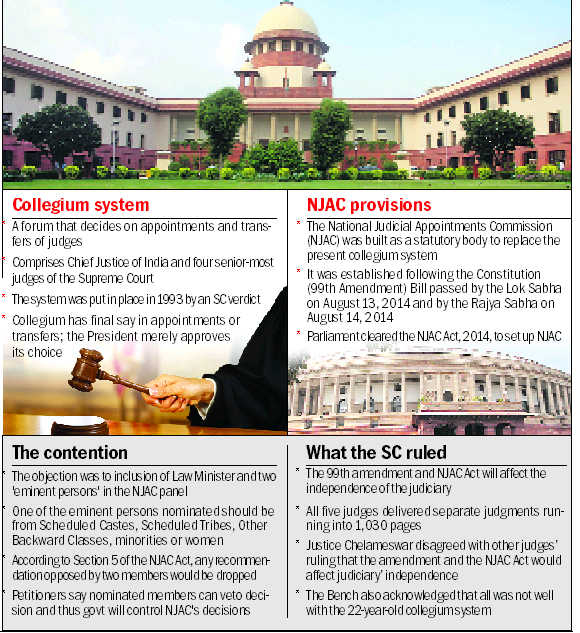
    What is Collegium System?


    UPSC 2022 countdown has begun! Get your personal guidance plan now! (Click here)

  • Foreign Policy Watch: India-Russia

    Society for Worldwide Interbank Financial Telecommunication (SWIFT)

    The U.S., Europe and several other western nations are moving to exclude Russia from SWIFT, an international network for banks worldwide to facilitate smooth money transactions globally.

    What is SWIFT?

    • SWIFT is an international network for banks worldwide to facilitate smooth money transactions globally.
    • It is basically a messaging network used by banks and financial institutions globally for quick and faultless exchange of information pertaining to financial transactions.
    • The Belgium-headquartered SWIFT connects more than 11,000 banking and securities organizations in over 200 countries and territories.
    • First used in 1973, it went live in 1977 with 518 institutions from 22 countries, its website states.

    What exactly is it?

    • SWIFT is merely a platform that sends messages and does not hold any securities or money.
    • It facilitates standardized and reliable communication to facilitate the transaction.

    How does it facilitate banking?

    • Each participant on the platform is assigned a unique eight-digit SWIFT code or a bank identification code (BIC).
    • If a person, say, in New York with a Citibank account, wants to send money to someone with an HSBC account in London, the payee would have to submit to his bank the London-based beneficiary’s account number along with the eight-digit SWIFT code of the latter’s bank.
    • Citibank would then send a SWIFT message to HSBC. Once that is received and approved, the money would be credited to the required account.

    How is the organization governed?

    • SWIFT claims to be neutral. Its shareholders, consisting of 3,500 firms across the globe, elect the 25-member board, which is responsible for oversight and management of the company.
    • It is regulated by G-10 central banks from Belgium, Canada, France, Germany, Italy, Japan, The Netherlands, the UK, the US, Switzerland, and Sweden, alongside the European Central Bank.
    • Its lead overseer is the National Bank of Belgium.
    • The SWIFT oversight forum was established in 2012.
    • The G-10 participants were joined by the central banks of India, Australia, Russia, South Korea, Saudi Arabia, Singapore, South Africa, the Republic of Turkey, and the People’s Republic of China.
    • Europe, Middle East, and Africa are highest contributors to SWIFT.

    What happens if one is excluded from SWIFT?

    • US excluding Russia from SWIFT could have serious repercussions on how Russian banks carry out international financial transactions.
    • If a country is excluded from the most participatory financial facilitating platform, its foreign funding would take a hit, making it entirely reliant on domestic investors.
    • This is particularly troublesome when institutional investors are constantly seeking new markets in newer territories.
    • An alternative system would be cumbersome to build and even more difficult to integrate with an already expansive system.

    Are any countries excluded from SWIFT?

    • Iranian banks were ousted from the system in 2018 despite resistance from several countries in Europe.
    • This step, while regrettable, was taken in the interest of the stability and integrity of the wider global financial system, and based on an assessment of the economic situation.


    UPSC 2022 countdown has begun! Get your personal guidance plan now! (Click here)

  • Foreign Policy Watch: India – EU

    What is the Munich Security Conference (MSC)?

    The latest edition of MSC a week ago assumed significance as it was here that the Ukrainian President appealed for help ahead of the Russian invasion.

    Munich Security Conference

    • The Munich Security Conference is an annual conference on international security policy that has been held in Munich, Bavaria, Germany since 1963.
    • It brings together heads of state, diplomats and business leaders from the world’s leading democracies for three days of meetings and presentations.
    • It is the world’s largest gathering of its kind.
    • Over the past four decades the MSC has become the most important independent forum for the exchange of views by international security policy decision-makers.

    How did it begin?

    • When the MSC was founded in 1963, it was envisioned as a way for leaders, mostly from the West, to discuss threats and dangers in an informal setting.
    • Most of the concerns at the time stemmed from the Cold War, which had dominated world politics for nearly a half-century.
    • Over time, the conference evolved into a platform for airing grievances and workshopping political agreements, some of them outside the realm of East-West relations.
    • In recent years, the conference has often invited leaders from authoritarian countries, and even adversaries, to speak.


    UPSC 2022 countdown has begun! Get your personal guidance plan now! (Click here)

  • Inflection point for the West-led global order

    Context

    The Ukraine crisis has come to a head with Russia biting the bullet and launching “a full-scale invasion of Ukraine.

    Russian invasion and response of the West

    • Hours before the invasion, the western countries had imposed a new round of sanctions against Moscow (targeting Russian individuals and banks linked to Mr. Putin’s regime).
    • German Chancellor Olaf Scholz suspended certification of Nord Stream 2, a major gas pipeline between Russia and his nation.
    • The European Union has announced a “massive” package of sanctions.
    • Incoherence in response: the West has been incoherent in its response — not being able to present a united front, and worse, not even speaking the same language at times.
    •  For the West, this has been a moment when it has been found wanting — a lack of imagination, lack of will and lack of leadership, all rolled into producing a lackadaisical response to the one of most serious security crises in decades.
    • France has used this moment of crisis in trying to showcase its own leadership credentials.
    • Lack of trans-Atlantic engagement: It turns out that even Mr. Biden has not been able to build the trans-Atlantic engagement around common objectives to be pursued collectively.
    • Energy dependence: With the EU importing 39% of its total gas imports and 30% of oil from Russia, and with the Central and Eastern European countries being almost 100% dependent on Russian gas, the reasons for internal EU dissonance are not that difficult to fathom.

    Implications for Indo-Pacific

    • Emboldening China: This ineffectual western response has emboldened not only Russia but also China as the focus of the West is in danger of moving away from the Indo-Pacific.
    •  The Russia-China ‘axis’ is only getting stronger as the two nations seem ready to take on the West that seems willing to concede without even putting up a fight.

    Conclusion

    Today, the balance of power is once again in flux, and as China develops a strategic partnership with Russia, the future of the West-led global order will be defined by how effectively it responds to the crisis in Ukraine.

    UPSC 2022 countdown has begun! Get your personal guidance plan now! (Click here)

  • Foreign Policy Watch: India – EU

    Russian actions in Ukraine hardly pass the test for strategic victory

    Context

    On February 24, Russian President Vladimir Putin launched “special military operations” with the objective of “demilitarising Ukraine” but not “occupying” it.

    Why it was a crisis in the making?

    • Redrawing national boundaries by force: After 1945, this is the second time that national boundaries are being redrawn by force; the first was the 1999 North Atlantic Treaty Organization (NATO) air strikes on Serbian forces that led to the creation of Kosovo.
    • Russian and Chinese protests about NATO undertaking “out of area operations” without United Nations Security Council approval carried little weight.
    • After the fall of the Berlin Wall in late-1989, then U.S. Secretary Of State had assured the Soviet President that “there would be no extension of NATO’s jurisdiction one inch to the east”.
    • Rather than look for a new European security framework, the newly independent Baltic and central European states sought security in a U.S.-led NATO.
    • Beginning in 1999, NATO has added 14 new members in stages.
    • At the NATO summit in 2008, at U.S. President George Bush’s urging, an in-principle opening for Ukraine and Georgia was announced, though France and Germany, conscious of Russian concerns, successfully opposed defining a time frame.
    • Later that year, Russia intervened in Georgia on the grounds of protecting the Russian minorities and took over the northern provinces of Abkhazia and South Ossetia.
    • Annexation of Crimea:  In 2014 Mr. Putin annexed Crimea.
    • For Russia, Crimea is vital as the peninsula hosts Russia’s Black Sea fleet, providing it access to the Mediterranean and its bases at Latakia and Tartus in Syria.
    • Despite no timeline for membership, Ukraine was made a NATO Enhanced Opportunity Partner in 2020.
    • The presence of British and U.S. warships in the Black Sea began to increase.
    • In 2019, the U.K. entered into a cooperation agreement with Ukraine to develop two new naval ports, Ochakiv on the Black Sea and Berdyansk on the Sea of Azov, a move that Russia saw as potentially threatening.
    • Beginning with NATO’s bombing of Serbia in 1999, interventions in Afghanistan, Iraq and Libya and colour revolutions to engineer regime changes, the U.S.’ unilateral withdrawal from the Anti-Ballistic Missile (ABM) Treaty in 2002 coupled with missile defence deployments in Poland and Romania, Russia’s grievances were accumulating.

    Faltering diplomacy

    • France and Germany initiated talks between Ukraine and Russia under the Normandy format leading to the Minsk agreements, in 2014 and 2015.
    • The first was for a ceasefire between Ukraine and the Russian-backed separatists and the second was between Ukraine, Russia, the two separatist regions of Luhansk and Donetsk and the Organization for Security and Co-operation in Europe (OSCE).
    • Supportive declarations by France and Germany were intended to address Russian security concerns.
    • Ukraine undertook to introduce certain constitutional amendments to provide a degree of autonomy to the two provinces and Russia was to assist in withdrawal of all foreign forces.
    • However, neither side implemented and positions have only hardened since.
    • Russia’s threatening moves made NATO members, especially the Baltic states (Estonia, Latvia and Lithuania) and the central Europeans like Poland and Romania, especially nervous.
    • Finally, NATO remained united but unable to provide an off-ramps solution.

    Implications for Russia

    • NATO has been rejuvenated, the trans-Atlantic unity strengthened and Russia’s economic ties with Europe have been adversely impacted.
    • Given Russia’s considerable foreign exchange reserves, of nearly $640 billion, sanctions imposed by the U.S. and EU may not hurt immediately but eventually will begin to bite both the oligarchs and the common people.
    • Worse, Russia will become more dependent on China — for political support as well as a market for its energy exports. 
    • This will eventually weaken its hand in central Asia.

    Conclusion

    For Mr Putin challenge is to constrain the adversary’s options while increasing one’s own options and space for manoeuvre. His actions this week may yield tactical gains but hardly pass the test for strategic victory.

    UPSC 2022 countdown has begun! Get your personal guidance plan now! (Click here)

  • Nuclear Diplomacy and Disarmament

    Places in news: Chernobyl


    Ukrainian authorities said that radiation levels had increased in the Chernobyl exclusion zone after the Russian Invasion.

    What is Chernobyl Disaster?

    • The Chernobyl disaster was a nuclear accident that occurred on 26 April 1986 at the No. 4 reactor in the Chernobyl Nuclear Power Plant, near the city of Pripyat in the north of Ukraine (formerly USSR).
    • It is considered the worst nuclear disaster in history both in cost and casualties.
    • It is one of only two nuclear energy accidents rated at seven—the maximum severity—on the International Nuclear Event Scale.
    • The other such incident was the 2011 Fukushima Daiichi nuclear disaster in Japan.

    Destruction caused

    • Some sources state that two people were killed in the initial explosions, whereas others report that the figure was closer to 50.
    • Dozens more people contracted serious radiation sickness; some of them later died.
    • Between 50 and 185 million curies of radionuclides (radioactive forms of chemical elements) escaped into the atmosphere.
    • This is several times more radioactivity than that created by the atomic bombs dropped on Hiroshima and Nagasaki, Japan.
    • This radioactivity was spread by the wind over Belarus, Russia, and Ukraine and soon reached as far west as France and Italy.


    UPSC 2022 countdown has begun! Get your personal guidance plan now! (Click here)

  • Modern Indian History-Events and Personalities

    Who was Lachit Borphukan?

    The Prime Minister has paid tribute to Lachit Borphukan on Lachit Diwas.

    Who was Lachit Borphukan?

    • The year was 1671 and the decisive Battle of Saraighat was fought on the raging waters of the Brahmaputra.
    • On one side was Mughal Emperor Aurangzeb’s army headed by Ram Singh of Amer (Jaipur) and on the other was the Ahom General Lachit Borphukan.
    • He was a commander in the Ahom kingdom, located in present-day Assam.
    • Ram Singh failed to make any advance against the Assamese army during the first phase of the war.
    • Lachit Borphukan emerged victorious in the war and the Mughals were forced to retreat from Guwahati.

    Lachit Diwas

    • On 24 November each year, Lachit Divas is celebrated state-wide in Assam to commemorate the heroism of Lachit Borphukan.
    • On this day, Borphukan has defeated the Mughal army on the banks of the Brahmaputra in the Battle of Saraighat in 1671.
    • The best passing out cadet of National Defence Academy has been conferred the Lachit gold medal every year since 1999 commemorating his valor.

    Try this PYQ:

    Q.What was the immediate cause for Ahmad Shah Abdali to invade and fight the Third Battle of Panipat?

    (a) He wanted to avenge the expulsion by Marathas of his viceroy Timur Shah from Lahore

    (b) The frustrated governor of Jullundhar Adina Beg khan invited him to invade Punjab

    (c) He wanted to punish Mughal administration for non-payment of the revenues of the Chahar Mahal (Gujrat Aurangabad, Sialkot and Pasrur)

    (d) He wanted to annex all the fertile plains of Punjab upto borders of Delhi to his kingdom


    Post your answer here.


    UPSC 2022 countdown has begun! Get your personal guidance plan now! (Click here)

  • Indian Navy Updates

    In news: P-8I Aircraft

    Aviation and defence colossus Boeing delivered India’s 12th maritime surveillance and anti-submarine warfare P-8I aircraft.

    P-8I Aircraft

    • It is a multi-mission aircraft with state of the art sensors, proven weapons systems, and a globally recognised platform.
    • The first aircraft produced by Boeing flew in 2009, and has been in service with the US Navy since 2013, the same year as the Indian Navy.
    • Apart from India and the US, it has been chosen by six other militaries in the world.
    • The aircraft has two variants — the P-8I, which is manufactured for the Indian Navy, and the P-8A Poseidon.
    • The aircraft is designed for long-range anti-submarine warfare (ASW), anti-surface warfare (ASuW), and intelligence, surveillance and reconnaissance (ISR) missions.

    Naval operations

    • While the Indian Navy uses it for maritime operations, the aircraft was also used in eastern Ladakh in 2020 and 2021, when the standoff with China was at its peak.
    • The aircraft for the Indian Navy are called P-8I, and have replaced the ageing Soviet/Russian Tupolev Tu-142s.

    Specifications and features

    • The P-8I can fly as high as 41,000 feet, and has a short transit time, which reduces the size of the Area of Probability when searching for submarines, surface vessels or search and rescue survivors.
    • The aircraft has two engines, and is about 40 metres long, with a wingspan of 37.64 metres.
    • Each aircraft weighs about 85,000 kg, and has a top speed of 490 knots, or 789 km/hour.
    • It requires a crew of nine, and has a range of 1,200+ nautical miles, with 4 hours on station, which means about 2,222 km.
    • According to Boeing, more than 140 P-8 aircraft have “executed more than 400,000 mishap-free flight-hours around the globe”.


    UPSC 2022 countdown has begun! Get your personal guidance plan now! (Click here)

  • Wildlife Conservation Efforts

    Species in news: Dugong

    India’s first Dugong conservation reserve will be built in Tamil Nadu for the conservation of Dugong, a marine mammal.

    Dugong Conservation Reserve

    • The reserve will spread over an area of 500 km in Palk Bay on the southeast coast of Tamil Nadu.
    • Palk Bay is a semi-enclosed shallow water body with a water depth maximum of 13 meters.
    • Located between India and Sri Lanka along the Tamil Nadu coast, the dugong is a flagship species in the region.

    Dugong: The sea cow

    • Dugong or the sea cow is the State animal of Andaman & Nicobar Islands.
    • This endangered marine species survive on seagrass and other aquatic vegetation found in the area.
    • It is the only herbivorous mammal that is strictly marine and is the only extant species in the family Dugongidae.
    • Dugongs are usually about three-meter long and weigh about 400 kg.
    • Dugongs have an expanded head and trunk-like upper lip.
    • Elephants are considered to be their closest relatives. However, unlike dolphins and other cetaceans, sea cows have two nostrils and no dorsal fin.

    Their habitat

    • Distributed in shallow tropical waters in the Indo-Pacific region, in India, they are found in the Gulf of Kutch, Gulf of Mannar, Palk Bay, and Andaman & Nicobar Islands.
    • Dugongs are long-living animals, that have a low reproductive rate, long generation time, and high investment in each offspring.
    • The female dugongs do not bear their first calf until they are at least 10 and up to 17 years old.
    • A dugong population is unlikely to increase more than 5% per year. They take a long time to recover due to the slow breeding rate.

    Causes of extinction

    • Having being declared vulnerable, the marine animal calls for conserving efforts.
    • Studies have suggested the reasons for the extinction of the animal such as slow breeding rate, fishing, and the loss of habitat.
    • They are also known to suffer due to accidental entanglement and drowning in gill-nets.

    Conservation in India

    • The conservation reserve can promote growth and save vulnerable species from the verge of extinction.
    • Dugongs are protected in India under Schedule 1 of the Indian Wildlife Act 1972 which bans the killing and purchasing of dugong meat.
    • IUCN status: Vulnerable

    Try answering this PYQ:

    Q. With reference to ‘dugong’, a mammal found in India, which of the following statements is/are correct?

    1. It is a herbivorous marine animal.
    2. It is found along the entire coast of India.
    3. It is given legal protection under Schedule I of the Wildlife (Protection) Act, 1974.

    Select the correct answer using the code given below:

    (a) 1 and 2 only

    (b) 2 only

    (c) 1 and 3 only

    (d) 3 only


    Post your answers here.


    UPSC 2022 countdown has begun! Get your personal guidance plan now! (Click here)

  • Agricultural Sector and Marketing Reforms – eNAM, Model APMC Act, Eco Survey Reco, etc.

    New approach for India’s food systems

    Context

    The country faces the dual challenge of achieving nutrition security, as well as addressing declining land productivity, land degradation and loss of ecological services with change in land use. Not surprisingly, widespread concerns about poverty, malnutrition and the need for a second Green Revolution are being made in tandem.


    Challenges for India

    • Macro- and micronutrient malnutrition is widespread in India.
    • 18.7% of women and 16.2% of men are unable to access enough food to meet basic nutritional needs.
    • Over 32% of children below five years are still underweight as per the recently released fifth National Family Health Survey (2019-2021) phase 2 compendium.
    • India is ranked 101 out of 116 countries in the Global Hunger Index, 2021.
    • Although India is now self-sufficient in food grains production in the macro sense, it has about a quarter of the world’s food insecure people, a pointer to the amount of food necessary to allow all income groups to reach the caloric target (2,400 kcal in rural and 2,100 kcal in the urban set-up). 

    India needs to adopt ‘food systems’ for ‘sustainability’ and ‘better nutrition’

    • The UN Food Systems Summit called for action by governments in five areas: nourish all people; boost nature-based solutions; advance equitable livelihoods, decent work and empowered communities; build resilience to vulnerabilities, shocks and stresses; and accelerate the means of implementation.
    • Wholistic policy approach: In the context of the intensifying economic, environmental and climate challenges and crisis, the need of the hour is a good theory of transition encompassing the spatial, social and scientific dimensions, supported by policy incentives and mechanisms for achieving a sustainable, resilient and food secure agriculture.
    • Agro-climatic approach: An agro-climatic approach to agricultural development is important for sustainability and better nutrition.
    • Potential for crop diversification: Data compiled in the agro-climatic zones reports of the Indian Council of Agricultural Research and the erstwhile Planning Commission of India reveal enormous potential for crop diversification and precision for enhanced crop productivity based on soil type, climate (temperature and rainfall), and captive water resources.
    • The focus should be on improving farmers’ competitiveness, supporting business growth in the rural economy, and incentivising farmers to improve the environment.
    • Review of agro-climatic zones: It is assumed that a meticulous review of agro-climatic zones could make smallholders farming a profitable business, enhancing agricultural efficiency and socio-economic development, as well as sustainability.
    • Strengthening and shortening food supply chains, reinforcing regional food systems, food processing, agricultural resilience and sustainability in a climate-changing world will require prioritising research and investments along these lines.
    • A stress status of the natural resource base — soil and water in different agro-climatic zones — will help understand the micro as well as meso-level interventions needed with regard to technologies, extension activities and policies.
    • Infrastructure: Lastly, infrastructure and institutions supporting producers, agri-preneurs and agri micro, small and medium enterprises (MSMEs) in their production value chain are central to the transition.
    • Alignment with national and State policies: This should be aligned to the national and State policy priorities such as the National Policy guidelines 2012 of the Ministry of Agriculture for the promotion of farmer producer organisations, and the National Resource Efficiency Policy of 2019 of the Ministry of Environment, Forest and Climate Change.

    Conclusion

    Clearly, science, society and policy have a lot to gain from an effective interface encompassing the range of actors and institutions in the food value-chain and a multidisciplinary and holistic approach, along with a greater emphasis on policy design, management and behavioural change.

    UPSC 2022 countdown has begun! Get your personal guidance plan now! (Click here)

Join the Community

Join us across Social Media platforms.