💥UPSC 2027,2028 Mentorship (April Batch) + Access XFactor Notes & Microthemes PDF

Archives: News

  • Economic Indicators and Various Reports On It- GDP, FD, EODB, WIR etc

    Analysing Indian State’s macro-fiscal health

    Introduction

    India’s federal system depends heavily on States for delivering core welfare, infrastructure, and development. For much of the 2000s, reforms and tax buoyancy allowed States to report surpluses, better spending, and healthier balance sheets. However, the COVID-19 pandemic marked a turning point: revenues plummeted while emergency spending skyrocketed, forcing States into unprecedented borrowing. The Comptroller and Auditor General (CAG)’s decade-long analysis highlights this transition, exposing systemic stress points in India’s fiscal federalism.

    Why is this issue in the news?

    India’s States, once showing signs of fiscal prudence with even surpluses, now find themselves trapped in a debt spiral. The pandemic alone pushed almost every State into record borrowing, reversing earlier trends. For example, Uttar Pradesh, once lauded for surplus budgets, reported a revenue surplus of only ₹2,000 crore, down sharply from ₹37,000 crore in FY20. Kerala, which borrowed ₹80,575 crore in 2020-22, saw its debt mount to unsustainable levels. The contrast is stark: States that earlier prospered through buoyancy and reforms are today weighed down by heavy fiscal deficits and repayment burdens.

    How has the States’ borrowing changed over time?

    1. Sharp rise post-pandemic: Borrowings spiked everywhere during the pandemic, with Kerala, Maharashtra, Andhra Pradesh, and Tamil Nadu reporting unprecedented debt levels.
    2. Uttar Pradesh’s decline: From a revenue surplus of ₹37,000 crore in 2019-20, UP fell to only ₹2,000 crore.
    3. Kerala’s crisis: Borrowed ₹80,575 crore between 2020-22 and exceeded ₹1.04 lakh crore later, making it one of the most indebted States.
    4. National trends: From 2017 to 2022-23, States’ gross borrowings rose from ₹5.6 lakh crore to ₹8.2 lakh crore, reflecting widespread fiscal strain.

    Why are States borrowing so heavily?

    1. Emergency spending: The pandemic forced huge expenditures on health, welfare, and relief, while revenues collapsed.
    2. Welfare paradox: Despite borrowing, States continue with high welfare commitments such as free electricity, pensions, and subsidies.
    3. GST regime pressures: Dependence on GST compensation and delayed transfers added strain to State finances.
    4. Capital expenditure trade-offs: More money went into welfare subsidies than infrastructure, raising concerns of long-term growth stagnation.

    What are the fiscal risks emerging?

    1. Debt sustainability: States like Punjab, Kerala, and Rajasthan carry some of the heaviest debt burdens relative to GSDP.
    2. Revenue shortfall: Weak own-tax revenues coupled with GST dependency reduce fiscal space.
    3. Deficit pressures: Gross fiscal deficit (GFD) levels remain elevated, restricting maneuverability.
    4. Crowding out growth: Excessive borrowing for subsidies diverts funds from capital creation, weakening long-term competitiveness.

    How are States coping with fiscal pressures?

    1. Raising borrowings: Kerala, Maharashtra, and Tamil Nadu remain among the largest borrowers.
    2. Cutting investments: Many States reduced capital expenditure to fund populist schemes.
    3. Seeking Centre’s support: GST compensation and Union transfers remain critical lifelines.
    4. Relying on lotteries and land: Kerala and other States turn to non-tax sources like lottery revenues or land monetisation.

    What is the way forward for States’ fiscal health?

    1. Prudent fiscal management: Focus on long-term debt sustainability instead of short-term populism.
    2. Rationalised welfare: Targeted subsidies over blanket schemes to avoid unsustainable fiscal stress.
    3. Strengthened GST framework: Ensure timely compensation and greater autonomy in tax mobilisation.
    4. Balanced expenditure: Redirect focus toward capital creation and infrastructure while safeguarding essential welfare.

    Conclusion

    The macro-fiscal health of Indian States has reached a critical juncture. The transition from buoyancy and surpluses in the 2000s to widespread borrowing and debt stress post-pandemic illustrates both structural vulnerabilities and political compulsions. While welfare commitments reflect democratic imperatives, unchecked populism coupled with weak revenue growth risks undermining fiscal stability. The future of India’s growth story rests not only on the Centre but equally on how States recalibrate their spending priorities and borrowing practices.

    PYQ Relevance

    [UPSC 2024] Examine the pattern and trend of public expenditure on social services in the post-reforms period in India. To what extent this has been in consonance with achieving the objective of inclusive growth?

    Linkage: The article’s discussion on States’ rising welfare spending, shrinking capital outlays, and mounting debt post-pandemic directly links to this PYQ by questioning whether such expenditure patterns genuinely advance inclusive growth.

  • Forest Conservation Efforts – NFP, Western Ghats, etc.

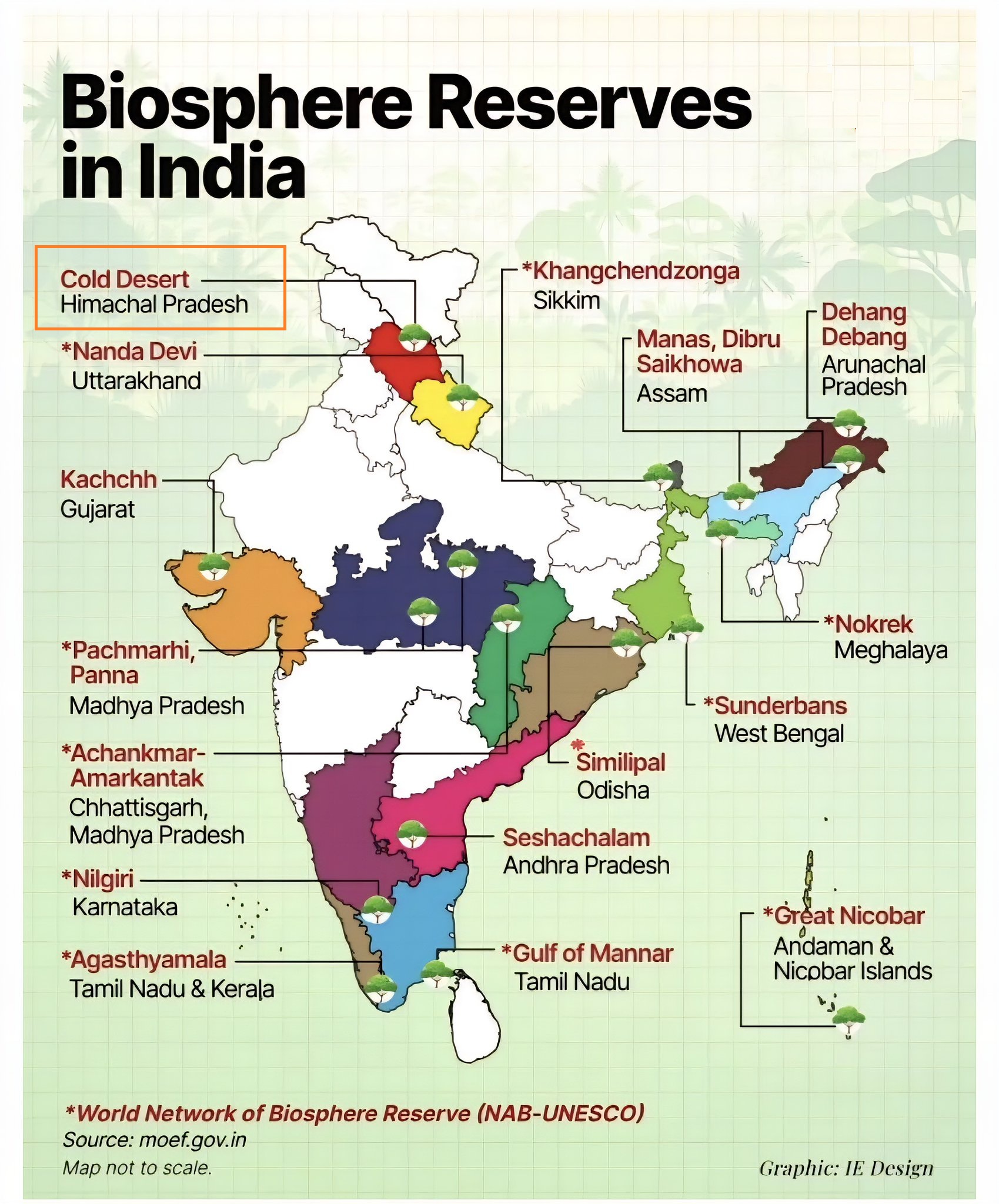
    Cold Desert named India’s 13th UNESCO Biosphere Reserve

    Why in the News?

    UNESCO added India’s Cold Desert Biosphere Reserve (CDBR) to the World Network of Biosphere Reserves (WNBR) under the Man and the Biosphere (MAB) programme.

    With this, India now has 13 UNESCO-recognized biosphere reserves out of 18 designated nationally.

    What are UNESCO Biosphere Reserves?

    • Overview: Sites integrating biodiversity conservation + cultural heritage + sustainable development.
    • Programme: MAB (1971).
    • Designation Criteria:
      • Must include a protected core zone.
      • Must represent a unique biogeographical unit.
      • Involve local communities in conservation.
      • Potential to preserve traditional lifestyles.
    • Functions: Conservation, Development, Logistic Support.
    • Global Network (WNBR): 785 sites, 142 countries (2025); 7.4 million sq. km (~5% Earth’s surface); home to 275 million people.

    About Cold Desert Biosphere Reserve (CDBR):

    • Location: Lahaul–Spiti (Himachal Pradesh), part of Trans-Himalayan biogeographic province.
    • Constituents: Includes Pin Valley National Park, Kibber Wildlife Sanctuary, Chandratal Wetland, Sarchu Plains.
    • Biodiversity:
      • Flora:  732 vascular plants, incl. 30 endemic, 47 medicinal plants (Amchi / Sowa Rigpa).
      • Fauna: Snow leopard (flagship), Tibetan wolf, Himalayan ibex, blue sheep (800+ in Spiti), Himalayan snowcock, golden eagle, bearded vulture.
    • Communities: ~12,000 people; practice yak & goat herding, barley/pea farming, Tibetan herbal medicine, Buddhist monastic councils.
    • Significance: Boosts eco-tourism, climate research, community-led conservation, sustainable livelihoods. Supports climate-resilient development in fragile ecosystems.

    cold desert biosphere reserve

    Biosphere Reserves in India:

    • Total: 18 designated, of which 13 in UNESCO-WNBR (as of 2025).
    • First: Nilgiri BR (1986); Largest: Gulf of Kachchh (Gujarat); Smallest: Dibru-Saikhowa (Assam).
    • Scheme: Launched 1986; implemented by MoEFCC under MAB Programme.
    • Three zones: Each biosphere reserve is organised into-
      1. Core zone (strictly protected),
      2. Buffer zone (limited human activity such as research, grazing, and tourism permitted), and
      3. Transition zone (sustainable human settlements and economic activities allowed).
    • Funding: 90:10 (NE & Himalayan states); 60:40 (others).
    [UPSC 2019] Which of the following are in Agasthyamala Biosphere Reserve?

    Options: (a) Neyyar, Peppara and Shendurney Wildlife Sanctuaries; and Kalakad Mundanthurai Tiger Reserve*

    (b) Mudumalai, Sathyamangalam and Wayanad Wildlife Sanctuaries; and Silent Valley National Park

    (c) Kaundinya, Gundla Brahmeswaram and Papikonda Wildlife Sanctuaries; and Mukurthi National Park

    (d) Kawal and Sri Venkateswara Wildlife Sanctuaries; and Nagarjunasagar-Srisailam Tiger Reserve


  • Internal Security Architecture Shortcomings – Key Forces, NIA, IB, CCTNS, etc.

    National Security Act of 1980

    Why in the News?

    Climate activist Sonam Wangchuk, leading the demand for statehood and Sixth Schedule protections for Ladakh, was detained under the National Security Act (NSA) in Leh.

    About the National Security Act, 1980:

    • Enactment: Passed on 23 September 1980; applicable across India (earlier not in Jammu & Kashmir).
    • Constitutional Basis: Rooted in Article 22(3)(b) (preventive detention permitted) and Article 22(4) (limit of 3 months unless Board approves).
    • Objective: Provides for preventive detention to safeguard defence, national security, public order, foreign relations, and essential supplies/services.
    • Grounds for Detention: Acts prejudicial to India’s defence or security, harming foreign relations, disturbing public order, endangering essential supplies, or regulating foreigners’ presence/expulsion.
    • Authorities Empowered: Centre, States, District Magistrates, and Police Commissioners (if authorised).
    • Duration: Detention up to 12 months; must communicate grounds within 5 days (extendable to 15). A person can be held 10 days without disclosure of charges.
    • Advisory Board: Composed of three persons qualified to be High Court judges. Orders reviewed within 3 weeks; if no sufficient cause exists, release is mandatory.
    • Background: Builds on colonial-era Bengal Regulation III (1818), Rowlatt Acts (1919), post-independence Preventive Detention Act (1950), and MISA (1971, repealed 1977). Reintroduced by Indira Gandhi in 1980.

    Legal Options after Arrest under NSA:

    • Representation to Government: Detainee can file a written representation challenging detention.
    • Advisory Board Review: Must be reviewed within 3 weeks; release ordered if detention unjustified.
    • Judicial Remedies: Writ petition in High Court (Art. 226) or Supreme Court (Art. 32).
    • Revocation: Centre or State may revoke detention anytime.
    • Limitations: No right to lawyer before Advisory Board; grounds may be withheld in “public interest.”
    [UPSC 2023] Consider the following statements:

    1. According to the Constitution of India, the Central Government has a duty to protect States from internal disturbances.

    2. The Constitution of India exempts the States from providing legal counsel to a person being held for preventive detention.

    3. According to the Prevention of Terrorism Act, 2002, the confession of the accused before the police cannot be used as evidence.

    How many of the above statements are correct?

    (a) Only one* (b) Only two (c) All three (d) None


  • ISRO Missions and Discoveries

    India’s first space observatory AstroSat completes 10 years

    Why in the News?

    AstroSat, India’s first multi-wavelength space observatory has completed 10 years on September 28, 2025, boosting India’s role in multi-messenger astronomy.

    What is Multi-Messenger Astronomy?

    • Overview:  A modern approach that uses different cosmic messengers to study the universe, not just light.
    • Messengers:
      • Light (photons): Radio, visible, UV, X-ray, gamma rays.
      • Gravitational waves: From black hole/neutron star mergers.
      • Neutrinos: From nuclear reactions in stars.
      • Cosmic rays: Charged particles from space.
    • Insights: Light shows stellar surfaces; Gravitational waves show collisions; Neutrinos probe stellar interiors.
    • Example: 2017 neutron star collision observed with both light and gravitational waves, proving origin of heavy elements like gold.
    • AstroSat’s Role: Enabled simultaneous UV, optical, and X-ray observations, tracking flares, black holes, and neutron stars.

    What is AstroSat?

    • Overview: India’s first dedicated multi-wavelength space observatory, launched on September 28, 2015 by PSLV-C30 from Sriharikota.
    • Objective: To study celestial sources simultaneously in X-ray, ultraviolet (UV), and optical bands, unlike most single-band missions.
    • Management: Controlled by the Mission Operations Complex (MOX), ISTRAC, Bengaluru.
    • Mission Life: Designed for 5 years but operational even after 10 years.
    • Payloads:
      • UVIT (Ultra Violet Imaging Telescope).
      • LAXPC (Large Area X-ray Proportional Counter).
      • CZTI (Cadmium-Zinc-Telluride Imager).
      • SXT (Soft X-ray Telescope).
      • SSM (Scanning Sky Monitor).

    Its Accomplishments:

    • Extended Life: Surpassed design life; still generating data.
    • Black Hole Studies: Captured 500+ black hole births, advancing high-energy astrophysics.
    • Galaxy Detection: Tracked extreme UV light from a galaxy 9.3 billion light-years away, aiding early universe studies.
    • Gamma-Ray Bursts: 500+ bursts studied by CZTI.
    • Discoveries: Identified rare UV-bright Milky Way stars, thousands of times brighter than the Sun.
    [UPSC 2016] With reference to ‘Astrosat’,’ the astronomical observatory launched by India, which of the following statements is/are correct?

    1. Other than USA and Russia, India is the only country to have launched a similar observatory into space.

    2. Astrosat is a 2000 kg satellite placed in an orbit at 1650 km above the surface of the Earth.

    Select the correct answer using the code given below.

    (a) 1 only (b) 2 only (c) Both 1 and 2 (d) Neither 1 nor 2*


  • Modern Indian History-Events and Personalities

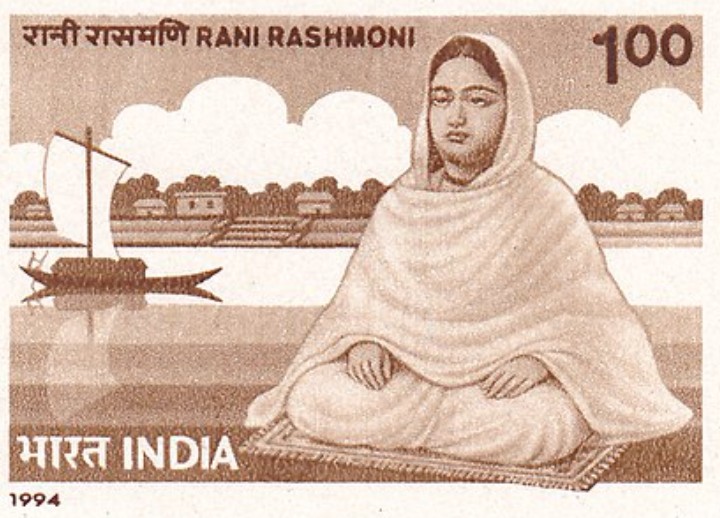
    [pib] Who was Rani Rashmoni (1793-1861)?

    Why in the News?

    The Prime Minister has paid tribute to Rani Rashmoni on her birth anniversary on 28th September.

    Rani Rashmoni (1793-1861)

    Who was Rani Rashmoni (1793–1861)?

    • Overview: A prominent zamindar, businesswoman, philanthropist, and social reformer from 19th-century Bengal.
    • Birth: Born on 28 September 1793 in Halisahar, Bengal.
    • Marriage: Married at the age of 11 to Raja Raj Chandra Das, wealthy zamindar of Janbazar, Kolkata.
    • Leadership: Took charge of the estate and business after her husband’s death in 1836, unusual for women of her time.
    • Reputation: Revered as “Lokmata” (Mother of the People) for her courage, administration, and social commitment.

    Her Contributions:

    • Patronage: Built the Dakshineswar Kali Temple (1847–1855); appointed Sri Ramakrishna Paramahamsa as chief priest despite caste opposition.
    • Social Reforms: Opposed polygamy and child marriage; supported widow remarriage; submitted a draft bill against polygamy to the British.
    • Public Welfare & Infrastructure: Constructed major ghats on the Ganga including Babughat, Ahiritola Ghat, Nimtala Ghat. Funded roads, reservoirs, and pilgrim facilities, such as the road from Subarnarekha River to Puri.
    • Resistance to British Rule: Fought against fishing taxes on Hooghly fishermen by blocking river traffic, compelling British to abolish the tax. Defied British restrictions on Durga Puja processions, preserving traditions.
    • Support for Education & Culture: Donated to the Imperial Library (now National Library of India) and Hindu College (now Presidency University). Established schools for women and marginalized groups.
    [UPSC 2024] Consider the following statements about Raja Ram Mohan Roy:

    I. He possessed great love and respect for the traditional philosophical systems of the East.

    II. He desired his countrymen to accept the rational and scientific approach and the principle of human dignity and social equality of all men and women.

    Which of the statements given above is/are correct?

    (a) I only (b) II only (c) Both I and II* (d) Neither I nor II


  • Port Infrastructure and Shipping Industry – Sagarmala Project, SDC, CEZ, etc.

    [pib] The Indian Ports Act, 2025

    Why in the News?

    The Indian Ports Act, 2025 enacted in August, repealing the age-old Indian Ports Act of 1908 seeks to establish a more modern legal and institutional framework for India’s port sector.

    About Indian Ports Act, 2025:

    • Overview: Enacted in August 2025, replacing the Indian Ports Act of 1908 to modernize India’s port governance.
    • Aim: To integrate port law, tariff regulation, safety, environmental standards, and Centre–State cooperation into one comprehensive legal framework.
    • Vision: Aligns with broader maritime reforms alongside the Merchant Shipping Act, 2025 and Carriage of Goods by Sea Act, 2025.
    • Seeks to position India’s port sector for global competitiveness through transparency, sustainability, and efficient regulation.

    Key Features:

    • Maritime State Development Council (MSDC): Becomes a statutory consultative body to coordinate between Centre and States, advise on national port strategy, tariff transparency, data standards, and connectivity planning.
    • State Maritime Boards: Each coastal state must establish or recognize a board within 6 months to regulate non-major ports, manage licensing, tariffs, development, safety, and environmental compliance.
    • Tariff Setting:
      • Major Ports: Tariffs fixed by Port Authority Boards or Boards of Directors.
      • Non-Major Ports: Tariffs fixed by State Maritime Boards or concessionaires.
      • All tariffs must be electronically published for transparency.
    • Dispute Resolution: States must create Dispute Resolution Committees; appeals go directly to High Courts. Arbitration and ADR allowed.
    • Environmental Norms: Mandates waste management, pollution control, disaster preparedness, ballast water restrictions, and penalties for violations.
    • Applicability: Covers all existing and future ports, navigable channels, and vessels within port limits, except those serving armed forces, Coast Guard, or customs.
    [UPSC 2023] With reference to India, consider the following pairs:

    Port : Well Known as

    1. Kamarajar Port : First major port in India registered as a company

    2. Mundra Port : Largest privately owned port in India

    3. Visakhapatnam Port : Largest container port in India

    How many of the above pairs are correctly matched?

    (a) Only one pair (b) Only two pairs* (c) All three pairs (d) None of the pairs


  • Climate Change Impact on India and World – International Reports, Key Observations, etc.

    Ganga River is drying faster than in 1,300 years: Report

    Why in the News?

    A recent study by researchers from IIT Gandhinagar and the University of Arizona warns that the Ganga River is drying at a rate unseen in more than a millennium.

    About Drying of the Ganga River: New Study Findings

    • Overview: Reconstructed streamflow since 700 AD using tree-ring records (Monsoon Asia Drought Atlas) and hydrological models. Validated against historic droughts and famines such as the Bengal famine.
    • Findings:

      • Between 1991 and 2020, multiple droughts lasted 4–7 years, the rarest in the past 1,300 years.
      • The 2004–2010 drought was the most severe in 1,300 years.
      • Post-1990s drying was 76% more intense than the worst 16th-century drought.
    • Causes:

      • Weaker monsoons from Indian Ocean warming and aerosol pollution.
      • Groundwater over-extraction reducing river baseflow.
      • Land-use change disrupting natural recharge.
    • Climate Models: Most fail to reproduce the drying trend, raising doubts about optimistic rainfall projections.
    • Implications: Severe threats to agriculture, 600 million livelihoods, Bay of Bengal ecosystems, and the 40% GDP share of the basin. Calls for adaptive water management.

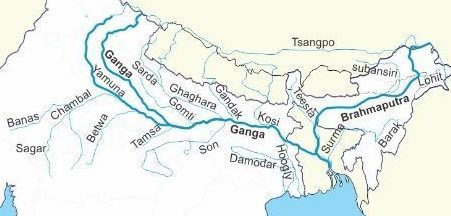
    ganga

    About the Ganga River:

    • Length: ~2,525 km, the longest river in India.
    • Origin: Gangotri Glacier in Uttarakhand at 3,892 m elevation as Bhagirathi.
    • Formation: Named Ganga at Devprayag after meeting Bhagirathi and Alaknanda.
    • Course: Flows through Uttarakhand, Uttar Pradesh, Bihar, Jharkhand, West Bengal before entering Bangladesh as Padma and emptying into the Bay of Bengal through the Sundarbans Delta.
    • Basin: Covers about 8.61 lakh sq. km, which is 26.4% of India’s area.
    • Tributaries:

      • Left bank: Ramganga, Gomti, Ghaghara, Gandak, Burhi Gandak, Koshi, Mahananda.
      • Right bank: Yamuna, Tons, Karamnasa, Sone, Punpun, Falgu, Kiul, Chandan, Ajoy, Damodar, Rupnarayan.
    • Population: Supports over 600 million people, making it the world’s most densely populated river basin.
    • Cultural Importance: Sacred in Indian culture; declared National River in 2008.
    • Economic Role: Central to agriculture, fisheries, and trade, contributing about 40% of India’s GDP.
    • Ecological Significance: Home to snow leopard, elephants, and Ganga dolphin; includes Corbett, Dudhwa, and Sundarbans reserves.
    • Conservation Efforts: Ganga Action Plan (1985) and Namami Gange Programme (2014); persistent issues of pollution, over-extraction, and climate change.
    [UPSC 2024] With reference to the Himalayan rivers joining the Ganga downstream of Prayagraj from West to East, which one of the following sequences is correct?

    Options: (a) Ghaghara – Gomati – Gandak – Kosi

    (b) Gomati – Ghaghara – Gandak – Kosi*

    (c) Ghaghara – Gomati – Kosi – Gandak

    (d) Gomati – Ghaghara – Kosi – Gandak


  • Port Infrastructure and Shipping Industry – Sagarmala Project, SDC, CEZ, etc.

    [27th September 2025] The Hindu Op-ed: Incentives for shipbuilding must include longterm offtake possibilities

    PYQ Relevance:

    [UPSC 2013] Adoption of PPP model for infrastructure development of the country has not been free from criticism. Critically discuss the pros and cons of the PPP model.

    Linkage: India’s shipbuilding revival package too hinges on state support plus private shipowner participation, much like PPP projects, where delays, cost overruns, and weak ancillary ecosystems mirror the criticisms of PPP in other infrastructure sectors. Thus, the editorial’s concerns on viability and long-term offtake directly resonate with PPP model challenges.

    [UPSC 2022] What are the maritime security challenges in India? Discuss the organisational, technical and procedural initiatives taken to improve the maritime security.

    Linkage: Strengthening indigenous shipbuilding directly supports maritime security, as a larger and modern merchant fleet reduces reliance on foreign vessels, ensures secure energy transport, and complements India’s naval and coastal defence preparedness.

    Mentor’s Comment

    The Government’s announcement of a ₹69,725 crore package to revive India’s shipbuilding ecosystem marks a crucial moment for maritime infrastructure. With India building only a handful of merchant ships in the last decade despite global growth, the new push signals both opportunity and urgency. The challenge lies in transforming policy incentives into real competitiveness, something India failed to do under the 2015 package.

    Introduction

    India aspires to emerge as a global maritime power, but its shipbuilding sector has lagged far behind peers like China, Japan, and South Korea. While lucrative defence contracts have kept select shipyards active, India’s merchant ship production remains negligible. The new package seeks to expand capacity to 4.5 million gross tonnage, modernise yards, and create ancillary clusters. However, unless structural inefficiencies are addressed, ranging from delays in turnaround to absence of long-term offtake, the initiative risks becoming another missed opportunity.

    Why in the News

    The government has announced a massive ₹69,725 crore revival package to replace the expiring 2015 shipbuilding scheme. This is significant because, despite subsidies earlier, India produced only about half-a-dozen merchant ships in 10 years, a glaring failure when global yards deliver ships in just a year. The new plan aims to overcome these bottlenecks by upgrading infrastructure, ancillaries, and financing structures. The contrast between global efficiency (3–4 months keel to launch) and India’s 2–3 years turnaround highlights the magnitude of the problem.

    The Scale of the Problem

    1. Negligible merchant shipbuilding: Only half-a-dozen small ships built in the last decade.
    2. Long delays: Turnaround time of 2–3 years in India vs 1 year globally.
    3. Lack of competitiveness: Shipowners avoid Indian yards due to sunk capital and overruns.

    Global Best Practices in Shipbuilding

    1. Korea, Japan, China lead: Prefabricated component blocks welded in large assembly-line yards.
    2. High-capacity cranes: 1,000-tonne cranes enable block movement in foreign shipyards.
    3. Speed & efficiency: Keel-to-waterborne in 3–4 months; full build in about 1 year.

    India’s Bottlenecks

    1. Inadequate infrastructure: Indian yards too small, lack crane capacity and prefab space.
    2. Weak ancillary ecosystem: Absence of robust component manufacturing clusters.
    3. Finance limitations: Benefits of lower interest rates & extended repayment apply only to large vessels.

    Missed Opportunities in Policy Integration

    1. Green fuel projects: Kakinada & Kochi developing production for exports but no linkage with green shipbuilding.
    2. Lack of long-term offtake: Shipowners lack demand visibility; without assured contracts, newbuild investments stall.

    The Way Forward

    1. Cluster-based development: Establish ancillary industries around shipyards for supply chains.
    2. Capacity building: Training institutions on lines of China to create skilled manpower.
    3. Policy synergy: Link green shipping contracts with renewable fuel policies.
    4. Long-term contracts: Use State-owned utilities and oil companies’ chartering needs to guarantee orders.

    Conclusion

    India stands at a decisive moment. A robust maritime ecosystem can secure energy lifelines, generate employment, and project India’s presence as a global power. The ₹69,725 crore package is promising, but unless structural inefficiencies, ancillary gaps, and demand visibility issues are resolved, it risks going the way of the failed 2015 policy. Success lies not merely in incentives but in creating a seamless ecosystem of infrastructure, skills, finance, and guaranteed demand.

    Value Addition

    Data Points and Targets

    1. ₹69,725 crore package: A substantial commitment that signals government seriousness.
    2. Capacity goal: 4.5 million gross tonnage: Puts India on a higher trajectory, though still far below shipbuilding giants like China and South Korea.
    3. Current state: Only half-a-dozen merchant ships built in 10 years, showcasing India’s negligible share in global shipbuilding.

    Policy Continuity and Course Correction

    1. 2015 Shipbuilding Financial Assistance Policy: Provided subsidies and financing incentives but failed to attract private shipowners due to delays and lack of ancillary ecosystem.
    2. 2025 Package: Designed as a replacement, expiring in March 2026 → reflects a policy learning curve and government recognition that capital subsidy alone cannot solve systemic inefficiencies.

    Comparative Insights

    Global benchmarks:

    1. Korea/Japan/China → Keel-to-waterborne in 3–4 months; full build in 1 year.
    2. India → 2–3 years, meaning two additional years of sunk capital for shipowners.
    3. Infrastructure gap: Foreign yards use 1,000-tonne cranes and prefab assembly lines, while Indian yards lack such capacities.

    Linkage with Atmanirbhar Bharat & Make in India

    1. Strategic autonomy: India relies heavily on foreign-built merchant fleets; indigenous shipbuilding aligns with Atmanirbhar Bharat.
    2. Employment multiplier: Shipbuilding is a labour-intensive sector with downstream benefits in steel, electronics, design, and logistics.
    3. Ancillary clusters: Policy push for ecosystem development resonates with the cluster-based growth approach seen in auto and pharma sectors.

    Strategic and Security Relevance

    1. Energy lifelines: India’s crude oil and coal imports (~80% and ~45% dependence respectively) require long-term fleet security.
    2. Green transition: Linkage of shipbuilding with India’s green hydrogen/ammonia exports (Kakinada, Kochi projects) can make India a global hub for green shipping.
    3. Maritime security: A stronger indigenous merchant fleet reduces vulnerability to global freight disruptions and strengthens India’s position in the Indo-Pacific.

    Broader Economic Linkages

    1. Financing ecosystem: Recognising shipbuilding as “infrastructure” lowers cost of credit → aligns with long-term financing reforms.
    2. Trade competitiveness: Owning merchant ships reduces foreign exchange outflow in charter hire and freight payments.
    3. Technology upgradation: Push towards prefab block construction → spinoffs for other infrastructure and defence industries.
  • WTO and India

    India at the Crossroads: Navigating WTO Pressures After China’s SDT Exit

    Introduction

    The World Trade Organisation (WTO) has long been a battleground where developing nations, including India and China, defended their need for lenient subsidy caps, longer compliance timelines, and tariff protections. China’s self-exit from Special and Differential Treatment (SDT) concessions, despite retaining its developing country tag, signals a dramatic shift in the global trade order. For India, which has depended on SDT since its 1995 WTO accession, this development comes amid escalating US trade pressures, Trump-era tariff wars, and growing criticism of India’s subsidy regimes. The question is not only about trade but about food security, farmer livelihoods, and future economic strategy.

    Why is this development significant?

    1. First-time shift: China, the world’s second-largest economy, has for the first time announced it will not seek SDT despite being classified as a developing country.
    2. Sharp contrast: Since 1995, SDT flexibilities have been central to India’s WTO negotiations; China’s withdrawal isolates India’s position.
    3. Big stakes: India subsidises around $50 billion annually to low-income farmers and channels over $40 billion into Minimum Support Price (MSP) schemes, directly impacting 1.4 billion people.
    4. Striking implications: If phased AMS (Aggregate Measurement of Support) cuts are enforced, subsidies may fall by 20–30% per decade, with a 10–15% rural income drop and worsening food insecurity.

    How has India historically benefited from SDT?

    1. Tariff flexibility: Allowed India to impose 100%+ tariffs on sensitive goods such as branded medicines, automobiles, and luxury goods.
    2. Agriculture support: Article 6.2 exemptions for low-income farmers and public distribution schemes like MSP ensured food and livelihood security.
    3. Special treatment: Shielded India from disputes, despite often breaching the 10% subsidy cap under AMS rules.
    4. Trade defence: Enabled India to resist developed country pressures, citing its developing nation status.

    What challenges does India face now?

    1. Coercive reduction: Phased AMS cuts threaten to undermine National Food Security Act (NFSA) provisions.
    2. Malnutrition risk: With 35% of children under five malnourished, subsidy rollback could worsen hunger and inequality
    3. Export vulnerability: Without SDT, India’s MSMEs and farmers face tougher competition in global markets.
    4. US/EU pushback: Developed nations already accuse India of trade distortion, citing examples like MSP and high farm subsidies.

    What options does India have?

    1. Recalibrate subsidies: Shift from price support to income support (direct cash transfers), reducing WTO disputes.
    2. Promote Green Box subsidies: Focus on R&D, extension services, and sustainability programs which are WTO-compliant.
    3. Negotiate transitional safeguards: Demand longer compliance windows to cushion the shift.
    4. Defend digital/data sovereignty: Push for data localisation rights and tiered tariff structures in new trade deals.

    What should India’s strategic plan look like?

    1. Phased tariff liberalisation: Gradually reduce non-essential SDT protections while safeguarding food security.
    2. Boost MSME competitiveness: Use the ONDC (Open Network for Digital Commerce) to integrate small businesses into global e-commerce.
    3. Intellectual property balance: Protect generic drug exports while resisting pressure for stronger IP regimes.
    4. Coalition building: Revive alliances like the G33 to collectively defend agricultural and food security concerns.
    5. Domestic reforms: Enhance farm productivity and diversify exports to reduce dependence on SDT shield.

    Conclusion

    China’s withdrawal from SDT marks a turning point in global trade politics. India now faces mounting pressure to reform its subsidy structure, align with WTO disciplines, and balance food security with competitiveness. The way forward lies not in clinging to outdated protections but in crafting innovative, WTO-compliant support systems that secure farmer welfare while projecting India as a responsible global player. Strategic coalition-building, calibrated reforms, and smart diplomacy will decide whether India emerges weakened or empowered in the new trade order.

    PYQ Relevance

    [UPSC 2018] What are the key areas of reform if the WTO has to survive in the present context of ‘Trade War’, especially keeping in mind the interest of India?

    Linkage: China stepping back from SDT intensifies calls for WTO reforms in subsidy rules, dispute settlement, and fair treatment of developing nations, directly testing India’s ability to safeguard food security and farmer support while pushing for a more equitable trade order.

    Value Addition

    WTO Agreement on Agriculture (AoA) – Article 6.2 Exemptions

    • Provision: Allows developing countries to provide investment subsidies and input subsidies to low-income or resource-poor farmers without it being counted under the AMS cap.
    • India’s Use: India justifies its fertilizer, electricity, and irrigation subsidies under this clause to protect small farmers who form nearly 85% of the farming community.
    • Relevance: Central to defending India’s MSP and food security programs in global negotiations.

    Aggregate Measurement of Support (AMS)

    • Definition: WTO’s metric for calculating trade-distorting farm subsidies (amber box), capped at 10% of the value of production for developing countries.
    • India’s Issue: With large MSP and food procurement under NFSA, India is often accused of breaching this cap. Example – Rice subsidies have repeatedly attracted scrutiny in WTO disputes.
    • Relevance: Reform of AMS rules is India’s key demand in WTO negotiations, arguing current methodology undervalues developing nations’ needs.

    Green Box vs Amber Box Subsidies

    • Amber Box: Trade-distorting subsidies (e.g., MSP, procurement at administered prices).
    • Green Box: Non-trade distorting subsidies like agricultural R&D, extension services, crop insurance, and environmental protection.
    • India’s Position: Heavy reliance on amber box through MSP and PDS; however, India is now trying to expand its green box spending on crop diversification, climate-resilient agriculture, and digital extension services.
    • Relevance: Diversifying support to green box can shield India from WTO disputes while modernising agriculture.

    G33 Coalition

    • About: A group of 47 developing countries led by India, China, and Indonesia, advocating flexibility in agriculture negotiations.
    • India’s Role: Spearheads demands for a ‘Special Safeguard Mechanism’ (SSM) and permanent solution for public stockholding (PSH) of food grains.
    • Relevance: Strengthens India’s negotiating leverage by projecting its subsidy and food stockholding as a collective developing-world concern, not just a national exception.

    National Food Security Act (2013) (NFSA)

    • Provision: Legally entitles 75% of rural and 50% of urban population to subsidised food grains through PDS.
    • Conflict with WTO: Heavy procurement at MSP and distribution under NFSA is seen as trade-distorting. Critics argue this exceeds the 10% AMS cap.
    • Relevance: WTO restrictions on subsidies could directly affect India’s food security safety net covering over 800 million people.

    ONDC (Open Network for Digital Commerce)

    • Concept: A government-backed initiative to democratise e-commerce by creating an open-source, interoperable digital network for buyers and sellers.
    • Trade Defence: Seen as India’s strategic response to global e-commerce giants (Amazon, Walmart-Flipkart), ensuring fair competition for MSMEs.
    • Relevance: In WTO’s ongoing e-commerce negotiations, ONDC is a shield for India to resist pressure for blanket liberalisation of digital trade and data flows, while protecting domestic digital sovereignty.
  • Foreign Policy Watch: India – EU

    India-EU Strategic Agenda

    Introduction

    The India–European Union (EU) relationship has traditionally been overshadowed by India’s closer ties with the U.S. and Russia. However, the release of the EU’s Strategic Agenda for India, ahead of the 2026 leaders’ summit, is a milestone. It lays out a comprehensive framework across five pillars:

    • Economy & Trade
    • Global Connectivity
    • Emerging Technologies
    • Security & Defence
    • People-to-People Ties

    With trade volumes nearing EUR 180 billion (goods + services), EU FDI nearly doubling in five years, and ambitious connectivity projects like the India–Middle East–Europe Corridor, this document represents Europe’s intent to recalibrate its Asia policy with India at the centre.

    Why in the News?

    This development is significant because it is the first time the EU has released a detailed, forward-looking strategic agenda exclusively for India. Traditionally, India–EU ties have been seen as underwhelming compared to India–US or India–Russia ties. But with EUR 120 billion goods trade in 2024 (a 90% increase over the last decade) and the EU emerging as India’s largest trading partner, the stakes have never been higher. What makes this moment compelling is the convergence: Europe seeks predictability away from U.S. uncertainty, and India seeks diversification in partners. The scale of planned cooperation, from AI and nuclear fusion to migration and maritime security, signals that India–EU ties are set to move from rhetoric to institutionalised, multi-sectoral partnership.

    How significant is the economic partnership? (Pillar 1 – Economy & Trade)

    1. Largest trading partner: EU is India’s biggest trade partner; India is EU’s largest in the Global South.
    2. High-value trade: Goods trade at EUR 120 bn in 2024 (+90% in 10 years); services add EUR 60 bn.
    3. FDI surge: EU FDI in India EUR 140 bn in 2023 (doubled in 5 years).
    4. Employment impact: 6,000 European companies directly employ 3 million Indians.
    5. Future goals: Negotiations on FTA, Investment Protection Agreement (IPA), Geographical Indications (GI), and air transport deal.

    How are India and the EU shaping global connectivity? (Pillar 2 – Global Connectivity)

    • Global Gateway: EU’s EUR 300 bn infrastructure programme aligned with India’s MAHASAGAR initiative.
    • EU-India Connectivity Partnership (2021): Framework for joint digital, energy, and transport projects.
    • IMEC (India–Middle East–Europe Economic Corridor): Revival of historical trade routes via rail, maritime, clean hydrogen, and digital infrastructure.
    • Digital corridor: Blue Raman cable (11,700 km) connecting EU–Africa–India with secure, high-speed internet.
    • Green shipping: Joint efforts for sustainable maritime corridors to cut carbon dependency.

    How will cooperation in emerging technologies unfold? (Pillar 3 – Emerging Technologies)

    • Complementary strengths: EU = regulation, research, green tech; India = startups, datasets, frugal innovation.
    • Innovation hubs: Proposed EU-India platforms on critical tech domains.
    • Startup partnership: Collaboration with European Innovation Council & Start-up India.
    • AI applications: Joint work on large language models, multilingual NLP, climate-focused AI.
    • Nuclear cooperation: Euratom-India pact on nuclear safety, waste, security, and fusion energy.

    What are the prospects in security and defence? (Pillar 4 – Security & Defence)

    • Strategic Dialogue (2025): Maritime, cyber, counter-terrorism, and non-proliferation as focus areas.
    • Security of Information Agreement: To enable sharing of classified intelligence.
    • Indo-Pacific role: EU aligning with India as a stabilising force in the region.
    • Naval cooperation: Proposed link between EU Naval Force & Indian Navy in Western Indian Ocean.
    • Defence industry: EU–India Defence Forum under consideration to build resilient supply chains.

    Why are people-to-people ties central to this partnership? (Pillar 5 – People-to-People Ties)

    • Migration scale: 825,000 Indians in EU (2023); largest group with EU Blue Cards.
    • Visa access: 1 million Schengen visas issued in 2024 (many multiple-entry).
    • Education mobility: Focus on Erasmus+ expansion, Union of Skills, recognition of qualifications.
    • Talent mobility: Balancing India’s workforce needs with the EU’s labour market.
    • Strategic timing: EU’s education appeal grows as U.S. under Trump curtails research openness.

    Issues and Complications in India–EU Relations

    1. Stalled Free Trade Agreement (FTA) in the past: Negotiations began in 2007 but stalled due to disagreements over tariff reductions, intellectual property rights, and services access. This history raises doubts about the 2025 deadline.
    2. Agricultural sensitivities: India’s reluctance to open its farm sector clashes with EU’s push for market access and strict sanitary and phytosanitary standards.
    3. Regulatory frictions: The EU’s strict data protection regime (GDPR), climate-linked trade measures like the Carbon Border Adjustment Mechanism (CBAM), and sustainability norms could penalise Indian exports.
    4. Human rights and political conditionalities: The EU often raises concerns about human rights, labour laws, and democratic freedoms, which India perceives as interference in internal matters.
    5. Slow EU decision-making: Unlike bilateral partnerships with the US or Russia, negotiations with the EU are often complicated by the need for consensus among 27 member states.
    6. Strategic divergence: The EU still lacks a coherent Indo-Pacific strategy compared to the Quad or NATO, limiting its security role. India, on its part, prioritises strategic autonomy and may be hesitant to align too closely with Western blocs.

    Way Forward

    1. Conclude the FTA swiftly: India and the EU must avoid past deadlocks by ensuring flexibility on tariff and regulatory issues, especially in agriculture, services, and data protection.
    2. Deepen strategic convergence: Institutionalise the proposed EU–India Security and Defence Partnership, enhancing naval cooperation in the Indo-Pacific, and expanding counter-terrorism and cyber security frameworks.
    3. Leverage connectivity initiatives: Ensure timely execution of flagship projects like IMEC and the Blue Raman digital corridor, aligning them with India’s own initiatives (MAHASAGAR, Sagarmala) to strengthen regional integration.
    4. Balanced tech cooperation: Create safeguards for responsible AI, nuclear safety, and emerging tech to ensure mutual trust while tapping into EU’s regulatory strengths and India’s innovation ecosystem.
    5. Migration and education synergy: Streamline recognition of Indian qualifications in Europe and negotiate mobility partnerships that align with India’s demographic advantage and EU’s labour market shortages.
    6. Sustain political momentum: Regular high-level summits, parliamentary dialogues, and Track-II diplomacy should be pursued to prevent bureaucratic inertia from stalling this ambitious agenda.

    Conclusion

    The India–EU strategic agenda signals a qualitative shift in the partnership, moving beyond transactional trade ties to a multi-pillar strategic convergence. With ambitious timelines, such as concluding the FTA by 2025, and big-ticket projects like IMEC and nuclear fusion cooperation, both sides are investing political capital. For India, this means access to technology, markets, and security partnerships that complement ties with the U.S. and Indo-Pacific allies. For the EU, this provides an anchor in Asia’s fastest-growing economy and a reliable partner in turbulent global politics.

    PYQ Relevance:

    [UPSC 2023] The expansion and strengthening of NATO and a stronger US-Europe strategic partnership works well in India.’ What is your opinion about this statement? Give reasons and examples to support your answer.

    Linkage: The India–EU Strategic Agenda complements a stronger US–Europe partnership by giving India parallel, diversified strategic options in trade, technology, and security; together, they reinforce India’s strategic autonomy while balancing China’s rise. NATO’s strengthening secures Europe’s defence, freeing the EU to deepen economic and technological engagement with India, as seen in IMEC, AI cooperation, and FTA talks.

Join the Community

Join us across Social Media platforms.