💥UPSC 2026, 2027, 2028 UAP Mentorship (March Batch) + Access XFactor Notes & Microthemes PDF

Type: PIB

  • Digital India Initiatives

    [pib] National Internet Exchange of India (NIXI)

    Note4Students

    From UPSC perspective, the following things are important:

    Prelims level: NIXI

    Mains level: Not Much

    Two new Internet Exchange points (IXP) of NIXI were inaugurated at Durgapur and Bardhman.

    What is NIXI?

    • NIXI is a not for profit Organization under section 8 of the Companies Act 2013 and was registered on 19th June 2003.
    • It’s an initiative under Ministry of Electronics and Information Technology (MeitY) vision 1000 days.
    • It aims for spreading the internet infrastructure to the citizens of India through the following activities:
    1. Internet Exchanges through which the internet data is exchanged amongst Internet Service Protocols (ISPs), Data Centers and CDNs.
    2. .IN Registry, managing and operation of .IN country-code domain and .भारत IDN domain for India.
    3. Indian Registry for Internet Names and Numbers (IRINN), managing and operating Internet protocol (IPv4/IPv6).

    Why NIXI?

    • NIXI was set up for peering of Internet Service Protocols (ISPs) among themselves for the purpose of routing the domestic traffic within the country, instead of taking it all the way to US/Abroad.
    • It is thereby resulting in better quality of service (reduced latency) and reduced bandwidth charges for ISPs by saving on International Bandwidth.
    • NIXI is managed and operated on a Neutral basis, in line with the best practices for such initiatives globally.

    Utility of NIXI

    • The launch of these new NIXI internet exchanges will contribute to the enhancement and improvement of Internet and Broadband services at local level and in neighbouring regions.
    • The internet service providers connecting at these points will benefit as their broadband services to their end users will improve, bringing about a change in the lives of the people of the region.
    • It will benefit every sector of the state ranging from health, education, agriculture, startup, and ecosystem to MSMEs & other business verticals.
    • Accessibility and convenience will increase for citizens in terms of availing government benefits and improving quality of life.


    UPSC 2023 countdown has begun! Get your personal guidance plan now! (Click here)

  • Agmark, Hallmark, ISI, BIS, BEE and Other Ratings

    [pib] BIS develops an Standard for ‘Non-electric Cooling Cabinet made of Clay’

    Note4Students

    From UPSC perspective, the following things are important:

    Prelims level: IS 17693: 2022

    Mains level: NA

    Bureau of Indian Standards (BIS), the National Standards Body of India, has developed an Indian Standard, IS 17693: 2022 for ‘non-electric cooling cabinet made of clay’.

    IS 17693: 2022

    • BIS standard specifies the construction and performance requirements of a cooling cabinet made out of clay, which operates on the principle of evaporative cooling.
    • These cabinets may be used to store perishable foodstuff without the need of electricity.
    • This standard helps BIS in fulfilling 6 out of 17 UN Sustainable Development Goals (SDGs) like No poverty, Zero hunger, Gender equality, Affordable and clean energy, Industry, innovation, and infrastructure, and Responsible consumption and production.

    Why such move?

    • Named as ‘Mitticool refrigerator’, Mansukh Bhai Prajapati from Gujarat is the innovator behind the refrigerator which projects an eco-friendly technology.
    • It is a natural refrigerator made primarily from clay to store vegetables, fruits, milk, and also for cooling water.
    • It provides natural coolness to foodstuffs stored in it without requiring any electricity.
    • Fruits, vegetables, and milk can be stored reasonably fresh without deteriorating their quality.

    Back2Basics: Bureau of Indian Standards (BIS)

    • BIS is the National Standards Body of India working under the aegis of the Ministry of Consumer Affairs, Food & Public Distribution.
    • It is established by the Bureau of Indian Standards Act, 1986 which came into effect on 23 December 1986.
    • The organization was formerly the Indian Standards Institution (ISI), set up under the Resolution of the Department of Industries and Supplies in September 1946.
    • The ISI was registered under the Societies Registration Act, 1860.
    • A new Bureau of Indian standard (BIS) Act 2016 has been brought into force with effect from 12 October 2017.
    • The Act establishes the Bureau of Indian Standards (BIS) as the National Standards Body of India.

    UPSC 2023 countdown has begun! Get your personal guidance plan now! (Click here)

  • Innovations in Sciences, IT, Computers, Robotics and Nanotechnology

    [pib] Param Ananta Supercomputer

    Note4Students

    From UPSC perspective, the following things are important:

    Prelims level: Param Ananta Supercomputer

    Mains level: National Supercomputing Mission

    Param Ananta, a state-of the art Supercomputer was commissioned at IIT Gandhinagar.

    Param Ananta

    • Param Ananta is capable of offering peak performance of 838 teraflops.
    • It is a joint initiative of Ministry of Electronics and Information Technology (MeitY) and Department of Science and Technology (DST).
    • This facility is established under Phase 2 of the National Supercomputing Mission (NSM).
    • The system is equipped with a mix of CPU nodes, GPU nodes, High Memory nodes, High throughput storage and high performance Infiniband.
    • The supercomputer will rank behind C-DAC’s Param Siddhi-AI, which as of November 2021 was the 102nd most powerful supercomputer in the world — with peak performance capability of 3.3 petaflops.

    What is a Supercomputer?

    • A supercomputer is a computer with a high level of performance as compared to a general-purpose computer.
    • The performance of a supercomputer is commonly measured in floating-point operations per second (FLOPS) instead of million instructions per second (MIPS).
    • Since 2017, there are supercomputers which can perform over a hundred quadrillion FLOPS (peta FLOPS).
    • Since November 2017, all of the world’s fastest 500 supercomputers run Linux-based operating systems.

    Specific features

    • Param Ananta system is based on Direct Contact Liquid Cooling technology to obtain a high power usage effectiveness and thereby reducing the operational cost.
    • Multiple applications from various scientific domains such as Weather and Climate, Bioinformatics, Computational Chemistry, Molecular Dynamics, Material Sciences, Computational Fluid Dynamics etc. have been installed on the system for the benefit of researchers.
    • This high end computing system will be a great value addition for the research community.

    Back2Basics: National Supercomputing Mission (NSM)

    • NSM is a proposed plan by GoI to create a cluster of seventy supercomputers connecting various academic and research institutions across India.
    • In April 2015 the government approved the NSM with a total outlay of Rs.4500 crore for a period of 7 years.
    • The mission was set up to provide the country with supercomputing infrastructure to meet the increasing computational demands of academia, researchers, MSMEs, and startups by creating the capability design, manufacturing, of supercomputers indigenously in India.
    • Currently there are four supercomputers from India in Top 500 list of supercomputers in the world.

    Aims and objectives

    • The target of the mission was set to establish a network of supercomputers ranging from a few Tera Flops (TF) to Hundreds of Tera Flops (TF) and three systems with greater than or equal to 3 Peta Flops (PF) in academic and research institutions of National importance across the country by 2022.
    • This network of Supercomputers envisaging a total of 15-20 PF was approved in 2015 and was later revised to a total of 45 PF (45000 TFs), a jump of 6 times more compute power within the same cost and capable of solving large and complex computational problems.

    When did India initiate its efforts to build supercomputers?

    • India’s supercomputer program was initiated in the late 1980s, when the United States ceased the export of a Cray Supercomputer due to technology embargos.
    • This resulted in India setting up C-DAC in 1988, which in 1991, unveiled the prototype of PARAM 800, benchmarked at 5 Gflops. This supercomputer was the second-fastest in the world at that time.
    • Since June 2018, the USA’s Summit is the fastest supercomputer in the world, taking away this position from China.
    • As of January 2018, Pratyush and Mihir are the fastest supercomputers in India with a maximum speed of Peta Flops.

    What are the phases of the National Supercomputing Mission?

    Phase I:

    • In the first phase of the NSM, parts of the supercomputers are imported and assembled in India.
    • A total of 6 supercomputers are to be installed in this phase.
    • The first supercomputer that was assembled indigenously is called Param Shivay. It was installed in IIT (BHU) located in Varanasi.
    • Similar systems, Param Shakti (IIT Kharagpur) and Param Brahma (IISER, Pune) were also later installed within the country.
    • The rest will be installed at IIT Kanpur, IIT Hyderabad and Jawaharlal Nehru Institute of Advanced Studies (JNIAS).

    Phase II:

    • The supercomputers that are installed so far are about 60% indigenous.
    • The 11 systems that are going to be installed in the next phase will have processors designed by the Centre for Development of Advanced Computing (C-DAC) and will have a cumulative capacity of 10 petaflops.
    • These new systems are to be constructed more cost-effectively than the previous ones.
    • One of the 11 proposed supercomputers will be installed
    • at C-DAC exclusively for small and medium enterprises so that they can train employees as well as work on supercomputers at a very low cost.

    Phase III:

    • The third phase aims to build fully indigenous supercomputers.
    • The government had also approved a project to develop a cryogenic cooling system that rapidly dispels the heat generated by a computing chip. This will be jointly built together by IIT-Bombay and C-DAC.


    UPSC 2023 countdown has begun! Get your personal guidance plan now! (Click here)

  • UDAY Scheme for Discoms

    [pib] National Open Access Registry (NOAR)

    Note4Students

    From UPSC perspective, the following things are important:

    Prelims level: National Open Access Registry (NOAR)

    Mains level: Not Much

    National Open Access Registry (NOAR) has successfully gone live from 1st May 2022.

    What is NOAR?

    • NOAR is a centralized online platform through which the short-term open access to the inter-state transmission system is being managed in India.
    • It is an integrated platform accessible to all stakeholders in the power sector, including open access customers (both sellers and buyers), power traders, power exchanges, National/Regional/State LDCs and others.
    • The platform provides automation in the workflow to achieve shorter turnaround time for the transactions.
    • NOAR platform also has a payment gateway integrated for making payments related to interstate short-term open access transactions.
    • NOAR platform provides transparency and seamless flow of information among stakeholders of open access.

    Key features

    • Centralized System: Single point electronic platform for all the stakeholders
    • Automated Process: Automated administration process of the short-term open access
    • Common Interface: Interface with the RLDCs scheduling applications and Power Exchanges (s)
    • Payment Gateway: Make payments related to STOA transactions


    UPSC 2023 countdown has begun! Get your personal guidance plan now! (Click here)

  • Promoting Science and Technology – Missions,Policies & Schemes

    [pib] Petascale Supercomputer “PARAM Ganga” established at IIT Roorkee

    Note4Students

    From UPSC perspective, the following things are important:

    Prelims level: Param Ganga, Petaflops

    Mains level: National Supercomputing Mission

    The National Supercomputing Mission (NSM) has now deployed “PARAM Ganga”, a supercomputer at IIT Roorkee, with a supercomputing capacity of 1.66 Petaflops.

    What is a Supercomputer?

    • A supercomputer is a computer with a high level of performance as compared to a general-purpose computer.
    • The performance of a supercomputer is commonly measured in floating-point operations per second (FLOPS) instead of million instructions per second (MIPS).
    • Since 2017, there are supercomputers which can perform over a hundred quadrillion FLOPS (peta FLOPS).
    • Since November 2017, all of the world’s fastest 500 supercomputers run Linux-based operating systems.

    PARAM Ganga

    • PARAM Ganga is designed and commissioned by C-DAC under Phase 2 of the build approach of the NSM.
    • It is based on a heterogeneous and hybrid configuration of Intel Xeon Cascade lake processors, and NVIDIA Tesla V100.
    • There are 312 (CPU+GPU+HM) nodes with a total peak computing capacity of 1.67 (CPU+GPU+HM) PFLOPS performance.
    • The cluster consists of compute nodes connected with the Mellanox (HDR) InfiniBand interconnect network.
    • The system uses the Lustre parallel file system and operating system is CentOS 7.x.

    Back2Basics: National Supercomputing Mission (NSM)

    • NSM is a proposed plan by GoI to create a cluster of seventy supercomputers connecting various academic and research institutions across India.
    • In April 2015 the government approved the NSM with a total outlay of Rs.4500 crore for a period of 7 years.
    • The mission was set up to provide the country with supercomputing infrastructure to meet the increasing computational demands of academia, researchers, MSMEs, and startups by creating the capability design, manufacturing, of supercomputers indigenously in India.
    • Currently there are four supercomputers from India in Top 500 list of supercomputers in the world.

    Aims and objectives

    • The target of the mission was set to establish a network of supercomputers ranging from a few Tera Flops (TF) to Hundreds of Tera Flops (TF) and three systems with greater than or equal to 3 Peta Flops (PF) in academic and research institutions of National importance across the country by 2022.
    • This network of Supercomputers envisaging a total of 15-20 PF was approved in 2015 and was later revised to a total of 45 PF (45000 TFs), a jump of 6 times more compute power within the same cost and capable of solving large and complex computational problems.

    When did India initiate its efforts to build supercomputers?

    • India’s supercomputer program was initiated in the late 1980s, when the United States ceased the export of a Cray Supercomputer due to technology embargos.
    • This resulted in India setting up C-DAC in 1988, which in 1991, unveiled the prototype of PARAM 800, benchmarked at 5 Gflops. This supercomputer was the second-fastest in the world at that time.
    • Since June 2018, the USA’s Summit is the fastest supercomputer in the world, taking away this position from China.
    • As of January 2018, Pratyush and Mihir are the fastest supercomputers in India with a maximum speed of Peta Flops.

    What are the phases of the National Supercomputing Mission?

    Phase I:

    • In the first phase of the NSM, parts of the supercomputers are imported and assembled in India.
    • A total of 6 supercomputers are to be installed in this phase.
    • The first supercomputer that was assembled indigenously is called Param Shivay. It was installed in IIT (BHU) located in Varanasi.
    • Similar systems, Param Shakti (IIT Kharagpur) and Param Brahma (IISER, Pune) were also later installed within the country.
    • The rest will be installed at IIT Kanpur, IIT Hyderabad and Jawaharlal Nehru Institute of Advanced Studies (JNIAS).

    Phase II:

    • The supercomputers that are installed so far are about 60% indigenous.
    • The 11 systems that are going to be installed in the next phase will have processors designed by the Centre for Development of Advanced Computing (C-DAC) and will have a cumulative capacity of 10 petaflops.
    • These new systems are to be constructed more cost-effectively than the previous ones.
    • One of the 11 proposed supercomputers will be installed
    • at C-DAC exclusively for small and medium enterprises so that they can train employees as well as work on supercomputers at a very low cost.

    Phase III:

    • The third phase aims to build fully indigenous supercomputers.
    • The government had also approved a project to develop a cryogenic cooling system that rapidly dispels the heat generated by a computing chip. This will be jointly built together by IIT-Bombay and C-DAC.


    UPSC 2022 countdown has begun! Get your personal guidance plan now! (Click here)

  • Roads, Highways, Cargo, Air-Cargo and Logistics infrastructure – Bharatmala, LEEP, SetuBharatam, etc.

    [pib] Unified Logistics Interface Platform (ULIP)

    Note4Students

    From UPSC perspective, the following things are important:

    Prelims level: Unified Logistics Interface Platform (ULIP)

    Mains level: NA

    National Logistics Portal (NLP) is set to be integrated with Unified Logistics Interface Platform (ULIP) to make the multi-modal logistics ecosystem more efficient.

    Unified Logistics Interface Platform (ULIP)

    • ULIP is designed to enhance efficiency and reduce the cost of logistics in India by creating a transparent, one window platform that can provide real-time information to all stakeholders.
    • It was also emphasized that the solution should have the visibility of multi-modal transport, and all the existing systems of various ministries, governing bodies, and private stakeholders should be integrated with the ULIP system.
    • This will create a National Single Window Logistics Portal which will help in reducing the logistics cost.
    • ULIP will provide real-time monitoring of cargo movement while ensuring data confidentiality with end-to-end encryption, comprehensive reduction in logistic cost resulting in competitive costing.

    There are three key components which are defining the ULIP platform:

    • Integration with existing data sources of ministries: As authorization, compliance and clearance are some of the critical activities of Logistics; the integration with data points of ministries shall enable a holistic view and interlink the handshaking points.
    • Data exchange with private players: To enable the private players, logistics service providers, and industries to utilize the data available with ULIP and at the same time share their data (transportation, dispatch, delivery, etc.) with ULIP, thereby streamlining the processes to bring better efficiency through data exchange.
    • Unified document reference in the supply chain: To enable a single digitized document reference number for all the documentation processes in a single platform.


    UPSC 2022 countdown has begun! Get your personal guidance plan now! (Click here)

  • Defence Sector – DPP, Missions, Schemes, Security Forces, etc.

    [pib] Quantum Key Distribution

    Note4Students

    From UPSC perspective, the following things are important:

    Prelims level: QKD

    Mains level: Secured Communications, QKD

    A joint team of scientists from DRDO and IIT Delhi, for the first time in the country successfully demonstrated Quantum Key Distribution (QKD) link between Prayagraj and Vindhyachal in Uttar Pradesh, a distance of more than 100 kilometers.

    What is QKD Technology?

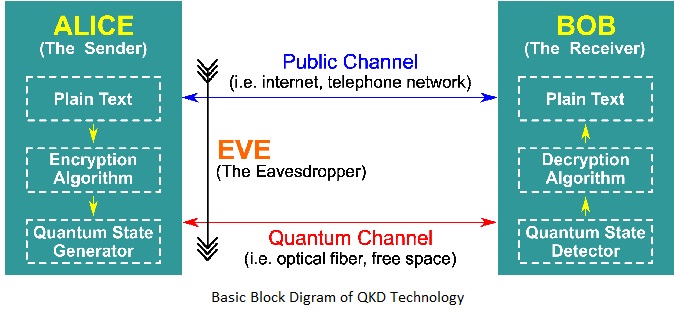
    • Quantum key distribution (QKD) is a secure communication method that implements a cryptographic protocol involving components of quantum mechanics.
    • It enables two parties to produce a shared random secret key known only to them, which can then be used to encrypt and decrypt messages.
    • It gives the ability of the two communicating users to detect the presence of any third party trying to gain knowledge of the key.
    • This is a result of a fundamental aspect of quantum mechanics: the process of measuring a quantum system, in general, disturbs the system.
    • By using quantum superposition or quantum entanglement and transmitting information in quantum states, a communication system can be implemented that detects data leak.

    How does it work?

    • QKD works by transmitting many light particles, or photons, over fiber optic cables between parties.
    • Each photon has a random quantum state, and collectively, the photons sent make up a stream of ones and zeros.
    • This stream of quantum states that make up ones and zeros are called qubits — the equivalent of bits in a binary system.
    • When a photon reaches its receiving end, it will travel through a beam splitter, which forces the photon to randomly take one path or another into a photon collector.
    • The receiver will then respond to the original sender with data regarding the sequence of the photons sent, and the sender will then compare that with the emitter, which would have sent each photon.

    Benefits offered

    • It allows the detection of data leak or hacking because it can detect any such attempt.
    • It also allows the process of setting the error level between the intercepted data in dependence.


    UPSC 2022 countdown has begun! Get your personal guidance plan now! (Click here)

  • Land Reforms

    What is the REWARD Project?

    Note4Students

    From UPSC perspective, the following things are important:

    Prelims level: REWARD Program

    Mains level: Not Much

    The GoI, the State Governments of Karnataka and Odisha, and the World Bank have signed a $115 million for the REWARD Project.

    What is REWARD Program?

    • REWARD stands for Rejuvenating Watersheds for Agricultural Resilience through Innovative Development.
    • The project aims to help national and state institutions adopt improved watershed management practices to help increase farmers’ resilience to climate change, promote higher productivity and better incomes.
    • REWARD is being implemented in three to four Indian States.
    • It is proposed as a 6 years Project.

    Objectives of the project

    • The outcomes are prevention of soil run-off, regeneration of natural vegetation, rainwater harvesting, and recharging of the groundwater table.
    • This enables multi-cropping and the introduction of diverse agro-based activities, which help to provide sustainable livelihoods to the people residing in the watershed area.


    UPSC 2022 countdown has begun! Get your personal guidance plan now! (Click here)

  • Waste Management – SWM Rules, EWM Rules, etc

    [pib] Extended Producers Responsibility on Plastic Packaging

    Note4Students

    From UPSC perspective, the following things are important:

    Prelims level: Extended Producers Responsibility

    Mains level: Need for plastic waste management

    The Union Ministry of Environment, Forest, and Climate Change has notified the Guidelines on Extended Producers Responsibility on plastic packaging under Plastic Waste Management Rules, 2016.

    What is EPR?

    • Extended Producer Responsibility (EPR) means the responsibility of a producer for the environmentally sound management of the product (plastic packaging) until the end of its life.
    • India had first introduced EPR in 2011 under the Plastic Waste (Management and Handling) Rules, 2011, and E-Waste Management and Handling Rules, 2011.

    What are the new EPR rules for Plastic Waste?

    (A) Plastic packaging

    • The new EPR guidelines cover three categories of plastic packaging including:
    1. Rigid plastic
    2. Flexible plastic packaging of a single layer or multilayer (more than one layer with different types of plastic), plastic sheets and covers made of plastic sheet, carry bags (including carrying bags made of compostable plastics), plastic sachet or pouches
    3. Multi-layered plastic packaging has at least one layer of plastic and at least one layer of material other than plastic.
    • It has also specified a system whereby makers and users of plastic packaging can collect certificates — called Extended Producer Responsibility (EPR) certificates — and trade in them.

    (B) Ineligible plastics for EPR

    • Only a fraction of plastic that cannot be recycled will be eligible to be sent for end-of-life disposals such as road construction, waste to energy, waste to oil, and cement kilns.
    • Only methods prescribed by the Central Pollution Control Board will be permitted for their disposal.

    Targets for recycling

    • In 2024, a minimum of 50% of their rigid plastic (category 1) will have to be recycled as will 30% of their category 2 and 3 plastic.
    • Every year will see progressively higher targets and after 2026-27, 80% of their category 1 and 60% of the other two categories will need to be recycled.
    • If entities cannot fulfill their obligations, they will on a “case by case basis” be permitted to buy certificates making up for their shortfall.

    Effects on non-compliance

    • Non-compliance, however, will not invite a traditional fine.
    • Instead, an “environmental compensation” will be levied, though the rules do not specify how much this compensation will be.

    Challenges in mandatory EPR

    There are several challenges faced by both producers and bulk consumers that hinder proactive participation.

    • Consumer awareness: Waste segregation has been the greatest challenge in India owing to the lack of consumer awareness.
    • Lack of compliance: The plastic producers do not wish to engage in the process holistically and take the effort to build awareness.
    • Large-scale involvement: The EPR doesn’t take into account the formalization of informal waste pickers, aggregators, and dismantlers.
    • Lack of recycling infrastructure: These challenges range from lack of handling capacity to illegitimate facilities in the forms of multiple accounting of waste, selling to aggregators, and leakages.

    Way forward

    • Tracking mechanism: Develop tracking mechanisms and provide oversight of waste compliance, in order to ensure that the mechanism of waste disposal is streamlined.
    • Strict enforcement: While enforcement strictness is of paramount importance, it is also vital to build an incentive structure around this to ensure better complicity by the producers.
    • Innovation: The time is ripe for innovators to come up with an alternative for plastics and the strong will of the Government to rid the toxic waste in a sustainable and safe manner.

    Try answering this PYQ:

    Q.In India, ‘extended producer responsibility’ was introduced as an important feature in which of the following?

    (a) The Bio-medical Waste (Management and Handling) Rules, 1998

    (b) The Recycled Plastic (Manufacturing and Usage) Rules, 1999

    (c) The e-Waste (Management and Handling) Rules, 2011

    (d) The Food Safety and Standard Regulations, 2011


    Post your answers here.


    UPSC 2022 countdown has begun! Get your personal guidance plan now! (Click here)

  • Tribes in News

    [pib] Scheme for Economic Empowerment of DNTs (SEED)

    Note4Students

    From UPSC perspective, the following things are important:

    Prelims level: SEED Scheme, DNTs, Criminal Tribes Act

    Mains level: Welfare of the Denotified and Nomadic Tribes

    The Minister of Social Justice and Empowerment has launched the Scheme for Economic Empowerment of De-notified, Nomadic, and Semi Nomadic Communities (SEED).

    Who are the DNTs?

    • The term ‘De-notified Tribes’ stands for all those communities which were once notified under the Criminal Tribes Acts, enforced by the British Raj between l87l and I947.
    • These Acts were repealed after Independence in l952, and these communities were “De-Notified”.
    • The DNTs (of whom most are the medieval period Banjaras) are the most neglected, marginalized, and economically and socially deprived communities.
    • Most of them have been living a life of destitution for generations and still continue to do so with an uncertain and gloomy future.

    SEED Scheme

    • Under the scheme, the government seeks to provide free coaching to students for civil services examinations, competitive exams for admission to professional courses; health insurance; livelihood support and housing.
    • It has been formulated for families having income from all sources of Rs.2.50 lakh or less per annum and not availing any such benefits from similar Scheme of Centre Government or the State Government.
    • The Scheme will be implemented through a portal, developed by the Department of Social Justice & Empowerment.
    • Post verification, the funds will be transferred directly to the beneficiaries in their account.
    • The other implementing agencies are Ministry of Rural Development, National Rural Livelihood Mission (NRLM) and National Health Authority (NHA).

    Components of the scheme

    The Scheme will have the following four components:

    [I] Free Coaching

    • A component of free Coaching for DNT Students has been envisioned for the educational empowerment of these communities.
    • The objective of this component is to enable them to appear in competitive examinations/ admission to professional courses like medicine, engineering, MBA, etc for obtaining an appropriate job in the Public/Private Sector.
    • The selection of the candidates for each course will be based on system generated merit list through the portal.
    • Approximately, 6250 students will be provided free coaching under this component in five years. The total funds spent in the five years will be Rs.50 crore.

    [II] Health Insurance

    • Members of these communities are likely to have little or no access to medical facilities and other benefits available under the mainstream health policies.
    • The primary objective of the scheme is to provide financial assistance to National Health Authority (NHA) in association with State Health Agencies (SHAs).
    • These agencies will provide a health insurance cover of Rs.5 lakhs per family per year for families as per norms of “Ayushman Bharat Pradhan Mantri Jan Arogya Yojana.

     [III] Livelihood Initiatives

    • The decline of traditional occupations of DNT/NT/SNT communities has exacerbated their poverty.
    • A focus to support livelihood generation for these communities is required.
    • The primary objective of the scheme is to provide financial assistance to National Rural Livelihood Mission (NRLM).
    • It would enhance productivity growth in key livelihood sectors for employment generation through investments in institutional support, technical assistance.

    [IV] Financial support for Housing

    • Considering the shortage of houses for DNTs, it has been proposed to earmark a separate outlay for PMAY to support specific importance in providing houses only for DNTs living in rural areas.
    • It is for those who have not taken benefit of the Pradhan Mantri Awas Yojana as SC, ST, OBC and are living below the poverty line.
    • The admissible support is Rs 1.20 lakhs in plains and 1.30 lakhs in hilly areas (per unit assistance).

    Why need such a scheme?

    • DNTs escaped the attention of our developmental framework and thus are deprived of the support unlike Scheduled Castes and Scheduled Tribes.
    • Historically, these communities never had access to private land or homeownership.
    • These tribes used forests and grazing lands for their livelihood and residential use and had “strong ecological connections.
    • Many of them are dependent upon various types of natural resources and carve out intricate ecological niches for their survival.
    • The changes in ecology and environment seriously affect their livelihood options.


    UPSC 2022 countdown has begun! Get your personal guidance plan now! (Click here)