💥UPSC 2027,2028 Mentorship (April Batch) + Access XFactor Notes & Microthemes PDF

Type: Prelims Only

  • Modern Indian History-Events and Personalities

    Evolution of Passports in the Context of ‘Dunki’

    Note4Students

    From UPSC perspective, the following things are important:

    Prelims level: Evolution of Passports

    Mains level: NA

    Passports

    Central Idea

    • A recent Bollywood movie ‘Dunki’ addresses the complex issue of immigration.
    • The term “donkey journey” in the title refers to the perilous routes taken by people lacking legal permits or financial means to immigrate.
    • The film highlights that the current system of visas and passports is a relatively recent development, dating back about 70 years.

    Historical Perspective on Passports

    • Early Forms of Passports: Passports, serving as identity proofs and travel permits, have existed in various forms for centuries.
    • Biblical Reference: The Book of Nehemiah mentions King Artaxerxes of ancient Persia providing letters for safe passage, akin to modern passports.
    • European Documentation: In France and the United Kingdom, systems similar to modern passports were in place well before the French Revolution of 1789.

    The French Passport System

    • Internal and Overseas Passports: France required internal passports for domestic travel and overseas passports for foreign trips.
    • State Control and Regulation: The system was also used to regulate skilled workers and prevent the entry of potential troublemakers.

    Emergence of Modern Passports

    • Shift in India: Before World War I, India did not issue passports, but the British government introduced mandatory passports under the Defence of India Act (1914 to 1918).
    • Global Changes Post-World Wars: The need for secure borders during the World Wars led to a global shift in the perception and use of passports.
    • British Nationality and Status of Aliens Act: This 1914 Act in Britain consolidated laws related to citizenship and introduced modern passport features.

    Standardization and Regulation

    • League of Nations’ Involvement: In 1920, the League of Nations aimed to standardize passport systems, with the British model becoming widely adopted.
    • US Immigration Laws and Passports: The US introduced passport laws in the 1920s, coinciding with immigration restrictions from Asia.

    Public Reception and Cultural Impact

    • Personal Discomfort: In the US and UK, some people found the detailed physical descriptions and identity verification in passports intrusive.
    • Media Attention: The requirement for prominent individuals, including President Woodrow Wilson, to have passports garnered significant media interest.

    Conclusion

    • Beyond Wartime Necessity: Initially intended as a wartime tool, passports have become an integral part of modern citizenship and international travel.
    • Continued Evolution: The history of passports, as explored in ‘Dunki’, reflects the ongoing evolution of identity verification and border control in response to global socio-political changes.
  • Innovations in Sciences, IT, Computers, Robotics and Nanotechnology

    National Mathematics Day: Remembering the legacy of Srinivasa Ramanujan

    Note4Students

    From UPSC perspective, the following things are important:

    Prelims level: Srinivasa Ramanujan (1887-1920)

    Mains level: NA

    Ramanujan

    Central Idea

    • December 22, Ramanujan’s birthday, was declared National Mathematics Day in India by Prime Minister Manmohan Singh in 2012, in recognition of his contributions to the field.

    Srinivasa Ramanujan (1887-1920)

    • Early life: Srinivasa Ramanujan, born on December 22, 1887, in Erode, Tamil Nadu, exhibited extraordinary mathematical abilities from a very young age.
    • Mathematical Mastery by 14: By age 14, Ramanujan had mastered advanced mathematics, excelling in exams and exploring complex topics.
    • Difficulties in Other Subjects: His singular focus on mathematics led to poor grades in other subjects, hindering his academic progress.
    • Scholarship Loss and Hardships: After losing a scholarship at Government College in Kumbakonam due to his academic struggles, Ramanujan faced financial difficulties and limited job opportunities.

    Rise in Mathematical Circles

    • Recognition in Madras: By 1910, Ramanujan had gained recognition in Madras’s mathematical circles for his independent work.
    • Clerical Job and Research: In 1912, he secured a clerical position at the Madras Port Trust, which afforded him time for mathematical research.
    • Collaboration with GH Hardy: In 1913, Ramanujan began a correspondence with British mathematician GH Hardy, leading to an invitation to Cambridge University.

    Collaboration and Achievements in Cambridge

    • Journey to Britain: Ramanujan arrived in Britain in 1914 and joined Trinity College, Cambridge.
    • Work with Hardy and Littlewood: Collaborating with Hardy and JE Littlewood, Ramanujan made significant contributions despite his lack of formal higher education.
    • Prestigious Honors: He was elected to the London Mathematical Society in 1917 and became a Fellow of the Royal Society in 1918, one of the youngest Fellows in its history.

    Health Struggles and Return to India

    • Declining Health: Ramanujan’s health worsened in the cold British climate, leading to a diagnosis of tuberculosis.
    • Final Years: He returned to India in 1919 and passed away on April 26, 1920, at the age of 32.

    Ramanujan’s Enduring Mathematical Legacy

    • High Praise from Hardy: GH Hardy ranked Ramanujan’s natural mathematical talent alongside greats like Euler and Jacobi.
    • Bruce C Berndt’s Analysis: American mathematician Bruce C Berndt extensively studied Ramanujan’s notebooks, emphasizing the depth of his contributions.
    • Impact on Number Theory: Ramanujan’s work, particularly on the partition function, has had a lasting impact on number theory.
    • Broad Contributions: His expertise included areas like continued fractions, Riemann series, elliptic integrals, hypergeometric series, and the zeta function.
    • Legacy of Unpublished Works: Ramanujan left behind notebooks filled with unpublished results that continued to inspire mathematicians for decades.

    Try this question from CSP 2016:

    A recent movie titled “The Man Who Knew Infinity” is based on the biography of-

    (a) S. Ramanujan

    (b) S. Chandrasekhar

    (c) S. N. Bose

    (d) C. V. Raman


    Post your answers here.

  • Global Geological And Climatic Events

    What are Polar Stratospheric Clouds (PSCs)?

    Note4Students

    From UPSC perspective, the following things are important:

    Prelims level: Polar Stratospheric Clouds

    Mains level: NA

    Polar Stratospheric Clouds (PSCs)

    Central Idea

    • Residents in the Arctic have witnessed an extraordinary atmospheric display of Polar Stratospheric Clouds (PSCs).

    Polar Stratospheric Clouds (PSCs)

    Details
    Formation and Location Form in the polar stratosphere at altitudes of 15,000–25,000 meters; common over Antarctica and the Arctic.
    Temperature Conditions Require extremely cold temperatures, typically below −78°C (−108°F).
    Types Type I: Composed of water and nitric acid.

    Type II: Made almost entirely of water ice.

    Role in Ozone Depletion Facilitate chemical reactions that produce chlorine and bromine compounds, leading to ozone destruction.
    Appearance Iridescent, shimmering pastel colors, leading to their nickname “nacreous” or “mother-of-pearl” clouds.
    Observation Visible during twilight, illuminated from below by the Sun.
    Research and Monitoring Studied for impact on ozone depletion and climate change; monitored via satellites and ground stations.
    Environmental Concern Linked to human-made chemicals like CFCs; subject to international regulation like the Montreal Protocol.
    Climate Change Connection Research ongoing into how climate change might affect PSCs’ frequency and distribution.
    Discovery and Study History Observed since the 19th century; their role in ozone depletion understood in the 1980s.
  • Global Geological And Climatic Events

    Volcanic Eruption in Iceland

    Note4Students

    From UPSC perspective, the following things are important:

    Prelims level: Eyjafjallajokull Eruption

    Mains level: Read the attached story

    Iceland

    Central Idea

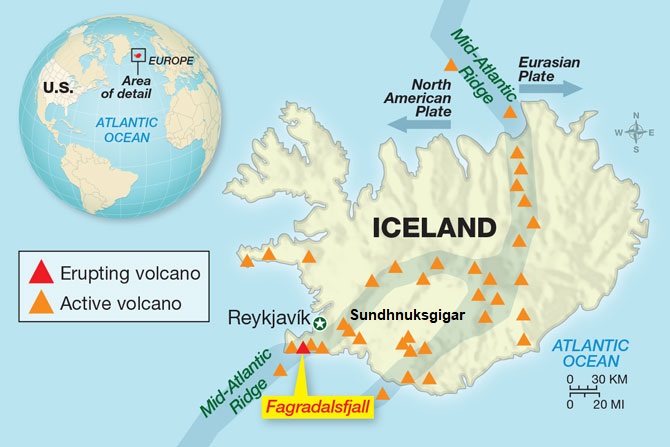
    • A volcanic eruption occurred near Iceland’s capital between Sýlingarfell and Hagafell, near the town of Grindavik on the Reykjanes Peninsula.

    Iceland: ‘Land of Fire and Ice’

    • Geographical Location: Iceland is situated just south of the Arctic Circle in the North Atlantic Ocean.
    • Tectonic Setting: The country lies on the Mid-Atlantic Ridge, marking the boundary between the North American and Eurasian tectonic plates.
    • Unique Landscape: Iceland’s landscape features geysers, glaciers, mountains, volcanoes, and lava fields, housing 33 active volcanoes – the highest number in Europe.
    • Historical Settlement: The first human settlement in Iceland dates back to 874 by Norsemen from Scandinavia, leading to the founding of Reykjavik.

    Recent Volcanic Activity on the Reykjanes Peninsula

    • Historical Dormancy: The Reykjanes Peninsula had not experienced volcanic eruptions for 800 years until recently.
    • Recent Eruptions: The current eruption is the fourth in less than three years on the peninsula, indicating a potential new era of volcanic activity.
    • Eyjafjallajokull Eruption: The last major volcanic event in Iceland that gained global attention was the 2010 eruption of Eyjafjallajokull.
    • Eruption Timeline and Impact: The volcano erupted twice in March and April 2010, spreading an ash cloud across continents and disrupting air traffic on the North Atlantic route for six days – the longest disruption since World War II.
  • Festivals, Dances, Theatre, Literature, Art in News

    Vipassana: the Ancient Buddhist Meditation Practice

    Note4Students

    From UPSC perspective, the following things are important:

    Prelims level: Vipassana

    Mains level: NA

    Central Idea

    • A political leader is set to attend a 10-day Vipassana meditation retreat in Punjab, skipping a summons by the Enforcement Directorate.

    About Vipassana

    Details
    Meaning “To see things as they really are”
    Origin Rooted in Buddhism, attributed to Gautama Buddha, rediscovered and refined by him over 2,500 years ago.
    Historical Roots Preserved in Theravada Buddhism, especially in Myanmar; based on teachings in the “Satipatthana Sutta.”
    Technique Mindfulness or insight meditation focusing on the interconnection between mind and body through physical sensations.
    Practice Observing natural breath and bodily sensations, understanding their impermanent nature, typically taught in 10-day retreats.
    Goal Self-transformation through self-observation, leading to improved mental clarity and insight.
    Non-Sectarian Taught as a universal practice, suitable for all backgrounds.
    Global Spread Popularized globally by S.N. Goenka and others in the 20th century.
    Retreats Offered worldwide, often free of charge, funded by donations.
    Scientific Research Studies show benefits in stress reduction, mental health, and treatment of substance abuse.
    Code of Discipline Includes abstaining from killing, stealing, sexual activity, false speech, and intoxicants during courses.
  • Indian Air Force Updates

    SAMAR Air Defence System

    Note4Students

    From UPSC perspective, the following things are important:

    Prelims level: SAMAR Air Defence System

    Mains level: NA

    samar

    Central Idea

    • In a major success for its in-house design and development efforts, the Indian Air Force has successfully testfired its SAMAR air defence missile system.

    About SAMAR Air Defence System

    Details
    Full Name Surface to Air Missile for Assured Retaliation (SAMAR)
    Type Short-range air-defence system
    Developed By A unit under the IAF’s Maintenance Command
    Range 10–12 km
    Target Low-flying aerial targets
    Speed Missiles operating at a speed range of 2 to 2.5 Mach
    Key Features – Uses existing inventory of Vympel R-73E missiles

    – Twin-turret launch platform

    – Capable of single and salvo modes

    Role in Defence Supplementing IAF’s Akash and SPYDER systems, replacing older systems like Pechora and OSA-AK
    Deployment Not specified

    https://www.hindustantimes.com/videos/world-news/indian-missile-shield-against-potential-threats-from-pak-china-iaf-samar-system-in-action-101702815648038.html

  • Historical and Archaeological Findings in News

    Prehistoric Andriamamelo Cave Art in Madagascar

    Note4Students

    From UPSC perspective, the following things are important:

    Prelims level: Andriamamelo Cave

    Mains level: Read the attached story

    Andriamamelo Cave

    Central Idea

    • Unique prehistoric rock art has been found in the Andriamamelo Cave in western Madagascar, marking a first for the island.
    • It reveals pictorial art with nature, human-like, and animal-like figures.

    Andriamamelo Cave Art: Key Features

    • Beyond Basic Symbols: Previously, Madagascar’s rock art mainly featured basic symbols. The new findings depict more complex scenes and figures.
    • Egyptian Religious Motifs: Some scenes bear a resemblance to motifs from Egypt’s Ptolemaic period (300-30 BCE). Major images hint at Egyptian deities like Horus, Thoth, Ma`at, and Anubis.
    • Ethiopian and Afro-Arab Connections: Symbols and writings suggest cultural links to the Ethiopian and Afro-Arab worlds.
    • Borneo Cave Art Style: The art shares similarities with a two-millennia-old cave art style from Borneo.
    • Depiction of Extinct Animals: The art may depict at least three extinct animals of Madagascar, including a giant sloth lemur, elephant birds, and a giant tortoise.
    • Mysterious M-Figures: The ubiquitous M-shaped symbol matches the Amharic alphabet’s “hawt” and is linked to the concept of the “breath of life” in some Austronesian languages.
    • Absence of Modern and Religious Symbols: The art lacks Christian, Muslim, Hindu symbols, and modern motifs, indicating its ancient origins.

    Dating Challenges and Speculations

    • Difficulty in Dating: Direct dating of the cave art is challenging due to the inorganic nature of the black pigment.
    • Estimated Age: The presence of extinct animals and absence of modern symbols suggest the art could be around 2,000 years old.
    • Potential Historical Evidence: The art might provide insights into who colonized Madagascar and when.
  • Climate Change Impact on India and World – International Reports, Key Observations, etc.

    Outcomes of COP28: Progress and Challenges in Climate Action

    Note4Students

    From UPSC perspective, the following things are important:

    Prelims level: COP28

    Mains level: Read the attached story

    COP28

    Central Idea

    • Annual Climate Summit: The 28th session of the Conference of the Parties (COP28) was held in Dubai, under the United Nations Framework Convention on Climate Change (UNFCCC).
    • High Expectations: There were significant expectations for countries to take decisive steps in addressing the climate crisis.
    • Key Focus Areas: Discussions at COP28 revolved around mitigation, adaptation, finance, and the differing responsibilities of developed and developing nations.

    Early Developments: Loss and Damage Fund

    • COP27 Agreement Follow-up: After agreeing to create the ‘Loss and Damage’ (L&D) fund at COP27, COP28 focused on its operationalization.
    • Funding Challenges: Despite the need for substantial funding, contributions have been limited, with the U.S. pledging only $17.5 million.
    • Administration and Access Concerns: The World Bank’s role in overseeing the fund raised issues regarding access, legal autonomy, and responsiveness to emergencies.

    Emissions Reduction and Energy Transition

    • Global Stocktake Findings: The first global stocktake (GST) assessed progress towards the Paris Agreement goals.
    • Fossil Fuel Transition: A commitment was made to move away from fossil fuels in energy systems, to triple renewable and nuclear energy capacity by 2030.
    • Continued Use in Other Sectors: Fossil fuels remain in use in sectors like plastics, transport, and agriculture.
    • Transitional Fuels and Climate Justice: The acceptance of natural gas as a transitional fuel was seen as a compromise on climate justice.

    Financial Mechanisms for Climate Action

    • Developed Nations’ Responsibility: The GST framework emphasized the leading role of developed nations in climate finance.
    • Private Sector Involvement: The role of private investment in addressing financial gaps was acknowledged.
    • Green Finance Initiatives: New mechanisms, including a $3.5 billion boost to the Green Climate Fund, were established to support sustainable practices in developing countries.

    India’s Stance on Climate and Health Declaration

    • UAE Declaration on Climate and Health: This declaration, partnered with the World Health Organisation, was signed by 123 countries but not by India.
    • India’s Concerns: India refrained from signing due to potential impacts on its growing healthcare infrastructure and the need to prioritize healthcare requirements.

    Global Methane Pledge and India’s Position

    • Renewed Focus on Methane: The pledge received attention with over $1 billion in new grants for methane reduction projects.
    • India’s Non-Participation: India did not sign the pledge, focusing instead on carbon dioxide emissions and considering the livelihood implications of methane reduction in agriculture.

    Assessment of COP28: Achievements and Shortcomings

    • Positive Developments: Notable achievements included the climate and health declaration, emphasis on nature-based solutions, and commitments to sustainable food systems.
    • Contentious Issues: Disagreements persisted over fossil-fuel subsidies, the role of the World Bank in the L&D fund, and private sector engagement in climate action.
    • Mixed Outcomes: While renewable energy targets marked progress, unresolved issues regarding L&D, fossil fuel use, and transitional fuels indicated ongoing challenges.

    Conclusion

    • Balancing Act: COP28 showcased the intricate balance between ambitious climate goals and the practical realities of economic and social factors.
    • Continued Dialogue: The outcomes reflect the need for ongoing dialogue and collaboration to address the multifaceted aspects of climate change and sustainable development.
  • Interstate River Water Dispute

    In news: Mullaperiyar Dam

    Note4Students

    From UPSC perspective, the following things are important:

    Prelims level: Mullaperiyar Dam

    Mains level: Not Much

    Mullaperiyar Dam

    Central Idea

    • Tamil Nadu cancelled the decision to open the spillway shutters of Mullaperiyar dam after a lull in rainfall and reduced inflow of water to the dam.

    Do you know?

    The Mullaperiyar dam is located in Kerala on the river Periyar but is operated and maintained by the neighbouring state of Tamil Nadu.

    John Pennycuick (the architect of this dam) sold his family property in England to mobilize money to fund the project! People of the region fondly name their children under his name a remark of reverence.

    Mullaperiyar Dam

    • It is a masonry gravity dam on the Periyar River in Kerala.
    • It is located on the Cardamom Hills of the Western Ghats in Thekkady, Idukki District.
    • It was constructed between 1887 and 1895 by John Pennycuick (who was born in Pune) and also reached in an agreement to divert water eastwards to the Madras Presidency area.
    • It has a height of 53.6 m (176 ft) from the foundation, and a length of 365.7 m (1,200 ft).

    Operational issue

    • The dam is located in Kerala but is operated and maintained by Tamil Nadu.
    • The catchment area of the Mullaperiyar Dam itself lies entirely in Kerala and thus not an inter-State river.
    • In November 2014, the water level hit 142 feet for first time in 35 years.
    • The reservoir again hit the maximum limit of 142 feet in August 2018, following incessant rains in the state of Kerala.
    • Indeed, the tendency to store water to almost the full level of reservoirs is becoming a norm among water managers across States.

    Dispute: Control and safety of the dam

    • Supreme court judgment came in February 2006, has allowed Tamil Nadu to raise the level of the dam to 152 ft (46 m) after strengthening it.
    • Responding to it, the Mullaperiyar dam was declared an ‘endangered’ scheduled dam by the Kerala Government under the disputed Kerala Irrigation and Water Conservation (Amendment) Act, 2006.
    • For Tamil Nadu, the Mullaperiyar dam and the diverted Periyar waters act as a lifeline for Theni, Madurai, Sivaganga, Dindigul and Ramnad districts.
    • Tamil Nadu has insisted on exercising the unfettered colonial rights to control the dam and its waters, based on the 1886 lease agreement.

    Rule of Curve issue

    • A rule curve or rule level specifies the storage or empty space to be maintained in a reservoir during different times of the year.
    • It decides the fluctuating storage levels in a reservoir.
    • The gate opening schedule of a dam is based on the rule curve. It is part of the “core safety” mechanism in a dam.
    • The TN government often blames Kerala for delaying the finalization of the rule curve.

    Back2Basics: Periyar River

    • The Periyar is the longest river in the state of Kerala with a length of 244 km.
    • It is also known as ‘Lifeline of Kerala’ as it is one of the few perennial rivers in the state.
    • It originates from Sivagiri hills of Western Ghats and flows through the Periyar National Park.
    • The main tributaries of Periyar are Muthirapuzha, Mullayar, Cheruthoni, Perinjankutti.
  • Electoral Reforms In India

    14th Amendment of US Constitution and Its Implications

    Note4Students

    From UPSC perspective, the following things are important:

    Prelims level: 14th Amendment of US Constitution

    Mains level: Comparison of Indian Constitution

    Central Idea

    • The US top court ordered the removal of former President Donald Trump from the ballot for the next Presidential elections.
    • The decision was based on Section 3 of the Fourteenth Amendment of the US Constitution, relating to Trump’s alleged role in the January 6, 2021, attacks on the US Capitol.

    14th Amendment of US Constitution

    Details
    Ratification Date July 9, 1868
    Primary Purpose To address civil rights issues following the Civil War, particularly regarding former slaves.
    Key Clauses Citizenship Clause: Citizenship for all persons born or naturalized in the U.S.

    Due Process Clause: Fair legal process required for all citizens.

    Equal Protection Clause: Equal legal protection for all citizens.

    Historical Context Response to post-Civil War issues, including the Black Codes in Southern states.
    Major Significance – Extended Bill of Rights protections to state actions.

    – Foundation for numerous civil rights advancements and Supreme Court decisions.

    Notable Cases – Brown v. Board of Education (1954) for desegregation

    – Roe v. Wade (1973) for abortion rights

    Why in news? Section 3 disqualifies anyone who, having taken an oath to support the Constitution, engages in insurrection or rebellion against the same, or aids its enemies, from holding any office, civil or military, in the United States.

    Applied to Donald Trump

    Impact on Federalism Altered the balance of power between the federal government and states, especially in civil rights and liberties.

    Similar Provisions in India

    Details
    Equal Protection Clause Article 14: Indian Constitution guarantees “equality before the law” and “equal protection of the laws” within the territory of India.
    Citizenship Clause Articles 5 to 11: Deal with aspects of citizenship in India, including citizenship by birth, descent, registration, naturalization, and incorporation of territory.
    Due Process Clause Article 21: Provides protection of life and personal liberty, stating “No person shall be deprived of his life or personal liberty except according to a procedure established by law.”
    Protection of Civil Liberties Article 19: Ensures the protection of certain rights regarding freedom of speech, assembly, etc.
    Prohibition of Discrimination Article 15: Prohibits discrimination on grounds of religion, race, caste, sex, or place of birth.
    Disqualification for Public Office Representation of the People Act, 1951 (Sections 8, 9, 10, 11): Lays out disqualifications for membership of Parliament and State Legislatures due to criminal convictions, corrupt practices, and certain office-of-profit positions.