💥UPSC 2026, 2027, 2028 UAP Mentorship (March Batch) + Access XFactor Notes & Microthemes PDF

Type: Prelims Only

  • Zoonotic Diseases: Medical Sciences Involved & Preventive Measures

    What is Hybrid Immunity?

    Note4Students

    From UPSC perspective, the following things are important:

    Prelims level: Hybrid immunity

    Mains level: Not Much

    A study has shown that a combination of natural infection with a single dose of vaccine provides greater immunity than either natural infection without vaccination or full vaccination in individuals.

    What is the new study?

    • People without prior infection but fully vaccinated with the Pfizer or AstraZeneca vaccine showed a decline in neutralising antibodies over a period of three to seven months.
    • But the decline was much less in vaccinated people with prior infection.
    • People with hybrid immunity had a higher and more durable neutralising antibody response.
    • The hybrid immunity offers stronger protection than just infection or full vaccination alone.

    What is Hybrid Immunity?

    • It is natural immunity from an infection combined with the immunity provided by the vaccine.
    • The immunological advantage from hybrid immunity arises mostly from memory B cells.

    What are memory B cells?

    • In immunology, a memory B cell (MBC) is a type of B lymphocyte that forms part of the adaptive immune system.
    • B lymphocytes are the cells of the immune system that make antibodies to invade pathogens like viruses.
    • They form memory cells that remember the same pathogen for faster antibody production in future infections.

    How do they assist hybrid immunity?

    • While the bulk of antibodies after infection or vaccination decline after a short while, the memory B cells get triggered on subsequent infection or vaccination.
    • The memory B cells triggered by infection and those triggered by vaccination have different responses to viruses.
    • Infection and vaccination expose the spike protein to the immune system in vastly different ways.
    • After full vaccination, antibodies produced by natural infection continued to grow in potency and their breadth against variants for a year after infection.
    • Unlike after vaccination, the memory B cells formed after natural infection are more likely to make antibodies that block immune-evading variants.


    UPSC 2022 countdown has begun! Get your personal guidance plan now! (Click here)

  • Animal Husbandry, Dairy & Fisheries Sector – Pashudhan Sanjivani, E- Pashudhan Haat, etc

    [pib] India’s First Banni Buffalo IVF Calf Born

    Note4Students

    From UPSC perspective, the following things are important:

    Prelims level: Banni Buffalo, IVF

    Mains level: Not Much

    With the birth of first IVF calf of a Buffalo breed namely Banni in the country, India’s Ovum Pick-Up (OPU) – IVF work has reached to next level.

    Banni Buffalo

    • Banni buffaloes are also known as “Kutchi” or “Kundi”.
    • The breeding tract includes the Banni area of Kutchchh district of Gujarat.
    • The breed is maintained mostly by Maldharis under locally adapted typical extensive production system in its breeding tract.

    What makes them unique?

    • Banni buffaloes are trained to graze on Banni grassland during night and brought to the villages in the morning for milking.
    • This traditional system of buffalo rearing has been adapted to avoid the heat stress and high temperature of the day.
    • It has unique qualities of adaptation such as the ability to survive water scarcity conditions, to cover long distances during periods of drought and disease resistance.

    Indigenous buffalo breeds in India

    S. No. Breed Breeding state
    1 Banni Gujarat
    2 Bargur Tamil Nadu
    3 Bhadawari Uttar Pradesh and Madhya Pradesh
    4 Chhattisgarhi Chhattisgarh
    5 Chilika Odisha
    6 Gojri Himachal Pradesh and Punjab
    7 Jaffarabadi Gujarat
    8 Kalahandi Odisha
    9 Luit (Swamp) Assam
    10 Marathwadi Maharashtra
    11 Mehsana Gujarat
    12 Murrah Haryana and Delhi
    13 Nagpuri Maharashtra
    14 Nili Ravi Punjab
    15 Pandharpuri Maharashtra
    16 Surti Gujarat
    17 Toda Tamil Nadu


    UPSC 2022 countdown has begun! Get your personal guidance plan now! (Click here)


    Back2Basics: In-vitro fertilization (IVF)

    • IVF is a type of assisted reproductive technology used for infertility treatment and gestational surrogacy.
    • A fertilised egg may be implanted into a surrogate’s uterus, and the resulting child is genetically unrelated to the surrogate.
    • Some countries have banned or otherwise regulate the availability of IVF treatment, giving rise to fertility tourism.
    • Restrictions on the availability of IVF include costs and age, in order for a woman to carry a healthy pregnancy to term.
    • IVF is generally not used until less invasive or expensive options have failed or been determined unlikely to work.

    IVF process

    • IVF is a process of fertilization where an egg is combined with sperm outside the body, in vitro (“in glass”).
    • The process involves monitoring and stimulating a female ovulatory process, removing an ovum or ova (egg or eggs) from the female ovaries and letting sperm fertilise them in a liquid in a laboratory.
    • After the fertilised egg (zygote) undergoes embryo culture for 2–6 days, it is implanted in the same or another female uterus, with the intention of establishing a successful pregnancy.


    UPSC 2022 countdown has begun! Get your personal guidance plan now! (Click here)

  • Modern Indian History-Events and Personalities

    [pib] Ramappa – Kakatiya Rudreshwara Temple

    Note4Students

    From UPSC perspective, the following things are important:

    Prelims level: Ramappa Temple, UNESCO Heritage sites

    Mains level: Ancient temple architecture

    The Union Minister for Culture, Tourism has unveiled the UNESCO World Heritage Listing plaque at Ramappa – Kakatiya Rudreshwara Temple in Palampet.

    Rudreswara Temple

    • The Rudreswara temple was constructed in 1213 AD during the reign of the Kakatiya Empire by Recharla Rudra, a general of Kakatiya king Ganapati Deva.
    • It is also known as the Ramappa temple, after the sculptor who executed the work in the temple for 40 years.
    • The main temple is flanked by the collapsed structures of the Kateshwarayya and Kameshwarayya temples in Palampet, about 220 km from Hyderabad.
    • An inscription dates the temple to 1135 Samvat-Saka on the eighth day of Magha (January 12, 1214).
    • It is India’s 39th UNESCO World Heritage Site. (Total 40 in number after Dholavira).

    Its architecture

    • The temple complexes of Kakatiyas have a distinct style, technology, and decoration exhibiting the influence of the Kakatiyan sculptor.
    • The temple stands on a 6 feet high star-shaped platform with walls, pillars, and ceilings adorned with intricate carvings that attest to the unique skill of the Kakatiyan sculptors.
    • The foundation is built with the “sandbox technique”, the flooring is granite, and the pillars are basalt.
    • The lower part of the temple is red sandstone while the white gopuram is built with light bricks that reportedly float on water.
    • European merchants and travelers were mesmerized by the beauty of the temple and one such traveler had remarked that the temple was the “brightest star in the galaxy of medieval temples of the Deccan”.

    Surviving through ages

    • According to the temple priest, some of the iconography on the temple was damaged during the invasion of Malik Kafur in 1310.
    • Treasure hunters vandalized the rest.
    • But the biggest test for the temple was an earthquake in the 17th century (one of the biggest was that of 7.7-8.2-magnitude on June 16, 1819).

    Answer this PYQ in the comment box:

    Q.Which one of the following was a very important seaport in the Kakatiya kingdom? (CSP 2017)

    (a) Kakinada

    (b) Motupalli

    (c) Machilipatnam (Masulipatnam)

    (d) Nelluru


    Post your answers here.

    Back2Basics: UNESCO World Heritage Sites

    • A World Heritage Site is a landmark or area, selected by the UN Educational, Scientific and Cultural Organization (UNESCO) for having cultural, historical, scientific, or other forms of significance, which is legally protected by international treaties.
    • The sites are judged to be important for the collective and preservative interests of humanity.
    • To be selected, a WHS must be an already-classified landmark, unique in some respect as a geographically and historically identifiable place having special cultural or physical significance (such as an ancient ruin or historical structure, building, city, complex, desert, forest, island, lake, monument, mountain, or wilderness area).
    • It may signify a remarkable accomplishment of humanity, and serve as evidence of our intellectual history on the planet.
    • The sites are intended for practical conservation for posterity, which otherwise would be subject to risk from human or animal trespassing, unmonitored/uncontrolled/unrestricted access, or threat from local administrative negligence.
    • The list is maintained by the international World Heritage Program administered by the UNESCO World Heritage Committee, composed of 21 “states parties” that are elected by their General Assembly.

    UNESCO World Heritage Committee

    • The World Heritage Committee selects the sites to be listed as UNESCO World Heritage Sites, including the World Heritage List and the List of World Heritage in Danger.
    • It monitors the state of conservation of the World Heritage properties, defines the use of the World Heritage Fund, and allocates financial assistance upon requests from States Parties.
    • It is composed of 21 states parties that are elected by the General Assembly of States Parties for a four-year term.
    • India is NOT a member of this Committee.


    UPSC 2022 countdown has begun! Get your personal guidance plan now! (Click here)
  • Genetically Modified (GM) crops – cotton, mustards, etc.

    What are Non-Transgenic Gene Editing techniques?

    Note4Students

    From UPSC perspective, the following things are important:

    Prelims level: Non-Transgenic Gene Editing

    Mains level: Hazards of using GMO crops

    The Centre is yet to decide on a research proposal from scientists which would allow plants to be genetically modified without the need for conventional transgenic technology.

    What is Genome Editing?

    • Genome editing (also called gene editing) is a group of technologies that give scientists the ability to change an organism’s DNA.
    • These technologies allow genetic material to be added, removed, or altered at particular locations in the genome.
    • Several approaches to genome editing have been developed.

    Techs for Genome Editing

    The core technologies now most commonly used to facilitate genome editing are

    1. Clustered regularly interspaced short palindromic repeats (CRISPR)- associated protein 9 (Cas9)
    2. Transcription activator-like effector nucleases (TALENs)
    3. Zinc-finger nucleases (ZFNs)
    4. Homing endonucleases or meganucleases

    Newer technologies

    • The Institute has now moved to newer technologies such as Site-Directed Nuclease (SDN) 1 and 2.
    • They aim to bring precision and efficiency into the breeding process using gene-editing tools such as CRISPR, whose developers won the Nobel Prize for Chemistry in 2020.

    About CRISPR

    • CRISPR-Cas9 was adapted from a naturally occurring genome editing system in bacteria.
    • The bacteria capture snippets of DNA from invading viruses and use them to create DNA segments known as CRISPR arrays.
    • The CRISPR arrays allow the bacteria to “remember” the viruses (or closely related ones).
    • If the viruses attack again, the bacteria produce RNA segments from the CRISPR arrays to target the viruses’ DNA.
    • The bacteria then use Cas9 or a similar enzyme to cut the virus DNA apart, which disables the virus.
    • This method is faster, cheaper, more accurate, and more efficient than other existing genome editing methods.

    What is Non-Transgenic Gene Editing?

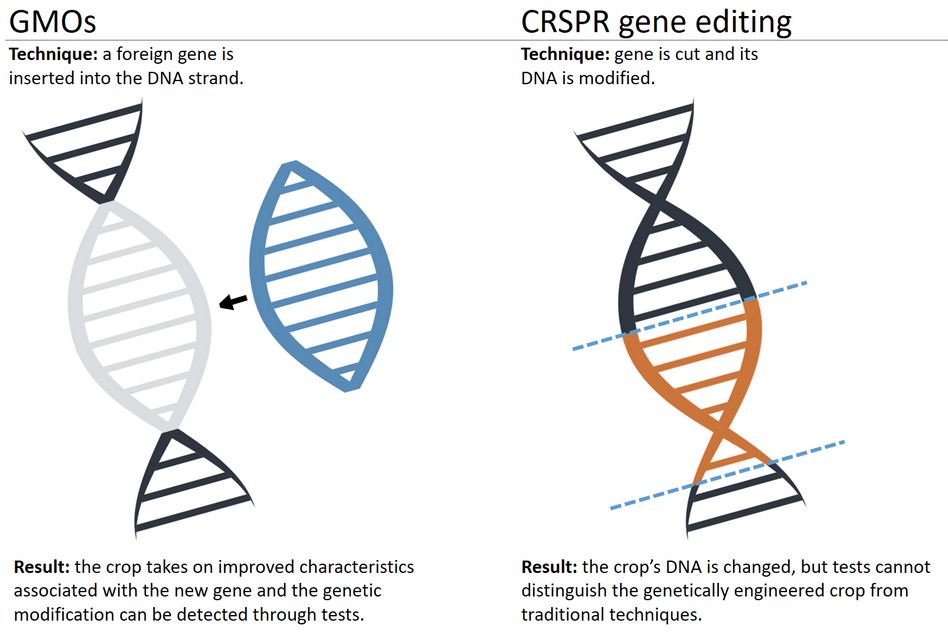
    • Unlike the older GM technology which involves the introduction of foreign DNA, the new proposal involves the use of gene editing tools to directly tweak the plant’s own genes instead.
    • It does not involve inserting any foreign DNA.

    Use in India

    • Scientists at the Indian Agricultural Research Institute (IARI) are in the process of developing resilient and high-yield rice varieties using such gene editing techniques.
    • However, this proposal has been pending with the Genetic Engineering Appraisal Committee (GEAC) for almost two years.

    Why need such technique?

    • Similar to natural mutation: But in this case, this protein is right there in the plant, and is being changed a little bit, just as nature does through mutation.
    • Faster and cheaper: It is much faster and far more precise than natural mutation or conventional breeding methods which involve trial and error and multiple breeding cycles.
    • Safe for consumption: When a protein comes from an outside organism, then you need to test for safety.
    • Pathbreaking: It is potentially a new Green Revolution.

    No approval issues

    • The SDN 1 and SDN 2 categories of genome-edited plants do not contain any foreign DNA when they are taken to the open field trials.
    • The US, Canada, Australia and Japan are among the countries which have already approved the SDN 1 and 2 technologies as not akin to GM.
    • So, such varieties of rice can be exported without any problem.
    • The European Food Safety Authority has also submitted its opinion that these technologies do not need the same level of safety assessment as conventional GM.


    UPSC 2022 countdown has begun! Get your personal guidance plan now! (Click here)

  • Innovations in Biotechnology and Medical Sciences

    Punjab farmers create Bio-Enzymes from Kinnow

    Note4Students

    From UPSC perspective, the following things are important:

    Prelims level: Bio-Enzymes

    Mains level: Not Much

    Some farmers in Punjab, especially in the Kinnow belt, have started making Bio-Enzymes (BEs) from this waste fruit — peel and ‘D’ grade, very small kinnows.

    What is a Kinnow?

    • The ‘Kinnow’ is a high yield citrus fruit cultivated extensively in the wider Punjab region of India and Pakistan.
    • It is a year-long duration crop and the main harvesting period is from November-end to March.
    • It looks similar to orange but is smaller in size.

    Agricultural significance of Kinnows

    • Fallen fruit is a major challenge for kinnow farmers in the state as one needs to dig up small pits to bury them, otherwise the fallen fruit rot and invite a fly attack on the healthy fruit still on the plants.
    • But now, some farmers are using this waste kinnow to improve the pH level and soil fertility of their land by making BEs from this waste fruit.

    What are Bio-Enzymes?

    • Chemically, the Bio Enzymes are a mixture of complex organic substances such as proteins, salts and other materials that are by-products of the bacteria/yeast.
    • They produced through fermentation of organic waste including various fruits, vegetable peels and flowers, by mixing in sugar, jaggery/molasses and water.
    • BE’s also have a lot of usage in our daily lives. They can be used as natural cleansers.

    Benefits offered by BEs

    • BEs have a lot of good microbes and one of the major methods which helps overall improvement of our ecology.
    • It helps in mitigating the imbalance occurred due to overuse of chemicals, in our soil, air and water.
    • In a state like Punjab where water table is depleting fast and water contamination is also major issue, BEs can bring the soil back to life.
    • It helps in better water recharging and also stops the contamination of water by improving the health of soil.


    UPSC 2022 countdown has begun! Get your personal guidance plan now! (Click here)

  • International Space Agencies – Missions and Discoveries

    What is the Lucy Mission?

    Note4Students

    From UPSC perspective, the following things are important:

    Prelims level: Lagrange Points, Lucy Mission

    Mains level: Not Much

    The NASA has launched Lucy, the spacecraft on a 12-year cruise to look back into the origins of the solar system through Trojans.

    Lucy Mission

    • Lucy will fly by eight Jupiter asteroids—seven Trojans and one main-belt asteroid — over the next 12 years.
    • It is NASA’s first single spacecraft mission in history to explore so many different asteroids.
    • Lucy will run on solar power out to 850 million kilometers away from the Sun.
    • This makes it the farthest-flung solar powered spacecraft ever, according to NASA.

    What is Jupiter Trojan Asteroids?

    • Simply known as Trojans, they are a large group of asteroids that share Jupiter’s orbit around the Sun.
    • Thousands of such asteroids exist in a gravitationally stable space.
    • The swarms lead and follow the planet Jupiter along its orbit around the Sun.

    What exactly are Trojans?

    • Lucy’s Trojan destinations are trapped near Jupiter’s Lagrange (L) points, which are gravitationally stable locations — it is where the gravity from the Sun and from Jupiter cancel each other out.
    • This means their orbits are stable and the Trojans are trapped in the space between.
    • This also means that asteroids are as far away from Jupiter as they are from the Sun.
    • Jupiter’s leading and trailing Lagrangian points (L4 and L5) have been stable over the age of the solar system.
    • This means that their orbits have accumulated many, many asteroids.
    • It makes sense to call a Trojan a co-orbital object, which moves around one of the two stable Lagrangian points.

    When and how were they discovered?

    • It took many a scientist to understand Trojans, and subsequently, name them so.
    • A German astro-photographer in 1906 made an important discovery: An asteroid with a particularly unusual orbit. As Jupiter moved, this asteroid remained ahead of Jupiter.
    • It was observed that the asteroid was nearly 60 degrees in front of Jupiter.

    Students with engineering background would better understand who Lagrange was. Rest need not care.

    Lagrange’s propositions

    • This specific position of a peculiar behaviour was predicted by the Italian-French mathematician Joseph-Louis Lagrange over 100 years earlier.
    • Lagrange had argued that if a small celestial body is placed at one of two stable points in a planet’s orbit around the Sun (the L4 and L5), the asteroid would remain stationary from the planet’s perspective.
    • This is due to the combined gravitational forces of the planet and the Sun.
    • Thus, Lagrange’s prediction acquired credibility. More such asteroids were discovered over subsequent months in Jupiter’s Lagrange point L5.

    Behind the name: Lucy

    • It is the fossil of a hominin that lived 3.2 million years ago.
    • She is known to be one of the most famous pre-human fossil in history.
    • Nearly 40 per cent of the fossilised skeleton of this hominin was discovered in 1974 by a team of paleoanthropologists led by Donald Johanson.
    • The name was inspired from the famous Beatles song “Lucy in the Sky With Diamonds,” which Johanson’s team listened to at camp the night of their discovery.


    UPSC 2022 countdown has begun! Get your personal guidance plan now! (Click here)


    Back2Basics: Lagrange Points

    • Lagrange points are positions in space where objects sent there tend to stay put.
    • They are named after Italian-French mathematician Josephy-Louis Lagrange.
    • At Lagrange points, the gravitational pull of two large masses precisely equals the centripetal force required for a small object to move with them.
    • These points in space can be used by spacecraft to reduce the fuel consumption needed to remain in position.
    • There are five special points where a small mass can orbit in a constant pattern with two larger masses.


  • Historical and Archaeological Findings in News

    Places in news: Mawsmai Cave

    Note4Students

    From UPSC perspective, the following things are important:

    Prelims level: Mawsmai Cave

    Mains level: Not Much

    A micro snail species named Georissa mawsmaiensis has recently been discovered from Mawsmai, a limestone cave in Meghalaya, 170 years after the last such discovery was made.

    Georissa mawsmaiensis

    • Georissa is found in soil or subterranean habitats in lowland tropical forest as well as high altitude evergreen forests or on rock surfaces rich in calcium.
    • The members of the Georissa genus are widely distributed across and reported from Africa, Asia, and the Pacific.
    • However, they are confined to microhabitats consisting of limestone caves or karst landscapes formed by the dissolution of limestone.

    About Mawsmai Cave

    • The Mawsmai cave is situated in the small village of Mawsmai, around four kilometres from Cherrapunjee (Sohra) in the East Khasi Hills district of Meghalaya.
    • It is located at an altitude of 1,195 metres above sea level and is indirectly influenced by the streams of the Kynshi river originating from the East Khasi Hills.
    • The term ‘Mawsmai’ means ‘Oath Stone’ in the Khasi language. The Khasi people use the local term ‘Krem’ for the cave.
    • It is famous for its fossils, some which can be spotted looking at the walls and formations inside.
    • The longest is Krem Liat Prah in the Jaintia Hills, which is 30,957 m (31 km approx.)


    UPSC 2022 countdown has begun! Get your personal guidance plan now! (Click here)

  • Indian Army Updates

    [pib] Exercise Cambrian Patrol

    Note4Students

    From UPSC perspective, the following things are important:

    Prelims level: Ex Cambrian Patrol

    Mains level: Not Much

    A team from Gorkha Rifles which represented the Indian Army at the prestigious Cambrian Patrol Exercise at Brecon, Wales, UK, has been awarded a Gold medal.

    Ex Cambrian Patrol

    • Organized by the UK Army, this exercise is considered the ultimate test of human endurance, team spirit and is sometimes referred as the Olympics of Military Patrolling.
    • The aim of The Cambrian Patrol is to provide a challenging patrols exercise in order to enhance operational capability.
    • The event has evolved into a cost-effective, ready-made exercise that Commanding Officers can use to test the basic training standards of their soldiers, in preparation for future operations.
    • It is mission-focused and scenario-based with role players used to enhance the training benefit.

    How it is conducted?

    • During the exercise, teams are assessed for their performance under harsh terrain and inclement cold weather conditions.
    • They undergo various challenges in addition to the complex real-world situations painted to them so as to assess their reactions in combat settings.


    UPSC 2022 countdown has begun! Get your personal guidance plan now! (Click here)

  • Innovations in Biotechnology and Medical Sciences

    Zeolite Oxygen Concentrators: Chemistry in 3-D

    Note4Students

    From UPSC perspective, the following things are important:

    Prelims level: Zeolite

    Mains level: NA

    To meet the demand of oxygen supply in the country during the peak of pandemic, the Defence Research and Development Organisation (DRDO) had chartered the Air India to import ‘Zeolite’ from different countries.

    What are Zeolites?

    • Zeolites are highly porous, 3-dimensional meshes of silica and alumina.
    • In nature, they occur where volcanic outflows have met water.
    • Synthetic zeolites have proven to be a big and low-cost boon.

    Uses in Oxygen Concentrator

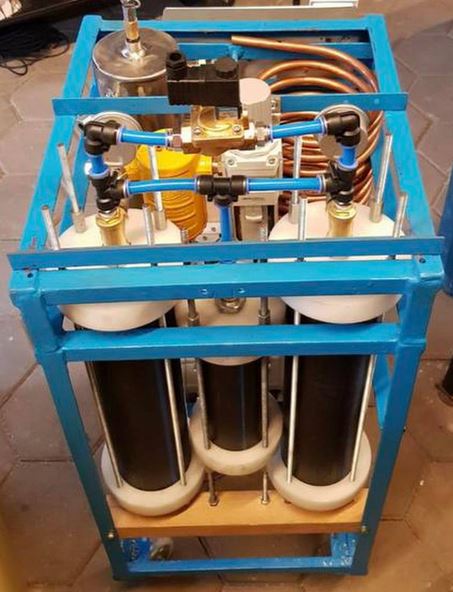
    • One biomedical device that has entered our lexicon during the pandemic is the oxygen concentrator.
    • This device has brought down the scale of oxygen purification from industrial-size plants to the volumes needed for a single person.
    • At the heart of this technology are synthetic frameworks of silica and alumina with nanometer-sized pores that are rigid and inflexible.
    • Beads of one such material, zeolite 13X, about a millimeter in diameter, are packed into two cylindrical columns in an oxygen concentrator.

    How does it work?

    • Zeolite performs the chemistry of separating oxygen from nitrogen in air.
    • Being highly porous, zeolite beads have a surface area of about 500 square meters per gram.
    • At high pressures in the column, nitrogen is in a tight embrace, chemically speaking, with the zeolite.
    • Interaction between the negatively charged zeolite and the asymmetric nucleus (quadrupole moment) of nitrogen causes it to be preferentially adsorbed on the surface of the zeolite.
    • Oxygen remains free, and is thus enriched.
    • Once nitrogen is captured, what flows out from the column is 90%-plus oxygen.
    • After this, lowering the pressure in the column releases the nitrogen, which is flushed out, and the cycle is repeated with fresh air.


    UPSC 2022 countdown has begun! Get your personal guidance plan now! (Click here)

  • Indian Army Updates

    Exercise Yudh Abhyas 2021

    Note4Students

    From UPSC perspective, the following things are important:

    Prelims level: Yudh Abhyas 2021

    Mains level: India-US defense ties

    The 17th edition of the India-U.S. bilateral exercise, Yudh Abhyas 2021, got underway in mountainous terrain and cold climate conditions of Alaska, US.

    Yudh Abhyas 2021

    • Exercise Yudh Abhyas is the largest running joint military training and defence cooperation endeavour between India and USA.
    • The exercise aims at enhancing understanding, cooperation and interoperability between the two armies.

    Why it is significant?

    • Interestingly, this is the only India-U.S. service exercise continuing in bilateral format.
    • The India-U.S. Malabar naval exercise became trilateral with the addition of Japan in 2015 and further brought in all the Quad partners together with the inclusion of Australia in 2020.
    • Similarly, Japan joined the India-U.S. bilateral air exercise, Cope India, as an Observer in 2018 and the plan is to make it trilateral in phases.
    • Other than the Malabar, Japan had sent observers for the first time during Cope India 2018 as an Observer in 2018. s


    UPSC 2022 countdown has begun! Get your personal guidance plan now! (Click here)