💥UPSC 2027,2028 Mentorship (April Batch) + Access XFactor Notes & Microthemes PDF

Archives: News

  • Forest Conservation Efforts – NFP, Western Ghats, etc.

    The controversy over eucalyptus planting in Kerala | Explained

    Why in the news?

    The Kerala state government permitted Kerala Forest Development Corporation (KFDC) to plant eucalyptus for financial reasons in 2024-2025. Environmentalists objected, citing forest impact and potential human-animal conflicts.

    Reasons for Allowing KFDC to Plant Eucalyptus Trees:

    • Financial Sustenance: KFDC was permitted to plant eucalyptus trees to support its financial viability.
    • Existing Plantations: KFDC manages around 7,000 hectares of plantations, including eucalyptus, which contribute to its revenue generation.
    • Rotation Age: Plantations like eucalyptus have specific rotation ages for harvesting, ensuring a continuous cycle of revenue generation.

    Significance of Eucalyptus

    • Timber and Fuel: Eucalyptus wood is extensively used in Australia as fuel and for building construction, fencing, and other timber applications.
    • Paper and Pulpwood: The bark of many eucalyptus species is used in papermaking and tanning, while the wood is used for pulpwood production.
    • Eucalyptus Oil: The leaves of many eucalyptus species contain aromatic oils, which are used for various purposes such as:
      • Medicinal Uses: Eucalyptus oil is used in expectorants and inhalants to relieve respiratory issues like asthma and bronchitis.
      • Insect Repellent: The oil is used as a natural insect repellent.
      • Antimicrobial Activity: Eucalyptus oil has antimicrobial properties, making it effective against bacteria and fungi

    Why were environmentalists and social activists against the order?

    • Ecological Impact: Environmentalists raised concerns about the adverse effects of eucalyptus plantations on natural forests and ecosystems.
    • Human-Animal Conflicts: The proliferation of invasive species like eucalyptus was linked to increased human-wildlife conflicts, as animals ventured into human habitats in search of food due to habitat depletion.
    • Contravention of Eco-Restoration Policy: Activists argued that permitting eucalyptus plantations contradicted the state’s eco-restoration policy, which aimed to phase out exotic species and replace them with natural forests by 2024.
    • Invasive Species Management: The order was seen as undermining efforts to eradicate invasive species and mitigate their damaging effects on natural habitats and ecosystems.

    Government Initiatives for Plant Conservation:

    • The National Bureau of Plant Genetic Resources (NBPGR) in India operates seed banks to conserve crop diversity and wild plant species.
    • National Afforestation Programme (NAP) has been implemented since 2000 for the afforestation of degraded forest lands. It is being implemented by the MoEFCC.


    Conclusion: The controversy over eucalyptus planting in Kerala reflects the balance between financial sustainability and ecological concerns. While eucalyptus offers economic benefits, it also poses ecological risks and challenges to conservation efforts.

    Mains PYQ: 

    Q Examine the status of forest resources of India and its resultant impact on climate change. (UPSC IAS/2020)

  • International Space Agencies – Missions and Discoveries

    What is Zero Debris Charter?

    Why in the News?

    • The Zero Debris Charter was signed by twelve nations and the European Space Agency (ESA) at the ESA/EU Space Council.

    Zero Debris Charter

      • The Zero Debris Charter was unveiled at the ESA Space Summit in Seville, Spain, in November 2023.
      • The Charter was facilitated by ESA’s Protection of Space AssetsAccelerator and developed through extensive collaboration among various space actors.
    • Objectives:
    • To achieve debris neutrality in space by 2030.
    • Long-term sustainability of human activities in Earth orbit.
    • Members:
      • The signatory countries are Austria, Belgium, Cyprus, Estonia, Germany, Lithuania, Poland, Portugal, Romania, Slovakia, Sweden, and the United Kingdom.
      • The ESA signed as an International Organization.

    Community Support and Leadership

    • Over 100 organizations are expected to sign the Charter in the coming months.
    • This includes national space agencies, satellite manufacturers, space startups, and astronomical societies.

    Space Debris Challenges

    • ESA estimates over one million pieces of space debris larger than 1 cm in Earth orbit.
    • These debris pieces pose significant risks to satellites and astronauts.

    Threats posed by Space Debris

    Space debris also leads to two major risks:

    1. It creates unusable regions of the orbit due to excessive debris, and
    2. Leads to the ‘Kessler syndrome’ – the creation of more debris due to cascading collisions resulting from one collision.
  • Climate Change Negotiations – UNFCCC, COP, Other Conventions and Protocols

    Small Island Developing States (SIDS)

    Why in the News?

    The 4th International Conference on Small Island Developing States (SIDS-4) is underway in Antigua and Barbuda.

    What are Small Island Developing States (SIDS)?

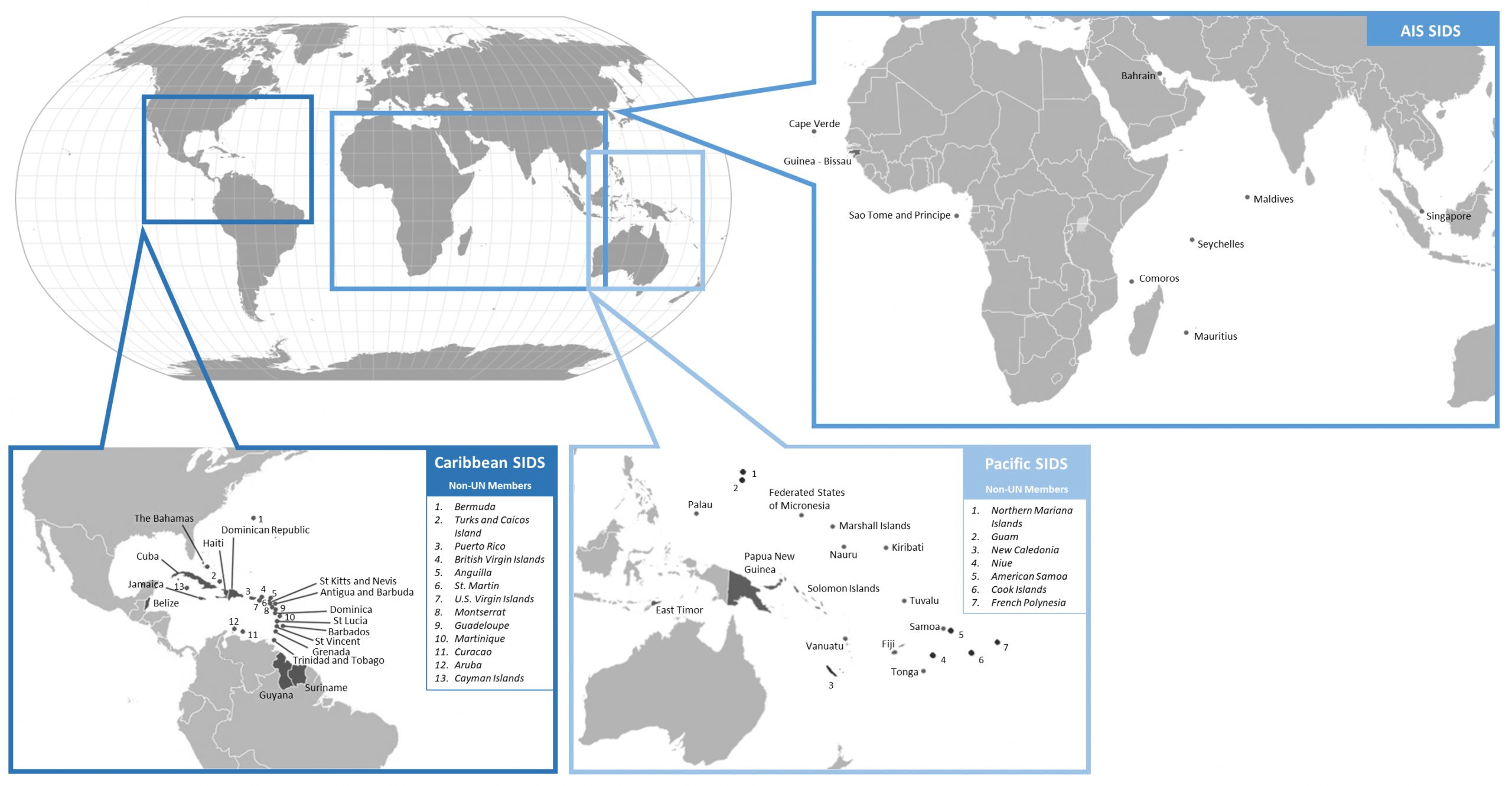
    • SIDS encompass 39 States and 18 Associate Members of United Nations regional commissions, facing unique social, economic, and environmental vulnerabilities.
    • SIDS are situated across three regions:
    1. the Caribbean,
    2. the Pacific
    3. the Atlantic, Indian Ocean, and South China Sea (AIS).
    • Their distinctive challenges were acknowledged at the 1992 United Nations Conference on Environment and Development in Rio de Janeiro, Brazil.

    SDGs supporting SIDS

    • Small island development states are mentioned in several of the Sustainable Development Goals.
    • For example, Target 7 of Sustainable Development Goal 14 (“Life below Water“) states-

    “By 2030, increase the economic benefits to Small Island developing States and least developed countries from the sustainable use of marine resources, including through sustainable management of fisheries, aquaculture and tourism”.

    Challenges Faced by SIDS:

    • Remote geography and reliance on external markets due to narrow resource bases contribute to high import/export costs.
    • Exclusive Economic Zone (EEZ), substantially larger than landmasses, provides vital resources but poses challenges like high transportation costs and vulnerability to economic shocks.

    Biodiversity and Economic Significance:

    • Biodiversity sustains key industries like tourism and fisheries, often constituting over half of SIDS’ GDP.
    • Beyond economic benefits, biodiversity holds aesthetic and spiritual value, providing essential services like food supply, erosion prevention, and protection from natural disasters.

    UN Programmes Supporting SIDS:

    • The Barbados Programme of Action (1994), Mauritius Strategy (2005), and Small Island Developing States Accelerated Modalities of Action (SAMOA) Pathway (2014) outline specific actions to achieve sustainable development and address gaps in implementation.
      • Barbados Programme of Action (1994): It prescribed actions enabling SIDS to achieve sustainable development.
      • Mauritius Strategy (2005): It addressed remaining gaps in implementing the Barbados Programme of Action.
      • SAMOA Pathway (2014): It emphasises challenges like climate change and biodiversity loss, outlining priorities for sustainable development.
    • These programmes underscore the ongoing commitment to supporting SIDS’ development and resilience.

    Priority areas defined by SAMOA Pathway:

    1. Economic Growth: Promote sustainable, inclusive economic growth, sustainable consumption/production, and transportation.
    2. Climate Action: Mitigate climate change, and implement sustainable energy, and disaster risk reduction programs.
    3. Biodiversity Protection: Safeguard biodiversity, mitigate invasive species, manage chemicals/water, and protect oceans/seas.
    4. Human Health and Social Development: Enhance food security, and water/sanitation, reduce non-communicable diseases, and promote gender equity.
    5. Partnerships: Foster collaborations among SIDS, UN Agencies, development partners, and stakeholders to achieve sustainable development goals.


    PYQ:

    [2021] Describe the major outcomes of the 26th session of the Conference of the Parties (COP) to the United Nations Framework Convention on Climate Change (UNFCCC). What are the commitments made by India in this conference?

  • Oil and Gas Sector – HELP, Open Acreage Policy, etc.

    GAIL inaugurates 10 MW Green Hydrogen Plant in Madhya Pradesh

    Why in the news?

    GAIL (India) Ltd has commissioned its first green hydrogen plant at Vijaipur in Madhya Pradesh, marking a significant step for the nation’s largest natural gas transmission and distribution firm into new and alternate energy sources.

    About Vijaipur Green Hydrogen Plant

    • The plant aligns with the National Green Hydrogen Mission‘s objective of achieving 5 million tons of annual green hydrogen production capacity by 2030.
    • The plant features a 10-megawatt proton exchange membrane electrolyser imported from Canada.
    • It will produce approximately 4.3 tonnes of green hydrogen per day with a purity of about 99.999% by volume.
    • The production process utilises electricity from renewable sources, such as solar energy, to split water and produce green hydrogen.

    Major Objective: Hydrogen Blending

    • GAIL is currently conducting experimental blending of hydrogen with natural gas.
    • Current regulations permit blending up to 5% hydrogen with natural gas, with ongoing studies to explore higher blending ratios.

    What is Green Hydrogen?

    • Green hydrogen is produced through electrolysis, where electricity derived from renewable sources, such as solar or wind power, is used to split water molecules into hydrogen and oxygen.
    • Since it relies on renewable energy, green hydrogen production has no direct emissions of CO2 or other greenhouse gases.

    What is the Green Hydrogen Standard?

    • Definition of Green Hydrogen: It has defined green hydrogen as having a well-to-gate emission – including water treatment, electrolysis, gas purification, drying and compression of hydrogen – of not more than 2 kg CO2 equivalent per kg of hydrogen produced.
    • Nodal Agency:  The Bureau of Energy Efficiency, Ministry of Power, will be the nodal authority for green hydrogen production projects.

    Back2Basics: National Green Hydrogen Mission, 2023

    Details
    Ministry Ministry of New and Renewable Energy
    Purpose To incentivise the commercial production of green hydrogen and make India a net exporter of the fuel.
    Key Activities Facilitates demand creation, production, utilisation, and export of green hydrogen.
    Sub-Schemes
    1. Strategic Interventions for the Green Hydrogen Transition Programme (SIGHT): To fund the domestic manufacturing of electrolysers and the production of green hydrogen.
    2. Green Hydrogen Hubs: Identify and develop states and regions capable of supporting large-scale production and/or utilisation of hydrogen as Green Hydrogen Hubs.
    Green Hydrogen Hubs Details Identifies and develops regions capable of large-scale hydrogen production and utilisation as Green Hydrogen Hubs.
    Objectives
    • Develop 5 MMT per annum of green hydrogen production by 2030.
    • Add 125 GW of renewable energy capacity by 2030.
    • Entail over Rs 8 lakh crore investments and generate six lakh jobs.
    • Reduce fossil fuel imports by over Rs 1 lakh crore and abate 50 MT of greenhouse gases annually.

    Significance of Hydrogen Energy 

    • Hydrogen is an important source of energy since it has zero carbon content and is a non-polluting source of energy in contrast to hydrocarbons that have net carbon content in the range of 75–85 per cent.
    • Hydrogen energy is expected to reduce carbon emissions that are set to jump by 1.5 billion tons in 2021.
    • It has the highest energy content by weight and lowest energy content by volume.
    • As per the International Renewable Energy Agency (IRENA), Hydrogen shall make up 6 per cent of total energy consumption by 2050.
    • Hydrogen energy is currently at a nascent stage of development but has considerable potential for aiding the process of energy transition from hydrocarbons to renewable.

    Types of Hydrogen

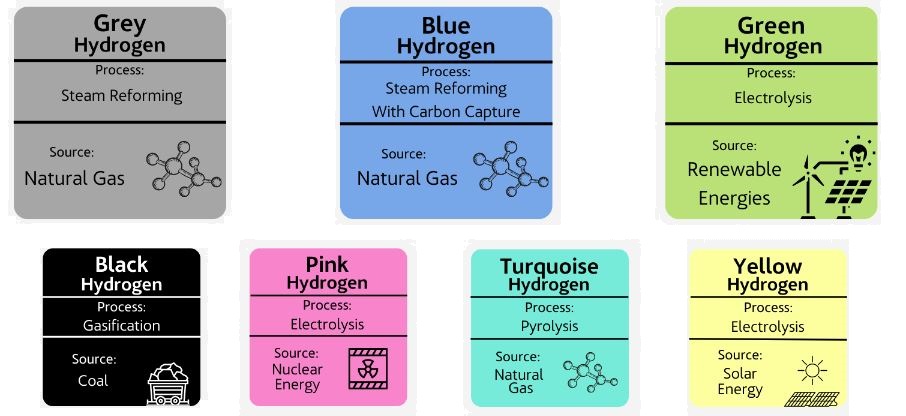
    Hydrogen extraction methods are classified into three types based on their processes: Grey, Blue, and Green etc.

    1. Green Hydrogen:  Discussed above.
    2. Grey Hydrogen: This type of hydrogen is obtained through coal or lignite gasification (black or brown), or by steam methane reformation (SMR) of natural gas or methane (grey). These processes are typically carbon-intensive.
    3. Blue Hydrogen: It is derived from natural gas or coal gasification, coupled with carbon capture storage (CCS) or carbon capture use (CCU) technologies to mitigate carbon emissions.
    4. Turquoise hydrogen: It refers to hydrogen produced from methane pyrolysis, while yellow hydrogen is produced from biomass.


    PYQ:

    [2023] Consider the following heavy industries:

    1. Fertilizer plants
    2. Oil refineries
    3. Steel plants

    Green hydrogen is expected to play a significant role in decarbonizing how many of the above industries?

    (a) Only one
    (b) Only two
    (c) All three
    (d) None

    [2023]  With reference to green hydrogen, consider the following statements:

    1. It can be used directly as a fuel for internal combustion.
    2. It can be blended with natural gas and used as fuel for heat or power generation.
    3. It can be used in the hydrogen fuel cell to run vehicles.

    How many of the above statements are correct?

    (a) Only one
    (b) Only two
    (c) All three
    (d) None

  • AYUSH – Indian Medicine System

    [pib] Central Council for Research in Ayurvedic Sciences (CCRAS) launches PRAGATI-2024

    Why in the news?

    • The Central Council for Research in Ayurvedic Sciences (CCRAS) is hosting “PRAGATI-2024” at the India Habitat Centre, New Delhi, to promote collaboration and research opportunities between CCRAS and the Ayurveda drug industry.

    About Central Council for Research in Ayurvedic Sciences (CCRAS)  

      • The CCRAS is an autonomous body of the Ministry of AYUSH (Ayurveda, Yoga & Naturopathy, Unani, Siddha and Homeopathy), Government of India.
      • It was established in 1978 to formulate, coordinate, develop, and promote research on scientific lines in the Ayurveda and Sowa-Rigpa system of medicine.
    • Primary Objectives:
      • Research: To undertake research to scientifically establish the efficacy of Ayurvedic practices.
      • Development: To develop and promote Ayurveda science through research and education.
      • Integration: To integrate traditional Ayurvedic methods with modern medicine for more comprehensive healthcare.

    Functions of CCRAS

    • Research Studies: Conducting various types of research studies like drug research, fundamental research, clinical research, literary research, and medicinal plant research.
    • Publication: Publishing scientific journals, research papers, and other documentation to disseminate knowledge.
    • Medicinal Plant Development: Focusing on the cultivation and conservation of medicinal plants used in Ayurveda.
    • Public Health Initiatives: Implementing public health programs and providing training to practitioners.

    Achievements of CCRAS:

    • Development of Ayurvedic Formulations: CCRAS has developed several notable Ayurvedic formulations and technologies, which have been patented and commercialised.
    • National Ayurveda Morbidity Codes: CCRAS has developed morbidity codes and standard terminologies to standardise the practice of Ayurveda.
    • AYUSH Research Portal: A comprehensive database of research on Ayurveda, which includes information on drugs, case studies, and clinical trials.

    Notable Projects:

    • Golden Triangle Partnership: A collaborative project with CSIR (Council of Scientific and Industrial Research) and ICMR (Indian Council of Medical Research) for enhancing the scientific validation of Ayurveda.
    • Tribal Health Care Research Program: Aimed at documenting ethno-medical knowledge and validating it for scientific purposes.

    PYQ:

    [2019] How is the Government of India protecting traditional knowledge of medicine from patenting by pharmaceutical companies?

  • Housing for all – PMAY, etc.

    A door to a housing scheme, tribals find hard to open

    Why in the News?

    The PM JANMAN presents a new opportunity to transform the lives of India’s Particularly Vulnerable Tribal Groups.

    About PVTGs:

    India has numerous Adivasi groups, with 75 identified as Particularly Vulnerable Tribal Groups (PVTGs). These comprise around 14.6 lakh households and live in scattered, remote, and often inaccessible areas. Their livelihoods rely on methods and tools that predate agriculture. PVTGs have low literacy rates, economic backwardness, and stagnant populations.

    In 1960-61, the Dhebar Commission identified disparities among Scheduled Tribes, leading to the creation of the “Primitive Tribal Groups” (PTG) category.
    In 2006, this category was renamed Particularly Vulnerable Tribal Groups (PVTGs).

    Government Initiatives:

    • Pradhan Mantri PVTG Development Mission. Announced for the fiscal year 2023-24 to improve socio-economic conditions of PVTGs.
    • Pradhan Mantri Janjati Adivasi Nyaya Maha Abhiyan (PM-JANMAN) launched in November 2023.
    •  Pradhan Mantri Adi Adarsh Gram Yojana, Integrated Tribal Development Project (ITDP) and Tribal Sub-Plan (TSP).

    PM JANMAN Objectives:

    • Provide essential services to PVTGs, including safe housing, clean drinking water, and sanitation.
    • The largest Direct Benefit Transfer (DBT) scheme in the initiative.
    • Aims to reach 4.90 lakh PVTG households by 2026.
    • Households to receive ₹2.39 lakh each in three instalments.

    Technical Challenges in the PM JANMAN Housing Scheme

    App Functionality and Data Gathering:

    • Data Collection Areas: The ‘Awaas+’ app records geographical locations, household profiles with geo-tagging, and bank account details for cash transfers.
    • Mandatory Jobcard: Registration requires a jobcard, but many have been deleted, affecting PVTGs’ eligibility.

    Jobcard Issues:

    • Deletion of Jobcards: Widespread deletion of over eight crore MGNREGA jobcards in the past two years has led to many PVTGs being ineligible for the scheme.
    • Jobcard Misuse: Cases of fraudulent registrations with someone else’s job cards further complicate the registration process.

    Village List Discrepancies:

    • Inconsistent Data: The pre-populated list of villages in the app does not match the MGNREGA Management Information System (MIS). For example, the app lists 22 villages while the MIS lists 31 villages for ‘Vanjari’ Panchayat in Andhra Pradesh, causing confusion.

    Aadhaar-related Issues:

    • Name Matching: The app requires names as per Aadhaar records but does not guide what to do if Aadhaar is absent.
    • PVTG Identification: The app does not explicitly identify PVTGs, using a default ‘ST’ option, leading to non-PVTG registrations.

    Certification Issues:

    • Local Certification: Ineligible registrations prompt local officials to ask PVTGs for certification from sarpanches/mukhiyas.
    • Conflict of Interest: Non-PVTG sarpanches/mukhiyas in mixed communities may act against the interests of PVTGs, complicating the certification process.

    Geo-tagging Problems:

    • Network Issues: Geo-tagging required for planned construction locations faces chaos due to poor network connectivity, hindering accurate data capture.

    Bank Selection Complexity:

    • Overwhelming Options: The app’s dropdown lists for banks are excessively long. For example, selecting ‘Commercial Bank’ shows over 300 options, and choosing ‘State Bank of India’ in Andhra Pradesh presents over 500 branches, adding unnecessary complexity for both PVTGs and officials.

    Opportunity/Way Forward for PM JANMAN Housing Scheme

    • Simplify App Interface: Update the ‘Awaas+’ app to have a more user-friendly interface and reduce unnecessary complexities, such as the long dropdown lists for banks.
    • Clear Guidelines for Aadhaar: Provide explicit instructions on what names to use in the absence of Aadhaar, ensuring all eligible PVTGs can register.
    • Verify Jobcard Authenticity: Introduce robust mechanisms to prevent fraudulent registrations using others’ jobcards.
    • Improve Network Infrastructure: Invest in better network infrastructure in remote areas to support the geo-tagging feature.

    Mains PYQ:

    Q Given the diversities among tribal communities in India, in which specific contexts should they be considered as a single category? (UPSC IAS/2022)

  • Health Sector – UHC, National Health Policy, Family Planning, Health Insurance, etc.

    How close is the World Health Organization to agreeing on pandemic response rules?

    Why in the News?

    Health officials of the World Health Organization (WHO) aim to finalize over two years of negotiations on new pandemic response rules when they convene in Geneva next week.

    About the ‘Pandemic Treaty’

    • The pandemic treaty is a new legally binding agreement being negotiated to improve the global pandemic response. The treaty aims to address the shortcomings revealed during the COVID-19 pandemic, such as inequitable vaccine distribution.
    • Article 12, a critical and contentious part of the treaty, proposes reserving around 20% of tests, treatments, and vaccines for WHO distribution to poorer countries during emergencies.
    • The treaty would be the second major health accord after the 2003 Framework Convention on Tobacco Control.

    Convention n Tobacco Control

    • Govt. of India ratified the WHO Framework Convention on Tobacco Control (WHO FCTC) in 2004, the first-ever international public health treaty focusing on the global public health issue of tobacco control.
    • The FCTC is a legally binding treaty that requires countries bound by the treaty — or Parties to implement evidence-based measures to reduce tobacco use and exposure to tobacco smoke.

    How will Global Health Rules Change?

    • Updates to the existing International Health Regulations (IHR) include a new alert system for different risk assessments of outbreaks, replacing the current single-level emergency declaration.
    • A new “early action alert” stage will be introduced, along with a potential “pandemic emergency” category for the most severe health threats.
    • Obligations for countries: Strengthened obligations for countries to inform the WHO about public health events, changing the language from “may” to “should”.

    How do the countries view this pact?

    • Developed Countries
        • Wealthy countries are often cautious about sharing resources such as drugs and vaccines.
        • There is significant political pressure, especially from right-wing groups, fearing that the treaty could infringe on national sovereignty.
        • These countries are concerned about the financial implications, debating whether to set up a new fund or use existing resources like the World Bank’s $1 billion pandemic fund.
    • Underdeveloped Countries
      • Poorer countries emphasize the need for equitable access to treatments and vaccines, reflecting experiences of “vaccine apartheid” during the COVID-19 pandemic.
      • They advocate for stronger commitments from wealthier nations to support global health infrastructure and emergency response capabilities.

    Future Scope of the New IHR Rules and the Pandemic Accord (Treaty):

    • More robust framework: The IHR updates and the pandemic treaty has designed to complement each other, creating a more robust framework for global health emergencies.
    • Promotes cooperation: The new rules aim to ensure faster, more transparent information sharing, and better co-operation during health crises.
    • Next steps for treaty negotiations: Next week’s World Health Assembly will focus on planning the next steps for the Treaty Negotiations, with a full agreement unlikely to be reached immediately.
    • Defenses against future pandemics: The successful implementation of both the IHR updates and the pandemic treaty could significantly strengthen the world’s defenses against future pandemics, addressing gaps exposed by COVID-19.

    Conclusion: While there is a shared understanding of the treaty’s importance, countries’ views are shaped by their National interests, Financial concerns, and Political pressures, leading to complex and protracted negotiations.

    Mains PYQ:

    Q Critically examine the role of WHO in providing global health security during the Covid-19 pandemic. (UPSC IAS/2020)

  • Artificial Intelligence (AI) Breakthrough

    How Europe’s AI convention balances innovation and human rights | Explained

    Why in the News?

    Global AI governance is becoming increasingly intricate, with countries employing diverse approaches. This shows that the Global treaties may face significant challenges despite widespread support.

    About the Council of Europe (COE)

    • The COE is an intergovernmental organization established in 1949. It currently has 46 member states, including the Holy See, Japan, and the U.S., alongside EU countries.
    • Aim: To uphold human rights, democracy, and the rule of law in Europe.

    What is Europe’s AI convention?

    • Europe’s AI convention, officially known as the Framework Convention on Artificial Intelligence and Human Rights, Democracy and the Rule of Law, represents a significant milestone in AI governance.
    • Adopted by the Council of Europe (COE) on May 17, this convention addresses the pressing need for comprehensive regulation of AI, particularly concerning its impact on human rights, democracy, and the rule of law.

    The scope of the Framework Convention on Artificial Intelligence and Human Rights, Democracy, and the Rule of Law encompasses:

    • It ensures that activities throughout the lifecycle of Artificial Intelligence (AI) systems align fully with Human Rights, Democracy, and the Rule of Law.
    • Consistent with the EU AI Act and the OECD’s definition, an AI system is defined as a machine-based system that generates outputs based on input to influence physical or virtual environments.

    Coverage:

    • Application by Parties: The convention applies to activities involving AI systems conducted by both public authorities and private actors acting on their behalf.
    • Addressing Risks: Parties are required to address risks and impacts from AI systems activities by private actors that are not covered under (a) in a manner consistent with the convention’s objectives.

    Difference Between a Framework Convention and a Protocol

    • Framework Convention: A legally binding treaty specifying broad commitments and objectives.Allows parties discretion in achieving objectives, adapting to their capacities and priorities.Example: Convention on Biological Diversity.
    • Protocol: Specific agreements are negotiated under a framework convention. Sets specific targets or detailed measures to achieve the broader objectives of the framework convention.Example: Cartagena Protocol on Biosafety under the Convention on Biological Diversity.

    Addressing National Security in the AI Convention

    • Exemptions for National Security: Articles 3.2, 3.3, and 3.4 provide broad exemptions for national security interests, research, development, testing, and national defense, excluding military AI applications from the convention’s scope.
    • Balancing Flexibility and Regulation: Article 3(b) allows parties some flexibility in applying the convention to the private sector, preventing total exemption but accommodating national security needs.
    • General Obligations: Articles 4 and 5 ensure the protection of human rights, democratic integrity, and the rule of law, requiring parties to address disinformation and deep fakes as part of their national security measures.
    • Scope for Further Action: Article 22 allows parties to exceed specified commitments, enabling additional measures to address national security concerns related to AI.

    Conclusion: The AI convention is essential because it reinforces existing human and fundamental rights within the context of AI applications, rather than creating new rights. It emphasizes the need for governments to uphold these rights and implement effective remedies and procedural safeguards.

    Mains PYQ:

    Q “The emergence of the Fourth Industrial Revolution (Digital Revolution) has initiated e-Governance as an integral part of government”. Discuss.(UPSC IAS/2020)

  • Capital Markets: Challenges and Developments

    Cost Inflation Index (CII) for FY25 to compute Capital Gains

    Why in the News?

    • The Income Tax Department has notified the cost inflation index (CII) for the current fiscal to calculate long-term capital gains arising from the sale of immovable property, securities and jewellery.
      • The CII is used by a taxpayer to compute gains arising out of the sale of capital assets after adjusting for inflation.

    CII Values:

    • For FY 2024-25, the CII is set at 363.
    • Previous years’ CII values were 348 for FY 2023-24 and 331 for FY 2022-23.

    What is Cost Inflation Index (CII)?

    • CII is a measure used by the Income Tax Department of India to account for inflation when calculating the capital gains on the sale of long-term capital assets.
    • It helps to adjust the purchase price of assets to reflect the effect of inflation.
      • CII adjusts the cost of acquisition of assets to the price level inflation at the time of sale.
      • This ensures that taxpayers pay taxes on the real gains rather than on the inflationary component of the price rise.
    • It is defined under Section 48 of the Income-tax Act, 1961.
    • The index is revised annually to keep up with inflation, with the base year being periodically reset (currently the base year is 2001-02 in India).

    Application of CII

    • CII is used to compute the indexed cost of acquisition of a capital asset that has been held for more than 36 months (considered as long-term capital assets).
    • Different holding periods apply for certain types of assets like immovable property and listed securities.

    Tax Calculation:

    • The formula used is:

    • This formula helps determine the adjusted cost basis from which any sale proceeds are subtracted to calculate capital gains.

    Back2Basics: Long Term Capital Gains

    • In India, long-term capital gains (LTCG) refer to the profit earned from the sale of a capital asset held for a specific period, qualifying it as “long-term” based on the duration of holding.
    • The tax implications and treatment of these gains are distinct from those of short-term capital gains.

    Definition of Long-Term Capital Assets

    • Equity or Preference Shares, Listed Securities, Units of UTI, etc.: These are considered long-term if held for more than 12 months before sale.
    • Immovable Property (e.g., Land, Building): Considered long-term if held for more than 24 months.
    • Other Assets (e.g., Jewellery, Debt-oriented Mutual Funds, etc.): These need to be held for more than 36 months to be considered long-term.

    Taxation of Long-Term Capital Gains

    • Equity Investments:
      • LTCG from the sale of listed shares or equity-oriented mutual funds over ₹1 lakh is taxed at 10% without the benefit of indexation, provided the securities transaction tax (STT) was paid at the time of sale.
    • Non-Equity Investments:
      • LTCG from assets like debt mutual funds, real estate, gold, etc., is taxed at 20% with the benefit of indexation.
    • Indexation Benefit:
      • For non-equity assets, the Cost Inflation Index (CII) is used to adjust the purchase price of the asset to reflect inflation. This reduces the taxable gain by increasing the acquisition cost.

    Calculation of Long-Term Capital Gains

    The general formula for calculating LTCG is:


    Where:

    Full Value of Consideration is the sale price of the asset.

    Indexed Cost of Acquisition is the purchase price adjusted by the CII.

    Indexed Cost of Improvement refers to the cost of any improvements made to the asset, adjusted by the CII.

    Cost of Transfer includes expenses directly related to the sale or transfer of the asset.

    Exemptions and Deductions

    • Section 54: Exemption on LTCG from the sale of a residential property if the proceeds are reinvested in another residential property in India.
    • Section 54EC: Exemption by investing LTCG in bonds issued by NHAI or REC within 6 months of the asset sale, subject to a cap of ₹50 lakhs.


    PYQ:

    [2015]  Which reference to inflation in India, which of the following statements is correct?

    (a) Controlling the inflation in India is the responsibility of the Government of India only

    (b) The Reserve Bank of India has no role in controlling the inflation

    (c) Decreased money circulation helps in controlling the inflation

    (d) Increased money circulation helps in controlling the inflation

  • Innovations in Biotechnology and Medical Sciences

    Omega-3 Fatty Acids and its Health Impacts

    Why in the News?

    • Fish oil supplements, highly regarded for their high omega-3 fatty acid content, have long been associated with heart health benefits.
      • A recent study has caused controversy by raising the possibility that these supplements may be as harmful as previously thought.

    What are Fatty Acids?


    Fatty acids are crucial lipids (fats and oils) essential for various biological functions (Fatty Acid + Glycerol = Fats). They are carboxylic acids with a long aliphatic chain, either saturated or unsaturated.

    • Basic Structure: Consists of a hydrocarbon chain with a terminal carboxyl group (-COOH). The length and degree of saturation of the hydrocarbon chain can vary.
    • Roles in the Body: Serve as energy sources, components of cell membranes, and precursors for bioactive lipids.

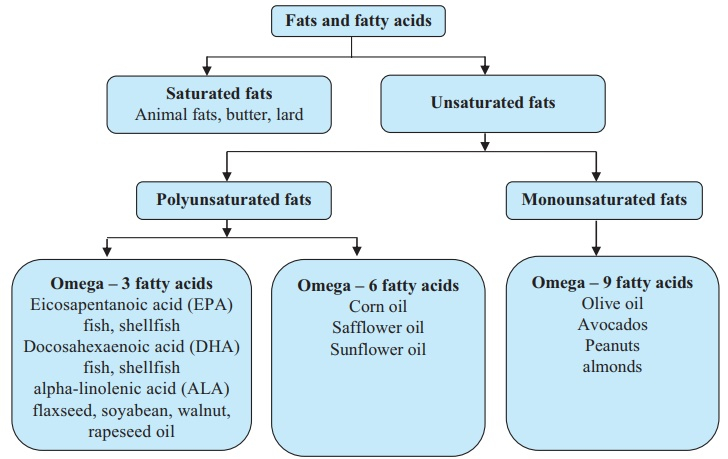
    Types of Fatty Acids

    Fatty acids are classified based on the presence and number of double bonds in their hydrocarbon chain:

    1. Saturated Fatty Acids (SFA)
      • Structure: Contain no double bonds between carbon atoms; the hydrocarbon chain is saturated with hydrogen atoms.
      • Properties: Typically solid at room temperature.
      • Sources: Animal fats, coconut oil, palm oil, dairy products.
      • Examples: Palmitic acid, stearic acid.
    2. Monounsaturated Fatty Acids (MUFA)
      • Structure: Contain one double bond in the hydrocarbon chain.
      • Properties: Generally liquid at room temperature but solidify when chilled.
      • Sources: Olive oil, canola oil, peanut oil, avocados, nuts.
      • Examples: Oleic acid.
    3. Polyunsaturated Fatty Acids (PUFA)
      • Structure: Contain two or more double bonds in the hydrocarbon chain.
      • Properties: Liquid at room temperature and in the refrigerator.
      • Sources: Fish, flax seeds, walnuts, sunflower oil, corn oil.
      • Examples:
    1. Omega-3 Fatty Acids: Alpha-linolenic acid (ALA), eicosapentaenoic acid (EPA), docosahexaenoic acid (DHA).
    2. Omega-6 Fatty Acids: Linoleic acid, arachidonic acid.
    1. Trans Fatty Acids
      • Formation: Produced by the industrial process of hydrogenation of unsaturated fats, or naturally in the guts of some animals.
      • Properties: Similar to saturated fats, solid at room temperature.
      • Health Impact: Associated with negative cardiovascular effects.
      • Sources: Margarine, partially hydrogenated oils, and some baked goods.

    What are Omega-3 Fatty Acids?

    • Omega-3 fatty acids (omega-3s) are polyunsaturated fats that perform important functions in the human body.
    • There are three main types of omega-3 fatty acids:
      • EPA (eicosapentaenoic acid). EPA is a “marine omega-3” because it’s found in fish.
      • DHA (docosahexaenoic acid). DHA is also a marine omega-3 found in fish.
      • ALA (alpha-linolenic acid). ALA is the form of omega-3 found in plants.
      • When we get ALA from food, the human body can turn some of the ALA into EPA and subsequently to DHA. However, this process provides just a small amount of EPA and DHA. So, dietary sources of EPA and DHA (like fish) are essential.

    Functions of Omega-s fatty acids:

      • They help to provide structure and supporting interactions between cells.
      • Omega-3s are concentrated in high levels in cells in human eyes and brain.
      • They provide the human body with energy (calories) and support the health of many body systems.  These include the human cardiovascular system and endocrine system.

    Significance of Omega-3 fatty acids:

    • Omega-3 fatty acids have many potential benefits for human cardiovascular health.
    • One key benefit is that they help lower human triglyceride levels.
      • Too many triglycerides in human blood (hypertriglyceridemia) raise human risk of atherosclerosis, and through this, can increase human risk of heart disease and stroke. So, it’s important to keep triglyceride levels under control.
    • Omega-3s may help us by raising human HDL (good) cholesterol and lowering human blood pressure.
      • Some studies show omega-3s may lower human risk for Cardiovascular disease (CVD), and hence lowering the sudden death caused by an abnormal heart rhythm (arrhythmia), and blood clots.
    • Beyond heart health, omega-3s may help lower the human risk of developing some forms of cancer, including breast cancer, Alzheimer’s disease, and dementia, age-related macular degeneration (AMD), research continues to investigate these and other possible benefits.

    PYQ:

    [2011] A company marketing food products advertises that its items do not contain trans-fats. What does this campaign signify to the customers?

    1. The food products are not made out of hydrogenated oils.
    2. The food products are not made out of animal fats/ oils.
    3. The oils used are not likely to damage the cardiovascular health of the consumers.

    Which of the statements given above is/are correct?

    (a) 1 only

    (b) 2 and 3 only

    (c) 1 and 3 only

    (d) 1, 2 and 3

Join the Community

Join us across Social Media platforms.